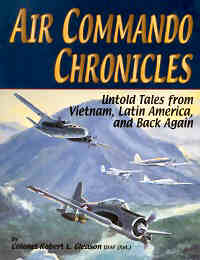
Air Commando Chronicles
by
Col. Bob Gleason
Email: RLGleason22@aol.com
(Click here to read Acknowledgments)
Book Intro: Contents | Forward | Introduction
Click on the Chapter of your choice:
Book Closure: Epilogue | Appendix A | Appendix B | Appendix C | Index
The Genesis of JUNGLE JIM
The Interview
Would you be willing to fight for your nation in a remote and hostile foreign country and agree to do so knowing that your government may deny that you are a member of the U.S. Military or that you are acting on their behalf?
The year 1961 was in many respects a watershed year for much of this nation. A chain of events was soon to unwind that would radically change the lives of millions of Americans. Indeed, these events and their Aunintended consequences@ were the first small steps that soon would usher in one of the most tumultuous periods of our nation=s history, perhaps second only to the tragic years of the Civil War, 1861-1865, and its aftermath. I was assigned to the USAF War College at Maxwell Air Force Base, Alabama. Early in 1961, the Base Commander phoned me and told me to report to his office that afternoon. This was an unusual request. The War College was not under the jurisdiction of the Base Commander. We were a tenant organization with our own command structure. Further, our Commandant was a general officer, outranking the Base Commander. I was also instructed not to tell anyone of this impending visit.
Upon arrival at his office, I was informed by the Commander that he was instructed by USAF Headquarters (HQ) to read me a series of questions. I was to answer only Ayes@ or Ano.@ I would be given no explanations or expansions of the questions, nor could I request one. If my answer to a question was yes, he would proceed to the next question. If I answered no, the interview would be terminated and I would be dismissed without prejudice. He then explained that a negative response would not be considered detrimental to my career. I was not to reveal the nature of the interview to anyone, and that included my Commander, Brigadier General Richard Carmichael, nor to my family.
I do not recall the exact wording of each individual question, but my recollection of their general context remains vivid. At first, the questions were fairly innocuous; for example, would you be willing to serve for prolonged periods under austere conditions? Would you be willing to serve for prolonged periods separated from your family? Then the tenor of the questions turned more ominous. Would you be willing to engage in dangerous operations fighting for a friendly foreign government at the request of the USAF? Would you fly and fight in situations where you could not wear the U.S. uniform? And finally, would you be willing to fly and fight on behalf of the U.S. government, and agree to do so knowing that your government might choose to deny that you were a member of the U.S. military, or even associated with this nation? Thus, the U.S. government may not be able to provide you with the protection normally given to a U.S. citizen?
This last question also contained a statement to the effect that in the event of my death while fighting out of uniform, the U.S. government would assure the financial support of my wife for the rest of her life, and also provide for the support of my two young sons through college age. Obviously, I answered all questions in the affirmative. Otherwise, I would not be writing these memoirs.
When the formal part of the interview was over, I commented that I was puzzled and even felt somewhat irritated by the nature of these questions. I said that when I took the oath as an officer in the U.S. military, I did so without equivocation or precondition. Further, with the exception of the last question, all the others fell within the purview of that oath, and I did not expect that I would be called upon to reaffirm these commitments while I was on active duty. Later, I found out that this same scenario was played out thousand of times on other USAF military installations throughout the world.
Behind these questions, and unknown to me at the time, lay the fact that the USAF had decided to form a new and highly classified organization. Among the criteria for membership were flying time, effectiveness ratings, type of previous experience, etc.
The interview was the final step in the screening process. Personnel files were reviewed and more than 3,000 officers and higher-ranking airmen were identified for this interview. Following the interviews, about 350 officers and enlisted men were selected as candidates for assignment to the initial cadre of this very unique organization. By the very nature of the interview we all were volunteers. Never before in the history of the USAF, or for that matter the U.S. military, had so many been asked to assume such a great personal risk without the vital protection provided by the mantle of U.S. citizenship.
To fully appreciate the magnitude of the commitment and dedication of these early volunteers to this organization one has only to ponder the vast difference between the conditions these men agreed to and the enticements being offered to today=s pilots to just remain in a peacetime Air Force.
At this writing the Chief of Staff, General Hugh Shelton, has announced that the Air Force is now offering its pilots a bonus of up to $44,000 just to stay in the military for an additional two years. Even with this incentive a great number of pilots who are eligible to resign are doing so rather than extend. We were offered nothing, nor did we ask for anything but an opportunity to serve our nation under the most unfavorable conditions that could be envisioned. These included the possibility of being branded as irresponsible renegades or mercenaries (or something even worse) after being captured or killed, while actually we were fighting for our nation.
A month or so after the secret interview I was again summoned to the Base Commander=s office. I was shown a set of classified orders assigning me to the 4400th Combat Crew Training Squadron (CCTS), at Eglin Air Force Base Auxiliary Field Number 9, more commonly referred to as Hurlburt Field, Florida. The Maxwell Commander then told me that the Air War College Commandant would be advised of my transfer and that I would be released from my present duties immediately. My dependents would not be allowed to accompany me to my new duty station. (Sometime later these restrictions were relaxed and orders were issued allowing dependents to join us.)
At the time the only thing that I could recall about Hurlburt Field was that it was the training site for AThe Tokyo Raiders@ led by General Jimmy Doolittle, who bombed Japan by flying Boeing B-25 Mitchell bombers off a U.S. Navy aircraft carrier during the early stages of World War II. This tidbit of knowledge added to the mystery and intrigue surrounding this new assignment.
Upon arrival at Hurlburt, I was told to report to the Base Headquarters for further instructions. There, I was told to report to a certain building on the flight line. This building was an open-bay type with only one enclosed room, a latrine. It was devoid of chairs, tables, benches, and the like, with one exception. At the far end of the building stood a marvelous and elaborate hardwood desk and console. The incongruity struck me at the time as humorous; it still does. Initially, only three or four people gathered there every morning. We just stood around or sat on the floor and viewed each other with mutual suspicion. No one among us knew what the others knew, nor did we feel free to tell the others what we knew. Among this group was Major John Downing, who was destined to become our trusty Supply Officer; Captain Warren Trent, our Adjutant; and another Lieutenant Colonel, besides myself, Chester AChet@ Jack, who was slated to become our deputy Commander.
Several days after our arrival we were visited by a full Colonel who introduced himself as Ben King, our Commander. He sat at the desk and gave us our respective assignments and very little else. I was assigned as the Operations Officer. King talked in very general and somewhat vague terms about the organization and our mission. One got the impression that he knew little more about this project than we did, but he wasn=t about to admit it.
* * *
Colonel King=s initial interview was even more remarkable than those of the rest of the members of this very select group. At the time he was stationed at Hurlburt. One morning he had been rousted out of bed in the wee hours by an urgent phone call from Eglin Air Force base about ten miles to the east. He was told to report to a certain building within ten minutes or as soon as possible thereafter. When he arrived, he was told that he was to talk with a senior Colonel from the Air Staff in Washington, who asked him the same questions that I was asked. After answering all of them in the affirmative, he was told to stand by to talk with General LeMay by phone from USAF HQ. Initially, LeMay verified that he was the same King whom LeMay had met during a national skeet match in the early 1950s. This match had been attended by two military teams. LeMay was captain of a Strategic Air Command (SAC) team and King had been a member of a Tactical Air Command (TAC) team. LeMay also asked King if he was the same person whom he recalled as being the Group Commander of a fighter squadron which won the Hughes Trophy in the mid-1950s. In both cases Colonel King replied yes, he was that person.
After this quick and informal screening General LeMay informed Colonel King that he was to be the Commander of this unique tactical organization. Thus, the 4400th Combat Crew Training Squadron was officially born. It seemed to us that there had to be more behind the formation of this organization than what we knew. There certainly was.
The Visitor in Black
When General Curtis LeMay, the Chief of Staff of the USAF, returned from the meeting of the Joint Chiefs of Staff (JCS) that morning, he was boiling mad. The CIA had pulled that lousy maneuver on him too many times. LeMay was determined to take the necessary action to prevent this from ever happening again.
About a week or so after we arrived at Hurlburt Field, and while we were gathered for our usual afternoon meeting, doing nothing in particular, we were surprised to see a black Martin B-57 Canberra pull up on the ramp just outside our window. A young Brigadier General who was dressed in a black flying suit, deplaned and entered our building. He introduced himself as General Jamie Goff. He had just flown in from the Pentagon. He asked the whereabouts of Colonel King. We were not sure where the Colonel was. General Goff seated himself on the Athrone,@ as we occasionally referred to King=s desk, and asked us to become comfortable, which translated to sit on the floor with your back against a pillar.
What followed was one of the most remarkable monologues that I had ever heard. What made it even more memorable was the setting. Here we had a USAF General sitting at a plush desk, the only furniture in the building, speaking to a small group of officers gathered at his feet. It struck me somewhat like a father getting ready to tell a strange bedtime story to his children, and indeed a strange tale it was. General Goff started out by saying that he supposed we were wondering what we were doing here and probably also curious about the process by which we were selected. We assured him that this was the understatement of the year. What follows is the essence of General Goff=s story.
The chain of events started several months previously when, during a routine meeting of the Joint Chief=s of Staff (JCS), the chairman turned to General LeMay, then Chief of Staff, USAF, and informed him that he (LeMay) had been tasked by the secretary of defense to make available to the CIA [Central Intelligence Agency] a fully sanitized World War II-type aircraft of a certain type for the use of a friendly foreign government. Further, LeMay was given a very short time to fulfill this directive.
When General LeMay returned from the ATank@ (the name given to the room where the JCS meet), he was boiling mad. There were several reasons for his anger and frustration. This was not the first time that the CIA had dumped on him in that manner. LeMay stated in no uncertain terms that he was not going to get sandbagged again by this sort of short order request from the CIA. He then directed the Air Staff to prepare not just one plane for delivery to the CIA but rather a number of different types of World War II aircraft that would be held in ready storage. Then the next time he was tasked to provide an aircraft of this type he would be able to respond immediately and with a minimum of disruption of other activities.
This seemed like a simple, straightforward proposition. However, in the Pentagon, with its large bureaucracy, things are seldom as simple as they seem. All actions, even those coming from the Chief of Staff, must be Astaffed,@ that is coordinated with a number of staff agencies. So it was with the LeMay idea. As this directive progressed through the numerous departments, some staff officer pointed out that the CIA did not have pilots available to ferry these aircraft to their destination so the USAF had better be prepared to also provide a pool of pilots who would have to be retrained in these old aircraft for this purpose. Failing to do so would retain part of the original problem, that is, delivering sanitized aircraft to friendly foreign governments.
Further Astaffing@ developed the thesis that once the aircraft were delivered, the receiving country might not have crews qualified to fly them. Thus, to make the package useable we had better be prepared to train their personnel in the tactical use of these aircraft. Finally, the thought was advanced that the receiving country might not even have an air force. Therefore, we had best provide a complete combat unit that could operate as a self contained fighting force in a foreign country=s counterinsurgency environment. Additionally, the entire unit, and not only the aircraft, must be prepared to operate under a cover of Aplausible deniability.@
There may have been one additional factor in play here although it was not a part of Goff=s narrative. We had just come through the disastrous Bay of Pigs fiasco of 1961.
The CIA had organized and launched a counterrevolutionary force, composed of about 1,500 mercenaries and supported by B-26s, intended to overthrow Fidel Castro. It was expected that when the forces hit the beach there would be a general uprising within the Cuban Military in support of this movement and a quick victory would be forthcoming. However, this was not the case. The Cuban Air Force jets shot down the prop-driven B-26s and the landing force was either captured or killed.
Additionally the role of the U.S. was uncovered in a deniability debacle, which resulted in considerable embarrassment to the U.S. government. In any event, the U.S. Military, which had not been consulted, became very skeptical of any covert military-type operations involving the CIA.
So there we have it. What started out as a simple idea born out of necessity for a single World War II aircraft had now evolved into a full-fledged Air Force fighting unit, the 4400th CCTS. The entrance interview, the subsequent screening process, and the special training were all intended to meet a worst case scenario in which USAF personnel would be asked to fly and fight for a friendly country without the involvement or the protection of the U.S. government. The name of the game was Aplausible deniability@
* * *
Years later, when I was stationed in USAF Headquarters, my associates would sometimes liken the Pentagon to a large log being carried hell-bent down a torrential mountain stream. As the story goes, the log is carrying 40,000 ants, and each ant thinks that he (or she) is steering. It should also be pointed out that about that time the Army and the Navy were starting to build up their counterinsurgency forces (Special Forces and the SEALS), also in response to Russia=s support of so-called wars of national liberation. It is entirely possible that the Air Staff viewed LeMay=s order as an opportunity to parlay this project into an Air Force counterinsurgency unit, although General Goff in his narrative never alluded to this as a possible motivation.
One can argue if the CIA had not requested this aircraft or if the Air Staff had not attempted to become extremely efficient in responding to anticipated future requests of a similar nature, the 4400th CCTS would not have been formed at that time. Certainly, we would not have organized our unit with the sense of haste and urgency that followed. Thus, it would not have been available for immediate deployment to Southeast Asia shortly after Soviet Premier Nikita Khrushchev announced his support for so-called wars of liberation.
I do not contend that this sequence of events reflects a miscalculation on the part of the Air Staff due to its desire for Acompleted staff work.@ Rather, I view this as an example of the phenomenon of Aunintended consequences@ that seems to have characterized much of our Vietnam involvement. The reader will find more examples of this phenomenon later in this work. A final irony in this sequence of events was that it now appears that the airplane the CIA had in mind was a C-47 or two to be sent to the Republic of Mali in Africa. Southeast Asia or Vietnam may not have even been Aon the scope@ at that time.
* * *
The original request for General LeMay to produce one or two sanitized aircraft may seem like a simple, straightforward proposition to a person who had almost inexhaustible Air Force resources available to him. However, that is not quite the case. First, one must go to the storage depot for that particular type of aircraft. You then select the best one that you can find and take it out of mothballs. The entire airplane must be gone over, which invariably requires replacing many parts. This, in turn, requires that you search many other craft for serviceable replacement parts.
After you restore the plane to good flying condition, you must then start the sanitization process, in itself is no small task. Every part that has a name, a serial number, a code letter, or any other identifying mark, must have it removed or ground down. In many cases, the part must be removed and disassembled in order to make certain that all numbers are removed. This procedure can disrupt the entire workload of the depot, especially when it is given such a high priority by the JCS. If the aircraft were later shot down while involved in covert operations and traced back to the U.S., LeMay=s neck would be on the block, not the CIA=s.
* * *
For years I harbored a certain amount of self-skepticism about my recall of General Goff=s account of the convoluted evolution of the 4400th CCTS. I suspected that I had misunderstood the General. Although I had served three years on the Strategic Air Command staff, at that time I had no experience with the workings of the Pentagon staffs. In fact, this account seemed just a little bizarre. However, I was wrong.
My last assignment before retirement was as the Chief of the CORONA HARVEST project, a high-powered study group working at the Air University at Maxwell Air Force Base. We were stationed at Maxwell because it is the repository of Air Force archives. However, we were under the direct supervision of the Vice Chief of Staff, USAF, General John Myers. The purpose of the project was to document and evaluate all aspects of the air war in Southeast Asia. The team was staffed by highly qualified and professional historians, including both military-combat experienced officers and civilian historians, of the caliber of Dr. Robert F. Futrell who wrote many Air Force and air power histories.
When the group had finished its voluminous report covering the early years of the war, having used both written documentation and oral histories, I sent a draft copy to Brigadier General William V. McBride, who during these early years was assigned to a key position on the Air Staff central to these types of activities. McBride confirmed the account laid out in the report with the comment that he didn=t believe any group could capture these seminal events of that area as accurately as the CORONA HARVEST team had.
During the writing of this book I located Major General Goff, now retired, and reviewed the scenario as I remembered it from 37 years ago. Although Goff did not have a clear recall of the specific visit to Hurlburt, he did confirm as substantially correct the version of the evolution of the 4400th CCTS related herein.
Brigadier General Ben King, USAF
A fighter pilot=s fighter pilot.\
Perhaps now is the time to introduce the person whose personality dominates most of this work, Benjamin H. King. This man=s unique brand of leadership permeates this entire story. Sometimes it=s obvious, sometimes it=s subtle, but his spirit is always somewhere behind the thoughts and the words.
Ben King was not only my senior in age but also in wisdom. He was born and raised in Oklahoma and never quite lost the spirit of the free range. More than anything else, a review of his remarkable combat record gives a quite accurate impression of the underlying character of this man.
His first combat tour came during the Second World War. He was assigned to the Pacific Theater flying out of Guadalcanal and up and down the Solomon Island chain. In King=s own words, his first combat mission flying a Lockheed P-38 Lightning was anything but auspicious. His fighter element had located an enemy U-boat that could not submerge. While they bombed the sub, or rather tried to, the crew raked the planes with machine-gun fire. The result was a sort of standoff. King and his buddies didn=t sink the U-boat and it didn=t down any of the aircraft. However, it was probably a victory of sorts for the U-boat, for King had to belly-land his aircraft back at the home base because of battle damage to the landing gear.
It was in the P-38 that Ben King shot down three enemy fighter Mitsubishi Zeros. Most victories in war do not come free, and King=s was no exception. Toward the end of his Pacific tour King was also shot down almost 400 miles deep in enemy-held territory.
After ditching, he spent seven days in a one-man dinghy all the while paddling toward an island 40 miles away. Incidentally, this was one of the first, if not the first successful ditching of a P-38, that had the reputation of converting to a submarine the moment its belly touched water. When he reached the island, he joined six other American pilots who had also been shot down. The island was occupied by about 100 Japanese soldiers who searched day and night for the Americans. After about three months King and three other Americans took off by boat toward U.S.-held territory. After paddling some 70 miles they were picked up at night by a Navy Consolidated PBY Catalina flying boat.
After completing his Pacific tour, King was assigned to a training unit in the States. However, stateside duty was not for this aerial warrior. He immediately volunteered for another P-38 unit that was scheduled to leave for England, and he arrived there in early 1944.
Ben completed his 100-mission tour in P-38s and immediately volunteered for a third combat tour while still in England, this time in North American P-51 Mustangs. A short time later he became the Commander of the 368th Fighter Squadron. It was on this tour that he shot down four German fighters, two Messerschmitt BF-109s and two Focke-Wulf FW-190s. Thus, King joined the exalted ranks of American fighter aces. It is significant that all his aerial victories were against enemy fighters and not the more easily downed transport or bomber aircraft.
After World War II, Ben King followed the usual path of most peacetime pilots who remained in the service. He attended several service schools, held various staff jobs, and commanded several tactical units. King was transferred to Alaska, where he played a key role in constructing Eielson Air Force Base, which he holds out as perhaps his most challenging peacetime assignment. Here we find an Air Force Major, the Commander of a fighter squadron, trying to control 4,000 civilian contractor personnel who were building the longest runway in the world.
Eventually, King was returned to the States and assigned to one of the early North American F-86 Sabre squadrons. While he was ferrying the last of these newly assigned aircraft to his home station in Maryland on a Sunday morning, the Korean War broke out in 1950. King immediately contacted a friend in the Pentagon and requested a transfer to Korea. Two days later he was on his way. However, what he thought was an en route stop in Japan turned out to be his next duty assignment. A very unhappy USAF Major was retained in Japan as the Commander of a fighter interceptor squadron. The other two squadrons of that group had already left for the war in Korea, and the remaining squadron had to remain in Japan for air defense protection.
When King protested this diversion to his Commander he was told that as soon as he had established four Ground-Controlled Interceptor (GCI) sites protecting Tokyo and had made the system operationally ready he would be released for combat in Korea. This took just three months, and true to his word, his superior arranged for his reassignment to another squadron scheduled for Korea. In the meantime, King was slipping in and out of Japan at every opportunity, going over to Korea and flying combat missions in P-51s belonging to the other two squadrons from his parent group. This Abootleg@ combat operation netted him more than 40 missions. After arriving in Korea, King became the Commander of the 8th Fighter Squadron where he flew additional 226 combat missions in the Lockheed F-80 Shooting Star.
* * *
After returning from the Korean War, Ben King, like many other pilots of that time, continued his military career with a variety of peacetime command and staff assignments, attending military schools and upgrading into new types of aircraft, etc. Since his career had always been oriented toward air defense operations, King eventually wound up at Hurlburt Air Force Base as director of the Joint BOMARC test staff. During that tour King=s team improved the launch reliability of the BOMARC from about 10 up to 82 percent. The Boeing BOMARC CIM-10A was a supersonic surface launched and guided air defense missile that became operational in 1961.
It was while in this assignment that Colonel King received the early morning call from General LeMay notifying him that he was to be the Commander of the 4400th Combat Crew Training Squadron. This tour again led him directly back into combat in Vietnam in the fall of 1961. A short time after he returned from Vietnam, King was assigned as the Commander of the Combat Application Group (CAG) of the Special Warfare Center. This he considers one of the biggest disappointments of his life. For here he was leaving a combat unit with a great mission and people to match for a newly formed support group. The mission of CAG was to develop and procure equipment for the expanding USAF Special Air Warfare Force.
* * *
However, other events were taking place throughout the world about that time. The predominant one was the Cuban missile crisis in the early 1960s. The Air Commandos were tasked to provide a number of Forward Air Controllers to direct the firepower of the high-speed strike aircraft. Although King was not in a combat element of the Special Air Warfare center, there was little doubt whom Brigadier General Gilbert Pritchard, the Commander of the Special Air Warfare Center, would select to organize and lead this critically important mission.
Thus, King again found himself on the verge of combat. He was given a force of TF-28s and Helio Super Courier U-10s together with their crews and sent to an advanced staging location at Opa Locka in southern Florida. Crews were briefed, targets were assigned, and all were placed on ready alert. Their mission was to locate and mark the Cuban missile sites for the bomb-carrying fast movers (jets). One problem that they faced was that the TF-28 tactical fighters had insufficient range for this mission, considering target loiter time. King knew that the TF-28s pilots would have to rely on a water rescue by the Search and Rescue (SAR) forces to get back to the mainland, but that was part of war. Fortunately, a few hours before the Aballoon was to go up@ the Russian cargo ships turned around and war was averted.
* * *
King had other opportunities for combat operations several years after he left the Air Commando organization and, as might be expected, he grabbed them with gusto. He eventually wound up in Bangkok, Thailand, as the Deputy Director of the Office of the Secretary of Defense (OSD) Advisory Research Project Agency Field Unit. King regarded this assignment as a first- rate boondoggle and he resented it. However, this did offer him another opportunity to join the war effort by occasionally slipping over to Vietnam and flying with the Vietnamese Air Force (VNAF) or going up into Thailand and flying combat missions with his old Commando buddies in their TF-28s or B-26s. Often while other people were taking Rest and Recuperation trips to exotic places, King was spending his R&R by signing up for unscheduled combat flights.
* * *
After returning from the Thailand tour, King (now a Brigadier General) was assigned to the USAF Office of Flying Safety as chief of the Fighter Division. This was toward the latter years of the Vietnam War. Reports were coming back to the States that many of our fighter pilots were not wearing a specially designed fire-retardant NOMAX flying suit, intended to help pilots survive a crash landing. However, many pilots considered the suits too hot for comfortable use in a tropical environment. King saw a final opportunity for one more combat tour.
King assembled a team of officers qualified in all the fighter-type aircraft flying in that Theater and headed west toward Vietnam. His approach to the problem was straightforward. First, he decided to set a personal example by using the NOMAX suit himself. Of course, it took him 35 to 40 combat missions in the North American F-100 Super Sabre and other aircraft before he became completely satisfied that the suits could be worn safely. Having proved his point, General King advised the Wing Commanders that if they did not enforce the directive requiring their pilots to wear this suit, upon his return they would be reported to Air Force Headquarters. That did the trick. The number of pilots killed during crash landings dropped significantly as a result of the additional protection provided by the NOMAX suit. When he had stayed in Vietnam for as long as he thought he could get away with it, King returned to his assignment at Norton Air Force Base, California, where he completed his military career and retired.
Truly, Ben King was attracted to aerial combat like a bee is to honey. Taken individually, each of his many tours is impressive. When considered collectively, they present a picture that very few if any combat USAF veterans, present or past, can match. General King flew nine combat tours that spanned three wars and involved many different type aircraft, while serving in just about every rank between Second Lieutenant and Brigadier General. During his remarkable career of combat flying, King amassed an impressive array of awards and decorations numbering over 35, including a Distinguished Service Medal, a Silver Star, and a host of other awards from both the U.S. and friendly foreign nations.
* * *
Various Air Force publications from time to time contain a list of famous fighter pilots along with their victories in World War II, Korea, and Vietnam. All of these airmen deserve the fame and praise that they have receive. However, someday someone will get around to publishing a list of fighter aces who flew the most combat missions, involving the greatest number of wars, over the longest time period. When they do Ben King will be at the top of that list.
Commando Commander Ben King
ABut I wouldn=t say no.@
Ben was a born leader of men. During Commander=s call with all the aircrews assembled, he would sometimes come out with an off-the-wall statement on some mundane subject or other. Nearly everyone knew what he was saying was not in the cards, but still we would all leave the meeting half believing it was true. One of his favorite expressions was, ANow I wouldn=t say no.@ For example, someone would stand up and ask, AColonel, we heard that all JUNGLE JIM crewmen were going to receive an extra promotion. Is this true?@ Ben=s answer would be, AWell, I haven=t heard anything official yet, BUT I WOULDN=T SAY NO.@ Sometimes the pilots would ask outlandish questions just to hear Ben go through that routine. Later when we were over in Vietnam, Captain Dick Tegge wrote a song titled AWell I Wouldn=t Say No.@ (Tegge and his guitar were a morale booster for our troops back in those days.) This was not done out of disrespect for King, far from it. He was universally admired by his men, and when the chips were down you always got straight answers.
King had the rare ability to humble someone without humiliating him. If during Commanders call some pilot stood up and indirectly questioned one of his policies, the Colonel had a stock answer. He would say,
Now Captain so and so, I want you to keep a notebook. In that notebook I want you to list every mistake that you think I have made. Now when you become a Commander, I want you to review that book periodically just to make sure that you don=t make the same mistakes. Oh yes, don=t make any new ones either. Now you will be on your way to becoming the greatest Commander in the history of the Air Force.
Even with King=s occasional reminder that all he could promise us was hard work and little glory, only one officer of the original group requested a transfer. This is a remarkable tribute to both his leadership and the quality of the original men of that unit.
* * *
Colonel King often repeated his philosophy for a successful military career. He was not afraid to stand above the crowd when his principles or core values were involved. He often expressed it this way to me, ABob, I like to keep a balanced personnel file with at least one letter of commendation to balance out each letter of admonition or reprimand that I receive.@ He had lots of both.
Sometimes King came close to the edge and survived. Shortly after General Walter Sweeney took over as Commander of Tactical Air Command, he sent a letter out to all Commanders covering personnel policies. King thought that a few of the items were too rigid for a unique outfit like the Commandos so he arraigned a meeting with Sweeney and told him straight out that he didn=t think that he could continue to command the Commandos under these additional restrictions, and continued to explain why. General Sweeney, a man not easily swayed by arguments questioning his published policies, listened to Colonel King=s explanations and then simply stated that King would return to his unit as Commander, and in those cases where he could follow the policy, he would appreciate it if he would do so.
* * *
King was a fighter pilot through and through. I always suspected that he had a rather low opinion of any pilot who could handle more than one throttle at the same time. I believe that one of the biggest disappointments of his professional life was discovering that this guy Gleason, a pilot with a background in bombers, was to become his Operations officer. Although I could never prove it, I always suspected that many of the Colonel=s early trips to TAC headquarters were for the sole purpose of obtaining a fighter pilot for his Operations Officer.
The closest that I ever came to receiving a compliment from this man was the day after we successfully completed our Operational Readiness Inspection (ORI). As we passed in the Operations office, Ben stopped for a moment and said, ABob, that was a fine show you put on during the inspection. I=m glad that I finally found something that a stupid ass SAC pilot could do.@ (I chose to believe that he intended the remark as a compliment.)
Colonel King reserved his most colorful comments for General LeMay. It was not that he disliked LeMay as a person or as a commander. In fact, he begrudgingly admired him. It was just that he disliked all bomber pilots, and LeMay, as the former Commander of SAC, was the personification of that breed.
I, of course, admire both men immensely. Both were great leaders of men but at different levels. If both LeMay and King were called upon to inspire a room full of aircrew members just before flying a dangerous mission King would win hands down. If, on the other hand, they both were called upon to inspire thousands of airmen, very few of whom they had ever met, and retain that inspiration over long periods of time, LeMay would probably come out first with King not far behind.
* * *
Over the years I have often pondered why King never progressed beyond the rank of Brigadier General, which normally is an interim rank on the way up the ladder. It seemed clear to me that he certainly had more than the required qualifications. Only recently did I learn the answer. Shortly after he was promoted to the rank of Brigadier General, King was given a physical examination to assure the Air Force that he would be physically fit to serve another five or ten years. It was then discovered that he had bladder cancer. Shortly thereafter, General Jack Ryan, who was then Chief of Staff, USAF, had an occasion to visit Hamilton Air Force Base, California, where King was stationed at the time. He met with King and informed him that because of his cancer he could either retire early in his present rank of Brigadier General or if he preferred, stay on and serve a few additional years. However, General Ryan made it perfectly clear that because of his affliction he would not be considered for further promotions. King chose to stay on active duty as a Brigadier General. Since retirement he has had major surgery for throat and other cancers. At this writing he has just passed the magic five-year point since his last operation. (King=s post-retirement activities are summarized in the epilogue of this work.)
* * *
Training and Aircraft Acquisition
JUNGLE JIM
The anatomy of a very unique military unit.
The 4400th CCTS, as originally composed, was by any criterion a unique organization on a very fast track. Although the operational concept for this unit was not issued until April 27, 1961, orders assigning personnel to the unit were cut a week or so earlier. Our full complement of 32 aircraft did not arrive until the first week in July. Nevertheless, we successfully had completed our Operational Readiness Inspection some two months later. Even before our ORI we had deployed our first detachment overseas. Within two months after we completed our ORI we had a large detachment flying combat in Vietnam. This short synopsis says much about the quality of the initial personnel, both aircrews and support personnel as well as our leadership. Very few, if any newly formed World War II combat units could match that record.
Some very imaginative Headquarters person came up with the project name of JUNGLE JIM. As things worked out this was not a bad moniker. However, after we were at Hurlburt Air Force Base for a short while even the term JUNGLE JIM became classified. On May 24, the Base Commander of Hurlburt wrote a letter to all units instructing them to refrain from using that term in either correspondence or in conversation.
Many elements made up the unique character of this organization. As mentioned previously, the initial cadre had been highly screened by a special Pentagon team. This initial selection had been followed up by a psychological screening, both written and oral of each person. Those who were finally selected were then sent to the Escape-and-Evasion School at Stead Air Force Base, California, which had had all previous restrictions removed on how rough it could treat its students.
JUNGLE JIM had been provided with old and in many cases poorly conditioned aircraft from another war and another era; and then tasked to train and prepare for combat in a wide variety of military and political situations with or without the acknowledgment and support of the U.S. government.
* * *
Our internal training was also intense. Shortly after arrival Colonel King initiated a policy of daily physical conditioning, consisting of calisthenics followed by a one- or two-mile run. Every member of the squadron, clerks as well as pilots, were expected to participate in this routine, usually led by a an unsympathetic jock from Minnesota named Dick Tegge. The unit was equipped with small-arms weapons not previously used or tested by any other U.S. military organization. (Another step on the road toward Aplausible deniability.@) We were also given hand-to-hand combat training. Many were cross-trained for a variety of duties, and in several different types of aircraft simultaneously. (For example, at one time I was qualified and current in five different types of aircraft.)
The FARM GATE detachment of JUNGLE JIM was the first USAF tactical unit to enter combat in Vietnam (and under covert conditions). When we first entered Vietnam we had to provide our own Search and Rescue service as well as our own aircraft security. Aircrews as well as ground crews became guards at night.
All of this internal training served several purposes. First, it helped prepare us for a variety of missions the nature of which could not be precisely forecast. (The more sobering aspects of our recruiting interview were still fresh in our memory.) Second, it infused the unit with an usual sense of cohesiveness and esprit de corps. Colonel King recalls that during his tour as Commander he had a re-enlistment rate among the enlisted personnel of 100 percent C a rare and perhaps unequaled achievement.
Much of this cohesion was due to the unique brand of King=s leadership. An example of this occurred not long after we formed up. Knowing that a unit of this type would attract a number of adventuresome Afree spirits,@ King took it upon himself to personally visit all of the local law-enforcement agencies. His purpose was to introduce himself to them and to ask them to notify him personally if any of his people were apprehended by their agencies. He gave the police chiefs and sheriffs a vague idea of the nature of our unit and informed them that some of these people might possess very sensitive information. Therefore, he did not want the Military Police or the civilian law enforcement people to interrogate them.
The system worked well. Maybe too well. King was once called out at a ungodly hour to retrieve three of his airmen who were involved in a brawl downtown. After picking them up at the police station and heading back to the base he realized that he recognized only two of the three airmen. He asked the third one who his supervising officer was. With a sheepish grin the man answered that he was not a member of the 4400th, but the word was out that if you got in trouble and wanted a fair shake, tell the police that you were a member of the 4400th and a Colonel named King would get you away from the local constabularies. Offenders of this type were not let off free C far from it. It was just that King would rather administer punishment himself than go through the normal military or civilian judicial system. A few years later, King again ran into the young bogus Commando in Laos where he was serving as an Air Commando FAC. After his previous enlistment in a non-Commando unit was up he went over and re-enlisted in the 4400th.
* * *
Shortly after I had arrived at Hurlburt it became obvious to me that we had outrun our organizational timetable and would have to wait for the troops to arrive. For the first few weeks or so we would meet once or twice a day and sit around and talk in general terms about mundane topics. No one was sure of what the others knew or what they were told, so we speculated very little about our assignment. King would attend some of these meetings for a short while before he had to leave for other duties.
When Colonel King was selected as the Commander of this unit he was Chief of the BOMARC missile-testing project that was being conducted at Eglin and Hurlburt. Therefore, he still had to take care of some phasing-out duties. Additionally, he would take occasional trips up to TAC HQ, which was designated as our first administrative and operational superior headquarters and this explained the grand desk and console that adorned our otherwise empty barracks. It seemed that King had had that desk especially made for him in the base shops at Eglin, and when he heard that he was to be transferred he had this masterpiece removed from his BOMARC office and squirreled away in this empty barracks so that his BOMARC Test Program successor would not inherit his throne along with his job.
Aircraft Acquisition
The birds start to arrive.
The troops and the equipment, including furniture, began to arrive at Hurlburt, shortly after my arrival. Finally, we were assigned aircraft. At first, we had only the use of a single C-47 borrowed from Hurlburt Field headquarters, then a few T-28s, USAF AA@ models with low-powered engines and two-bladed propellers. It was obvious that the T-28s were not capable of any type of operational flying, so King and the Pentagon personnel began to look around for something more suitable.
Our first choice for a strike aircraft was the Navy Douglas A-1E Skyraider dive bomber. This was a superb aircraft for the type of operation that we envisioned. Additionally, this plane was already in use in a number of small countries and performed well in austere environments. However, at the time the Navy would not release any of these aircraft to the USAF. Remember, at that time we still did not have a specific mission, nor had any country been identified to us that requested our services. Therefore, our priority was not as high as it eventually became. (Several years later, when the Vietnam War really heated up, the Navy was required to relinquish almost their entire A-1E fleet to the USAF.) Failing to get the A-1E, we looked around for some other replacement for the T-28.
Not too far down the Gulf Coast was the Naval training facility at Pensacola, Florida. They were flying a much different version of the T-28, with a larger engine, a three-bladed propeller, a beefed-up landing gear, and a tail hook required for carrier operations. Most important, its wings were stressed to carry external ordnance.
Colonel King pressed to obtain eight of those aircraft on loan from the Navy. In this case, the Navy agreed. Later, that type aircraft and modifications thereof were redesignated the TF-28. This designation more closely described their duel function of both a fighter and a trainer. Indeed, they were used considerably more in the role of a fighter than they were as a trainer. (Hereafter they will be referred to in this work as the TF-28.)
* * *
As time passed and the Air Staff began to get a better idea of our mission, we were assigned one of the highest supply and equipment priorities in the USAF. Eight Douglas B-26s Invaders were removed from mothballs and assigned to the 4400th CCTS. These aircraft had been previously designated the A-26 in World War II and Korea. Finally, we were given 16 C-47s, commonly referred to as AGooney Birds.@ (Technically, our models were designated the SC-47 because of certain modifications.)
The C-47s were the only aircraft that were specially modified for the type of mission that we eventually would be involved in. And what a modification it was. These aircraft were equipped with extra fuel tanks in the outer wing sections. All the tanks were lined with special sealant bladders intended to withstand small-arms fire without blowing up the aircraft. Additionally, they had a set of loudspeakers built into the belly with their on-board power source, intended to be used for Psychological Operations (Psyops).
These venerable old aircraft were also fitted with re-enforced sections in the belly to allow for the addition of JATO (jet-assisted takeoff) bottles. The cargo floors were built of unusual heavy material. Finally, the engine oil coolers were moved from the bottom of the engines to a position higher up on the engine nacelles. In this location they created considerably more drag and reduced the airspeed. The purpose of this last modification was to allow for the out-fitting of skis in the event that we were involved in Arctic operations. It didn=t take much imagination to realize that the Air Staff planners were still uncertain about our mission and area of operation. About the only thing they left off were floats.
The result was an aircraft much too heavy to perform very well in rough, unprepared, and remote fields. Another major deficiency was the location of the loudspeakers that were in the belly, slanted toward the rear. This type of installation made them useless for delivering verbal messages to people on the ground because of the Doppler effect. If you circled an area, the speakers were obviously pointing away from the target. If you flew directly over the people, the Doppler effect made your message unreadable, for the sound kept changing pitch as you first approached the target area and then flew away from it.
Months later, when we were involved in Physiological Operations in Vietnam, with the imagination and ingenuity of people like Master Sergeant George McNamara, our head loadmaster, and our Communications people we were able to remove these speakers from the belly and install them in fabricated free-standing racks. The speakers could then be installed in the main cargo door. Now we could circle target areas to the left and do a passable job of getting a message through to people on the ground. Additionally, now the speakers could easily be removed when we were not on a Psysop mission and save some weight, a very important factor on this much overweight aircraft.
* * *
With our fleet now in hand, we could start a training program. We had no established syllabus or training material to go by so we designed our own. In fact, we had no clear mission statement. We were not even sure what we were headed into. As best we could determine, we were to be some sort of a counterinsurgency unit, sort of a USAF counterpart of the U.S. Army Special Forces. The closest parallel to this type unit was the Air Commando Wing of World War II, commanded by the legendary Colonel Phil Cochran, which had fought in the jungle war against the Japanese in Burma and China. Even here the parallel was not exact. Although the World War II Air Commandos were a composite unit such as ours, they were fighting against a conventional military force, the Japanese army. In the later years in Vietnam and after, North Vietnam (NVN) had entered the war, this would also be the case with us, but that was considerably later than the initial FARM GATE period.
Since the only U.S. military organization that was advertised as having a counterinsurgency capability at that time was the Army Special Forces (the Navy SEALs were still in a pre-operational state), we immediately turned to them for initial guidance. Their Director of Operations, who was my counterpart at that time, was a young Lieutenant Colonel by the name of Art ABull@ Simons. He later became famous for heading the raid against the suspected American Prisoner of War (POW) camp in NVN. We designed our training to meet their needs and in effect became their air arm. This caused some consternation among the so- called purists in both Army and Air Force Headquarters. Army planners strongly objected to this arrangement because it undercut their attempt to obtain separate Army aviation units to support the Special Forces. USAF planners also held strong reservations because they believed that in effect we were being run by the Special Forces.
Nevertheless, Simons and I charged ahead, driven by our more pragmatic instincts. Simons badly needed good air support, both administratively and tactically. The JUNGLE JIM unit badly needed a customer that could use air resources in a counterinsurgency mode and around which we could build a realistic training program. This relationship between Simons and me continued for many years and served both of us well when we commanded our respective counterinsurgency units in Panama; he, the 8th Special Forces Group, and me, the 605th Air Commando Group.
* * *
As we started to gather equipment, we were assigned a high priority. To facilitate this priority we were given a supply expediter JUNGLE JIM. This seemed like a fitting name for an outfit that was rapidly evolving into a counterinsurgency/jungle warfare organization, so it began being used as a general-purpose name for the entire unit as well as a supply identifier. (As stated earlier I will continue to use the term JUNGLE JIM to refer to the initial cadre of the 4400th CCTS that gathered at Hurlburt in the spring of 1961 and FARM GATE to refer to the first detachment of that organization that was deployed to Vietnam in the fall of that year.)
The elements of TF-28 and the B-26 training programs were developed mostly by the flight commanders of those sections, respectively Captain Bill Dougherty and Captain Segal Dickson. Their straightforward training programs qualified the aircrews in these old-time aircraft and retrained them in ground-support techniques. It must be remembered that just about all of these Ajocks@ had come from first-line jet fighter aircraft. Many had not flown prop-driven aircraft since their days as aviation cadets many years ago. The tactics used by high-performance fighters could hardly be applied directly to low-performing prop jobs.
For example, Captain John Rowan had previously flown the Republic F-105 Thunderchief C about the heaviest and most densely constructed fighter in the Air Force. Rowan states that it was known by its pilots as the AF-10 Thud@ because of its hard-landing characteristics. He contended that its most effective use was against enemy tanks where it was employed as a Asquat bomber.@ In this tactic, the F-105 would land behind the tank and taxi up over it, and the pilot would work the landing gear handle up and down rapidly and pound the enemy tank right into the ground. This aircraft was so heavy that, according to Rowan, when a hurricane was headed toward their base in Florida, the Base Commander would order all aircraft except F-105s to deploy inland to prevent them from being blown away. He would then order the 105s to remain on the open ramp to keep the ramp from being blown away.
* * *
The C-47 training conducted under its Flight Commander, Captain Arnold Tillman, was another story. For here we were dealing with one of the essential elements of counterinsurgency/counter-guerilla warfare that requires moving small groups of troops or even single agents around jungle terrain under primitive conditions. We had to develop resupply techniques for both free fall and parachute [para] drops. As in so many other cases, the personnel screening system provided us with some of the best minds that the Air Force had in this area. Master Sergeant McNamara, a loadmaster with great experience and even a greater imagination, designed tactics for free-falling bags of rice without them breaking open, as well as techniques for safely dropping phosphorous flares out of the cargo door of a C-47. Many people considered loadmasters the Agrunts@ of the aircrews. But in an outfit like ours, which heavily depended on Alash-up and bailing wire,@ improvisations could not have succeeded without them.
We also received some valuable help from outside sources. Notable was the assistance of a TAC HQ staff officer Lieutenant Colonel named Dick Grant. In his younger days Dick was a covert-operations warrior with experience in dropping and recovering agents behind enemy lines in Eastern Europe during and after World War II. One day Dick showed up at Hurlburt with a few Army Special Forces friends that he had picked up at Fort Bragg, North Carolina, on his way down. He said that he would like to show us some infiltration/exfiltration techniques with the C-47 that he had used over in Europe. We were eager to accept his offer. We located a large meadow about 20 miles up the highway and not close to any village. We then waited for a moonless night, which wasn=t very long, for Dick had checked the lunar calendar before he had come down to Hurlburt. On the appointed night off we went.
The Special Forces were well-versed on what was about to happen. Six of the Special Forces had taken the bottom out of paper cups and fitted the cups over the lenses of their flashlights. They then formed the two sides of a runway in the center of this meadow, three on either side. As our aircraft approached the field the Special Forces people would point their cup- shielded flashlights in the direction that the sound of the aircraft was coming from. All of our running lights were off, and even the cockpit lights were dimmed. We were pre-briefed on the approach heading and told to land between these two rows of cups, touching down after passing the first two and stopping before reaching the last two. The Special Forces troops would keep the cups pointing in the direction of the approaching aircraft. I decided to try this operation first with Dick as my copilot.
On the first two tries I had no idea how high I was when I passed over the first two cups, so I went around. I was beginning to doubt the feasibility of this operation when Dick asked if he could try one. I was most willing to oblige. Dick came over the edge of the field at about the same height as I did but somewhat slower. When he passed the first two cups he closed the throttles and yanked back on the control column, and we banged into the ground. He slammed on the brakes and did a controlled-ground loop, which he called a 180-degree turn, even before we reached the center cup holders. He then raced back up to the approach end of the field, spun around, jammed forward the prop and throttle controls, and raced toward takeoff. We were on the ground for about two to three minutes C just enough time to drop off or pick up an agent. Now knowing that this operation was possible, I then did a few myself.
I had flown the old AGooney@ off and on for many years, but I had no idea that it would stand this kind of punishment. The next day I had the mechanics check the aircraft for structural or landing gear damage. They found none, so Dick and I acted as instructors while the other pilots went through the same routine. I often thought that the unsung heroes in this operation were the Special Forces troops on the ground. If we had missed the runway alignment they could easily have been chewed up by our propellers. They had been instructed to drop to the ground as a last resort, but even then they could have been hit by one of our landing gears. The problem that they faced was that they didn=t always know where we were. If they panicked and dropped their lights, they were inviting disaster because the pilot would then be disoriented and could easily run over them.
A short time later Colonel King thought that these blackout night landings might also be a desirable tactic for the B-26 aircraft, so off he went to the same field. There were several things that he did not count on. Unlike the C-47, the B-26 has a tricycle landing gear, that required the pilot to raise the nose of the aircraft prior to touchdown, virtually eliminating much of the forward visibility in a blacked-out condition. The B-26 also had a considerably higher landing speed than the venerable Gooney Bird. Finally, the more fragile nose gear of the B-26 was much more apt to collapse if it hit a depressed spot on the sod field than was the more rugged twin main gear of the C-47.
King made one attempt that night and correctly figured that discretion was the greater part of valor and headed back to Hurlburt. Finis the B-26 night-landing program. He figured that he didn=t survive several combat tours in different wars just to end up spattered all over a farmer=s pasture in southern Florida.
I spent a few nights holding those paper cups along with the Special Forces troops. So did most of our pilots. Colonel King had established both by policy and personal example that our people would view these exotic operations from the other guy=s perspective as well as from the cockpit. This was another example of his leadership genius. Finally the permanent job of holding those flashlights were turned over to our Ajack of all trades,@ the loadmasters for our continued training.
* * *
Every combat unit in the USAF had been given an Operational Readiness Test before it was declared combat-ready. After a relatively short training period, an ORI inspection team was sent down from TAC Headquarters. For the aircrew=s inspection, they flew and were graded on a series of missions and a number of functions such as navigation accuracy, bombing accuracy, and para-drops. The ORI team went over all our equipment and supplies in some detail. We passed all tests with no difficulty, primarily because of the high caliber of our personnel. Although this type of operation was new to all of our people, they had the ability to adapt quickly. Another advantage was that the inspection team knew considerably less about what we were doing than we did, so they had to more or less adapt the mission criteria that we gave them. We tried to be fair, however. After all, it was our butts that would be on the line when we entered combat. By that time, it would be too late to realize that we had short-changed ourselves in our training programs.
All in all, this Alashed-up@ outfit equipped with antiquated and retreaded aircraft had flown more than 9,000 accident-free hours during our self training. This statistic, more than any other evidence available, attests to the high quality of the flight crews, Major Rocky Stillwell=s Maintenance crews, and Major John Downing=s Supply people.
Still, we were operating under quite a few waivers C many rather vague, so were applied rather broadly. We were now nominally under TAC, but just about all of our directions came from the Pentagon directly to Colonel King. I always harbored the impression that TAC would just as soon maintain a comfortable distance between itself and that A ragtag@ outfit down at Hurlburt. An example of this was an incident involving a major SAC installation, Barksdale Air Force Base in Louisiana.
One of our C-47 crews with Captains Dick Sanborn and John Conners was flying a low-level navigation mission. To us low level meant something at or below 200 feet. Our guidance was to avoid populated areas as much as possible. For some reason or another, this crew flew off course and found itself flying directly over the center of Barksdale Air Force Base just when the SAC Wing stationed there was launching its Boeing B-52 Stratofortress aircraft under a Unit Simulated Combat Mission (USCM).
To put it bluntly, a SAC USCM is the sine qua non of SAC=s sacred mission of deterrence. The minimum take-off launch of an entire B-52 Wing is the Aproof the pudding@ of this process. It is an extremely impressive sight and culminates two or three days and nights of intensive effort. Many a Wing Commander had his career stunted and his chances for promotion terminated by poor performance on a USCM.
One can only imagine the consternation that resulted when, right in the middle of the take-off sequence, the climax of the USCM, a lone C-47 Gooney Bird came screaming (if you can call 130 knots screaming) across the active runway unannounced at about 200-feet altitude. Adding to the confusion was the possibility that this was another Adirty pool@ SAC Headquarters trick to screw up the USCM so that the Wing Commander=s reaction and response could be observed and graded. The people on the ground may logically have reasoned that no one in his right mind would pull an unauthorized stunt like that.
Sanborn was challenged via emergency radio frequencies by every military tower and FAA station in Louisiana. Sanborn=s answer did little to reassure those on the ground. He merely stated that he was on a classified mission, and if they had any further questions call Lieutenant Colonel Gleason. He gave them my home phone number. A short time later a General from SAC Headquarters ran me down by phone. After he realized that he couldn=t shoot me through the phone hookup, we worked through the problem. I always thought it odd that I never heard a word of that incident from TAC Headquarters. This was another indication that TAC would rather not be reminded of our existence.
I believe that I was the only former SAC officer in the JUNGLE JIM unit at that time, so no one appreciated the humor of that situation as much as I did. I laughed about it (to myself) for weeks, and always thought that this incident was a form of poetic justice for all the miserable hours I spent enmeshed in the tentacles of a SAC USCM during my previous ten years in that command. Of course, Colonel King who, in the tradition of most fighter pilots disdained bombers and all that they imply, merely viewed all of this as great theater.
* * *
During those early days the Maintenance section of the 4400th CCTS also had its challenges. The Maintenance Officer was Major Rocky Stillwell, a taciturn Texan who, true to his Lone Star State heritage, carried in Vietnam the biggest Ahog leg@ sidearm that I had ever seen. It must have been a .45-caliber Magnum plus.
The C-47 and the TF-28 were easily maintained. These aircraft were still in the active USAF inventory, so there were established supply procedures and some logistic tail, that is, there were still some spare parts in the supply system. The B-26 was a different story. The only source of spare parts was in various Abone yards,@ storage areas for old and discarded aircraft throughout the United States, so supply support was sketchy at best. Armament support was even more difficult to obtain. To produce the necessary flying hours to support our training programs took great ingenuity on the part of Rocky, the Supply Officer, John Downing, and their people.
King=s First Bombing Mission
Bull=s-eye Colonel.
The story of Colonel King=s first practice bombing mission in a B-26 best illustrates these points. One evening early on, when many of our people were still inbound to their Commando assignment, a group of us were sitting around a table in the club when King turned to Warren Trent, the Personnel Officer, and asked him if the Armament Officer had shown up yet. AYou know,@ he continued, Athat guy with the funny name.@ He was referring to Captain John L. APete@ Piotrowski, who was destined to become a four-star General and eventually rise to the position of Vice Chief of Staff, United States Air Force.
Warren replied, AYes Sir, he is sitting right across from you.@ King turned to Pete and told him to come to his office the first thing the next morning, a Friday.
When Pete reported in, he was informed that on Monday morning King intended to fly our first bombing and gunnery training mission in a B-26, and it had better be ready. The Colonel added that he expected to make good scores. The implication was that Pete had better be sure the nose guns and bomb-aiming systems were working properly. We had the hard-nose version of the B-26 (as compared to the glass-nose version) with eight .50-caliber forward-firing machine guns.
Pete rounded up one or two Sergeants that had also shown up by this time and went to work Afiring in@ the machine guns, aligning the sighting devices, checking out the bomb racks, etc. All went well until he tried to locate practice bombs. There were none to be found on Hurlburt. Eglin, which was our support base about 17 miles down the highway, would not issue any training bombs without a requisition. With the weekend coming up that was out of the question. These practice bombs, nicknamed Ablue blivets,@ were small bombs made of heavy-gauge tin that could be filled with sand to various weights, normally around 100 lbs. They were then fitted with a Aspotting charge,@ consisting of a few ounces of black powder, which detonated on impact so that the Range-scoring Officer could locate and score the impact point.
As it happens, Hurlburt Field is located on the Intracoastal Waterway, where it has a marina the military personnel tie up their privately owned boats. Pete had noticed earlier that many boat owners were using discarded practice bomb cases as anchors and boat hold-downs. He went down that evening and Amoonlight requisitioned@ a number of these bombs for King=s Monday morning mission. However, he could not locate any spotting charges. As a last resort, Pete contacted the Range-scoring Officer and after explaining the situation asked him to simply tell the Colonel that each of his bombs was a near bull=s-eye.
When King flew on that mission no one could see where the bombs were hitting. He could not have seen the impact point even if the bombs had spotting charges, for he would be pulling up and away from the target. All he knew was what the Range-scoring Officer told him after each bombing run. The radio messages from the Range Officer went something like this: AGood bomb ALPHA 1, right on target,@ or perhaps, @You were just five feet short, ALPHA 1, excellent hit,@ and so on. The guns fired okay, and having been an old fighter pilot King scored well on that phase. Also the gunnery scores were honest. Until General King reads this he no doubt believes that his first B-26 bombing mission was one of his best days on the range. It was C on paper.
The M-16 Rifle
A Commando first.
Although all the men of JUNGLE JIM had had years of military experience, some going clear back to World War II, we still underwent an additional small-arms training and had to qualify in an assortment of firearms. Once again, we come upon a unique aspect of the JUNGLE JIM experience. In this case it was an event that eventually had an impact on the entire U.S. military. Our story again crosses paths with General LeMay.
Somewhere along the line LeMay, who was a gun enthusiast, had become acquainted with an obscure small-arms company named Armalite that was marketing a new, cheaply priced .223-caliber rifle. This weapon was extremely light, simple to disassemble, fully automatic, fairly durable, and extremely accurate. Although .223 was a smaller caliber than any military weapon at the time, it had an extremely high muzzle velocity, around 3,280 feet per second (compared to the standard Army rifle of 2,700 feet per second). The high velocity imparted a considerable amount of energy to a relatively small slug. In most cases, its knock-down power was considerable in spite of the small size of the bullet.
The Armalite weapon (ARN-15) had a very high rate of fire in the fully automatic mode. A rifleman could carry 210 rounds with the same weight as 80 rounds for the M-1. Significantly, it was not a U.S.-stocked military item, thus it had Aplausible deniability.@ Within a year the Colt Company had teamed with Armalite, and in August 1962, the rifles were issued to the Commandos through normal supply channels. Two Commandos, Technical Sergeant Joseph Labrecque and Staff Sergeant Roger E. Burgress, Jr., were sent to Air Force Marksmanship School at Lackland Air Force Base, Texas, to receive training in this firearm. That was several years before it was accepted by the U.S. Army, one year after it was first issued to Vietnam-bound personnel by General LeMay. Somehow, LeMay obtained enough of these purely civilian (not government-issue weapons) to equip all the aircrews of the entire FARM GATE detachment. We were the first U.S. military unit to be so equipped.
As combat airmen, we were more interested in aerial machine guns and rockets than in this little rifle. However, it was a sort of novelty that we liked to show off to visiting dignitaries in Vietnam. A favorite trick was to take two one-gallon cans of stewing tomatoes, place one on top of the other, move back about 100 feet, and fire into the bottom can. We usually did this in front of a large, 20-feet high revetment, a wall that was used to Afire-in@ the machine guns on airplanes. If you placed the tomato cans just right, you could disintegrate the bottom can and the top can would land undamaged on the top of the revetment.
We showed this trick to many visitors, including U.S. Army Generals. Somewhere along the way the Army decided to evaluate the Armalite as a replacement for its much heavier infantry weapons, which resulted in a first-class Adonnybrook@ within the service. Up to that time the Army had developed its combat arms mostly through its Aarsenal system.@ However, the little Armalite (later its designation was changed from the ARN-15 to the M-16) finally won acceptance by all the services and is now the U.S. Army and the U.S. Marine Corps standard infantry weapon.
The first officially recorded use of this weapon in combat involved an Air Commando named Charlie Jones. Charlie was a Combat Controller who was in Vietnam in September 1962. On this occasion Charlie and a few Army Special Forces men were on patrol as advisers to a group of Rhade tribesmen when they became involved in a firefight with a group of Viet Cong (VC). Charlie was the only one with a ARN-15 so they pushed him up front to try out this new toy. In Charlie=s words, he Ahosed down good@ the area where the Viet Cong were located using the fully automatic mode. The VC scattered amid screams and shouts. When Charlie=s group later encountered this same group of VCs their numbers were noticeably reduced. Since this weapon had not gone through the normal testing procedures, many improvements were needed. Several of these were proposed by Charlie Jones and incorporated into future models.
An even more vivid example of this weapon=s firepower occurred about that time. On this occasion, the FARM GATE Detachment was visited in Vietnam by General Pritchard, the Commander of the newly formed USAF Special Warfare Center located back at Hurlburt in the States. He and General John Dunning, who was assigned to the Military Assistance Command Vietnam (MACV) staff, were driving down a back road a few miles from the Commando base when they were fired upon by a couple of hidden VCs. As the Generals jumped from their Jeep, the two VCs left their place of concealment and ran down the road away from them. General Dunning got off a single shot at the fleeing VC. One man fell to the ground face down. When the Generals walked up to the fallen man all they observed was a small hole in his back. When they rolled the man over they saw that his entire stomach cavity was empty and its contents lying on the ground. That incident readily demonstrated the terrific power of that little rifle.
* * *
The adoption of the M-16 as the standard military small arm for U.S. ground forces was one of the most important decisions made by our military as we entered the more intense phase of the Vietnam War. The enemy forces were equipped with the superb Russian-made AK-47. I believe that had our troops still been equipped with their older World War II- and Korean War-type weapons they would have been at a terrific disadvantage and the number of American causalities would have been substantially greater. Even the M-16 with all its attributes seems to be a tad inferior to the AK-47.
Years later when I was back in Vietnam as a Military Assistance Command, Vietnam, Studies and Observation Group (MACVSOG) deputy, I was struck by the fact that a good many of our Special Forces cross-border patrol teams preferred to carry the AK-47. As we had quite a few captured weapons this was a choice available to them. The reason they gave was that the extreme high velocity of the M-16 round would cause it to deflect or disintegrate when it struck even a small twig when fired in an area of heavy foliage. The heavier, slower AK-47-round was not as susceptible to this deficiency.
More Screening
The shrinks arrive B resistance testing.
The screening of JUNGLE JIM personnel had begun with that unique initial interview, but we had two additional screenings, or rites of passage, to complete before our position in the organization would be secured. The first was a no-notice visit from a psychological testing team from the USAF School of Aviation Medicine at Lackland Air Force Base, Texas. Each aircrew member, including Colonel King, was given a written battery of tests followed by separate hour-long interviews conducted by two different psychiatrists. These interviews covered all aspects of one=s life, starting almost with his potty training and continuing on to his sex life. It was later explained to me that the reason for this screening was to identify unstable personalities and to isolate those who were more motivated by running away from their present assignment or a bad family situation, than by being inspired to serving their country under the most extreme conditions without any qualifications whatsoever.
After this screening, some of the crew members were released without prejudice and reassigned to stations away from Hurlburt. In looking back on those days, I again express the conviction that the USAF Headquarters staff officers responsible for the creation of this organization had no clear idea of where they were going or just what they were going to do. Thus, they were trying to cover all contingencies and prepare for a worst case scenario.
We were subjected to one other screening of sorts. This was prisoner of war and resistance training conducted by the USAF Survival School at Stead Air Force Base, California. I had been through the Stead Escape-and-Evasion (E&E) course several times as a member of a SAC combat aircrew, and I thought that I knew what to expect. However, this was not the same program by a long shot.
Some years before the formation of JUNGLE JIM, the Stead program had gotten into trouble by using what some people considered excessive teaching techniques. They would try to anger or demoralize the trainees with insulting comments about their wives and daughters, subject the trainees to mild physical abuse, and use every other demeaning techniques they could dream up in an attempt to break down the student=s resistance. This was intended to prepare them for very rough interrogations by a wartime enemy. Many complaints were filed, and a congressional investigation followed, that resulted in severe restrictions being placed on the training methods of this school.
These restrictions were waived for all JUNGLE JIM classes. We were constantly harassed and because I was the ranking officer in my class, I received a little Aspecial training.@ On one occasion they pushed me into a very small cage in a very hot room. I would fit in the cage only in the fetal position. On the floor in front of the cage they placed a bucket in which all the guards would come around and urinate. When the bucket was partially full they would again start to ask me questions about my organization and its mission. The only acceptable answer back in those years was to give your name, rank, and serial number. When I persisted in giving only that information, the interrogator would pick up the bucket and throw the contents through the wire and right into my face. I absorbed several buckets of that stuff until the instructors/guards moved on to some other phase of the training.
On a subsequent visit to the Stead, when I was delivering another group of our personnel to the school, I hastened to look up the school Commandant to give him the word that I didn=t want the urine-in-the bucket treatment given to any other men from JUNGLE JIM. He replied that I should have no concern, for his instructors reserved that treatment for Lieutenant Colonels and above. He then explained that while one guard was hassling the trainee from in front of the cage, another guard would stealthily switch the buckets. What they really threw in my face was a bucket of warm tea flavored with uric acid and mixed with salt water. They sure had me fooled. In any event, I told them that it was a counterproductive technique because, rather than break down my resistance, it infuriated me to the point of greater resistance. The Commandant said that he agreed with me, but that was what they wanted to find out. He also commented that the bucket routine was a great morale booster for his enlisted instructors, who loved to pull that trick on higher-ranking officers. I withdrew my objections.
* * *
One of the highlights of the Stead course was the training in the use of Aprimitive weapons@ given by Sergeant Jack Kelso. By primitive weapons, I mean knives and hatchets. Kelso could put your hat on a tree, move back ten paces, whirl around, throw the hatchet, and split the hat in two. He could do the same thing with a large carving knife. Somehow Colonel King also had acquired the services of a civilian named Dermot APat@ O=Neill. O=Neill had considerable experience in hand-to-hand combat in the Philippines where he had trained the 1st Special Services Forces, a composite American and Canadian Commando Group (not U.S. Special Forces). O=Neill also held a 50th degree Black Belt rating in karate.
Because of the complexity and time required by this type of training, the program was not very effective. King=s next move was to recruit Jack Kelso away from the Stead Survival School and have him assigned permanently to the Commandos as a source of continuing survival training, a very effective move that served our organization very well in both Vietnam and in Panama.
The emphases that Colonel King placed on survival and evasion training generated in all of us a sense of confidence that we could survive in enemy territory and, more important, a strong will to do so. This attitude was evident in later years when both Captain Charlie Brown and Major John Pattee, two of the original group, were shot down over Laos. After surviving the bail-out, these two men, on separate occasions, evaded sizeable enemy patrols, who were searching within a few feet of their hiding place, and continued to do so until they were rescued.
* * *
Early Deployments
The Call to War
FARM GATE Detachment deployed.
After our Operation Readiness Inspection we were declared combat ready, and shortly thereafter, were notified that we would be heading for Southeast Asia. But even before this occurred, we were tasked to provide two C-47 aircraft and crews to assist in counterinsurgency training in the Republic of Mali, in Africa. This unit, designated Detachment 1, was given the code name of Sandy Beach and departed Hurlburt Field on August 15, 1961. The mission Commander was a young Naval Academy graduate named Captain Tom McEwan. (Tom was later killed while flying an A-1E in Vietnam.)
Upon arrival in Mali the detachment found itself in a most unusual situation. While they were conducting training exercises and para-jump support from one side of an airfield, a Russian transport plane and crew were doing the same thing on the other side of the field. In what would come to be a Commando trademark, the Sandy Beach crews were ready to operate almost from the moment they arrived, and within a day or two they were dropping Mali troopers by the hundreds.
Their stay, although short, was nevertheless very successful. They performed demonstration resupply and paratroop flights for both the U.S. Ambassador and President Modibo Keita. Tom McEwan happened to be a Black Belt-Judo expert, only one of three in that country holding this esteemed rating. He was also the highest-ranking one (in terms of Judo). As such, he spent much time at the Bamako Judo Club working out with the other two and cementing relations between the Mali and the American military.
The political situation in Mali at the time was very unstable, and after several months our team returned to the States as Mali turned more and more toward Communism. Thus, the requirement to send a couple of C-47s and their crews to Mali was possibly the basis for the original directive given to General LeMay several months earlier to provide a sanitized World War II aircraft to a friendly foreign country. The 4400th CCTS was perhaps an evolution of that initial directive. Once it was formed and combat ready, the Vietnam situation presented the Air Staff and the Joint Staff with an opportunity to utilize this unique organization that was waiting in Florida.
Almost concurrent with the Mali deployment we received orders to deploy a detachment of about 150 men, four C-47s, and eight TF-28s to South Vietnam. Additionally, on arrival, we were to be provided with eight B-26s. When the word got out that we were going to Vietnam every member of the organization immediately volunteered for the detachment, but it was limited to 41 officers and 115 airmen. Of course, we were to carry all the equipment we would need for self-sustained operations.
We deployed to Vietnam in early November 1961 in two elements: led by Colonel King, the four C-47s were flown to the destination; the rest of the detachment was airlifted over the Pacific by a number of Military Air Transport Command (MATS) Douglas C-124 Globemasters.
The original order made no mention of how we were to transport the TF-28s across the Pacific. Colonel King sent a wire to TAC Headquarters requesting depot support to disassemble the TF-28s and pack them aboard large transport aircraft. The answer he received was a mild rebuke. It also revealed for the first time, since the entrance interview, what was expected of us. In terse terms, we were expected to use extraordinary means to solve our own problems B in effect, ADon=t call us, we=ll call you.@
This caused a bit of a stir at Hurlburt and resulted in some bizarre proposals to solve the TF-28 movement problem. One suggestion was to replace the props on the TF-28s with counterweights and have them towed in pairs behind a C-124. A pilot or two would fly in each TF-28, and they would be cut loose over each scheduled base to make a no-power landing. Each TF-28 would be equipped with an air-driven generator hung out in the slipstream to provide electrical and hydraulic power. When a few of these ideas filtered up the chain of command, soberness took over and a more prudent solution was sought. We were then given the depot support King requested. The TF-28s were disassembled, flown over in the C-124s and reassembled at Clark Field in the Philippines.
Scheduled to join us at Clark, the C-47s flew the northern route via the Aleutian Islands. The flight was uneventful except for the aircraft piloted by Captain Jess Lewis, who lost an engine shortly after takeoff from Anderson Air Force Base, Guam. Bringing the old overweight Gooney back to Guam was not easy, but Jeff made it back as far as Agana Naval Air Station, also on Guam. After some carburetor repair work he took off the following day. He lost the same engine for the second time, and again he made it back to Agana. Figuring that he had used up all his luck and then some, Jeff insisted on a new engine. This solved the problem and the remainder of the trip was more or less routine.
While at Clark all the aircraft had their USAF insignias removed and replaced with those of the Vietnamese Air Force (VNAF). We also removed the patches from our uniforms but retained our rank insignias. At Clark, Colonel King transferred to a TF-28, and I replaced him as the pilot of the C-47. From there we led our motley group on into Saigon. The six B-26 aircraft did not arrive until a month or two later. The acquisition of these aircraft, as we will see later, is a story in itself.
* * *
About a year later, after Colonel King had returned from Vietnam, he was directed to report to Tactical Air Command Headquarters to brief General Walter Sweeney, its new Commander. During the briefing King mentioned that we were serving without U.S. insignias on our uniforms. General Sweeney was obviously surprised at that revelation. He stopped King at that point and advised him that this practice would stop immediately. Sweeney further commented that Americans serving under his command would fly and fight only in the uniform of the U.S., and that he would clear the matter with General LeMay. This dictum did not apply to the insignias on our aircraft.
* * *
Every military aircraft that entered Vietnam in those days had to do so via the main international airport at Saigon named Tan Son Nhut, in compliance with an international agreement resulting from the 1954 Geneva Accords and also established a committee that monitored all military equipment entering that country. Upon landing, our aircraft was required to taxi around in front of the administration building, where we would be examined by a team of observers with binoculars posted on the upper levels of the building. We could then proceed to the end on the runway and take off.
Bien Hoa
Our home away from home.
Our final destination was Bien Hoa, the home of the Vietnamese Air Force First Fighter Squadron, about 30 miles northeast of Saigon. It was a typical French colonial military installation with adequate permanent quarters for the officers and their families and dismal facilities for the enlisted personnel. The shop and maintenance facilities were adequate, but the approximately 5,000-foot runway was substandard, having been constructed with pierced steel planking (PSP), a material used by the U.S. for constructing temporary runways during World War II. PSP, only loosely fastened to the ground, was satisfactory for most lighter-weight aircraft but marginal for a heavily loaded B-26. It was most disconcerting for a pilot to watch the runway roll up and take the form of a low wave moving down the runway in front of him during the takeoff. Fortunately, the hump stayed about 20 yards in front of the nose wheel of the B-26s and progressed down the runway at about the same speed as the aircraft.
A few USAF personnel, who had been assigned to the U.S. Military Assistance Group (MAG), were stationed there when we arrived. The Commandos were assigned a large field toward the edge of the base. Tents were erected over dirt Afloors;@ a couple of old, unused flight line buildings were allotted to us for Operations and Maintenance, and we were in business.
It was obvious from the beginning that neither the VNAF nor the MAG was quite sure what we were doing there. The VNAF 1st Fighter Squadron was equipped with old U.S. Navy A-1E Skyraiders, a perfect choice for the type of operation it was involved in. This aircraft was much better than the TF-28. (In later years, the Air Commando units were also equipped with A-1Es.) The VNAF pilots were good at executing the basic tactics that they were employing. Also, they had the assistance of a few MAG instructors who monitored their training and their use of U.S.-supplied equipment. Unfortunately, in the tradition of their former trainers, the French, the VNAF was wedded to its main base at Bien Hoa and not always responsive to the request for air support from the Vietnam Army (ARVN) units in the field. For the first several weeks or so, we flew primarily self-training sorties while Colonel King tried his best to find a niche where we could contribute to the war effort. It was obvious that we were running well ahead of planning and the conceptual thinking that should have proceeded our deployment.
* * *
Our training at Hurlburt had been intense, but brief. Early on, in Vietnam, we acquired the use of a practice bombing and gunnery range. One of our first endeavors was to develop a napalm capability. We had brought none of the necessary supplies or equipment for this operation with us, and we had minimal training in the use of napalm at Hurlburt. Again we turned to our Armament Officer, Pete Piotrowski. At first, Pete could not get the napalm to ignite upon impact. Finally, he got the correct mix and fusing combination and we were in business. The next problem was range safety that is, safety for those on the ground in the vicinity of our target area. This was supposed to be provided by VNAF personnel. To say the least, it was loose.
One morning I set out to drop some napalm and to give final approval to our pilots to use the range. As I approached the target on my first run I noticed groups of people on both sides of the range running as fast as they could towards the target I was zeroing in on. I aborted the run and demanded by radio that the range be secured. I circled as I watched a Jeep go up and down the border of the range with the driver talking to groups of people. I was then informed by radio that the range was secure. I started another run, but the same thing happened. Again I pulled off. Finally, I was told that it was safe to drop on the target and that the village people who were scurrying toward the target were planning to recover as much of the torn and shredded napalm tanks as they could.
After dropping my two napalm tanks it was disconcerting to watch droves of people run forward, drag the tank from the inferno and beat out the fire. Napalm was supposed to be a sort of terror weapon, not one that was a magnet for the villagers. After I landed back at Bien Hoa I summoned our VNAF Liaison Officer and asked what was going on. He replied that Vietnam was what he referred to as a Ametal hungry@ country and that the people would take the scavenged remains of the napalm tank, which contained high-quality aluminum, and fashion pots and pans and other metal implements. So much for napalm, the weapon of terror.
During those early days Colonel King would visit the VNAF Squadron Headquarters in an effort to find a job for our pilots. It wasn=t that they could not use the support. Rather, it was a case of not knowing how to establish procedures to coordinate our efforts with theirs. Our TF-28s were equipped to deliver bombs of several types, including cluster bombs, and could also carry two rocket pods each containing 19 2.75-inch rockets. We had the napalm problem licked and therefore could deliver two napalm tanks. Additionally, our TF-28s were equipped with two .50-caliber machine guns mounted on pods under each wing. This aircraft was extremely maneuverable and could get in and out of places that would have challenged the A-1E. Most important, when flown by a group of young highly skilled pilots the aircraft were a valuable asset to any counterinsurgency effort.
The venerable C-47, other that being considerably overweight, was ideally suited for this kind of conflict. Additionally, the VNAF possessed many C-47s, so we could tap into the MAG supply system for replacement parts. If there is one truism in counterinsurgency it is this: There is never enough airlift to go around. Additionally, Psychological Operations were practically non-existent in the Vietnam conflict at that time, and we had both the people and the equipment to do the job. No aircraft served so many purposes for so long a time as did the old Gooney.
I recall a remark made several years earlier by a guest speaker at the Air War College. We were being addressed by Astronaut Frank Borman about the APOLLO (moon shots) space program, which at the time was only in its planning stage. Borman was asked what kind of a rocket or missile system we would use to reach the moon. Borman said that he didn=t know the answer but that he was told by the NASA people that once the astronauts landed on the moon they would travel around its surface in the old C-47 Gooney Bird.
The B-26 Story
Ghost of Dien Bien Phu.
Around December 1961, we received word that our B-26s were ready for pickup at Kadena Air Base on Okinawa. How they arrived there typifies the type of operation that we were engaged in and the ingenuity of our people. This story had begun several months earlier back at Hurlburt. One morning Colonel King called Captain Piotrowski to his office and told him to pack his bags and depart for the Air Asia facilities in Taiwan. Upon arrival he was to locate and, with the help of the local maintenance people, make airworthy six B-26 aircraft. He was instructed to travel in civilian clothes and otherwise obscure his identity as a member of the 4400th CCTS or for that matter of the U.S. military. Air Asia was the maintenance facility on Taiwan that provided major maintenance service for Air America airplanes. Both organizations were leased or otherwise controlled by the CIA.
Upon arrival Pete found the B-26s in the local bone yard that were left over from the French campaign in Indochina following their defeat at Dien Bien Phu. Fortunately, the Marauders were in fairly good condition. Besides making the aircraft airworthy, Pete was to install a modification that would permit them to carry external bombs and rocket pods, in addition to the internal weapons that the B-26 was originally designed to carry. This modification was not very popular with our pilots because it slowed the aircraft by about 40 mph. It became affectionately referred to as the AKing Baldwin@ modification, a name derived from the Baldwin Locomotive steam engine that the pilots now thought the aircraft resembled aerodynamically. King wanted the extra bomb/rocket capacity for a very good reason. Guerrilla targets were both small and fleeting, lending themselves to a greater number of small bombs rather that a smaller number of large bombs. (In later years, even the massive B-52 carpet bombings seemed to have only marginal effect on the tactical progress of the war.) Further, Colonel King reasoned that defensive fire from guerrilla units would be weak at best, so the degradation of speed resulting from this modification would not present an undue hazard to the aircrews.
While Pete was recovering the B-26s, he was trying to maintain his civilian identity. On one occasion an Air Force Colonel was dispatched from the States by the Air Matériel Command (AMC) to see what was going on. Normally, retrieving airplanes from storage and returning them to flying condition was the job of AMC. However, following their procedures would take months rather than days, and Captain Piotrowski did not have that much time. Somehow or other, AMC heard about a guy over in Taiwan getting into their business, and they wanted to find out about it. To avoid having a confrontation with this irate Colonel, Pete hid out in the ammo dump every time the Colonel came on base. This cat-and-mouse game continued until the Colonel finally gave up and returned to the States.
After the aircraft were modified and ready to go, Pete checked out the Air Asia pilots who then flew the aircraft to Kadena Air Base, Okinawa, where our pilots would receive them. Before departure from Taiwan, Pete tried to put Vietnam insignias on these aircraft in accordance with King=s instructions, but the CIA people would have none of that and would not release the aircraft until he affixed USAF insignias.
Apparently, the CIA was gun-shy after the French fiasco at Dien Bien Phu in 1954. The French not only had lost many of these aircraft but had done little to protect the role of the CIA, who had supplied them with the B-26s in the first place. Thus, the CIA had felt very vulnerable and had been hesitant to release any more aircraft to a lowly Air Force Captain who possessed only obscure credentials.
* * *
The most potent weapon of the B-26 was its nose guns. Our version of the Marauder was referred to as the Ahard-nose@ model (as compared to the glass-nose version designed for level bombing). It contained eight forward-firing .50-caliber machine guns. If you zeroed in on a bamboo building and let go with all eight guns, the building exploded in front of your eyes. At night it was even more spectacular. Every fifth round was an incendiary bullet that allowed the pilot to determine the impact area of the ordnance. These tracers literally lit up the sky with flaming streaks. The ricochets coming off the ground added to this display, which must have been a frightening sight to someone on the ground. If the firing run was too long or too low, it was also disconcerting to the men in the cockpit, for these incendiaries would be flying up all around them. They also knew that for every tracer that saw buzzing by, there were four other .50- caliber slugs that they did not see but were also in the area.
* * *
In-Country Operations
We Join the War Effort
The search.
We tried to phase into the combat operation with the Vietnamese Air Force in every way we could think of. Initially, we even stood night guard with the Vietnamese Army soldiers who were guarding the perimeter on the base. By that, I mean everyone C from the pilots on down C including Colonel King, stood night guard on the edge of the airstrip. After King was satisfied that our aircraft were relatively secure we discontinued this practice.
About this time, an event occurred that drew us into some operational activity. The senior enlisted aide of General Lionel McGarr, who at that time was the head of the U.S. Military Assistance Group, was kidnaped by the Viet Cong in December 1961. As the Sergeant was a member of the U.S. military, King more or less just invited himself into the operation. We joined in both the ground search and the air search. Our combat control team commanded by Captain Tom Egleston (nicknamed AGray Eagle@) joined the ARVN in the ground search, and our TF-28s provided a Combat Air Patrol (CAP) over the operation, which continued for several days. We had an outstanding combat control team. All members were para-jump qualified as well as experienced Air Controllers. Colonel King led our ground contingent in this search while I ran the CAP.
Although we never found the kidnaped Sergeant, this exercise gave us an opportunity to display our concept of air/ground cooperation with the local ground forces, something that was sorely lacking but is essential to any successful counterinsurgency operation.
* * *
Shortly after this search, the 13th Air Force Headquarters at Clark Field in the Philippines, established a Tactical Control Unit (TCC) in South Vietnam with a crude and limited radar capability. Concurrent with the arrival of the TCC, the 13th Air Force also established an advanced Headquarters at Tan Son Nhut outside Saigon, designated the 2nd ADVON (Advanced Operational Unit), an agency charged with coordinating our activities with the Vietnamese military and tasking us for strike and airlift sorties. From this point on, we were in the war.
With the establishment of 2nd ADVON and with the arrival of Brigadier General Rollen Anthis as its first Commander, our command and control procedures began to normalize, but not completely. We would still, on occasion, communicate by Aback channel@ (U.S. embassy/CIA network) messages with Hurlburt or even with USAF HQ, bypassing ADVON and all intermediate commands.
The Attempted Coup
The limits of air power.
The early part of 1962 saw FARM GATE involved in an event that was humbling for anyone who was brought up to believe that air power, if properly employed, was almost invincible. One morning FARM GATE operations received a flash message from 2nd ADVON to immediately launch every aircraft that was airworthy. No further explanation was given C just get them into the air right now and have the pilots check in on a special ADVON frequency after they were airborne. This message was repeated over and over again in almost a panic tenor. As I recall, this occurred on a weekend, when only the crews (both air and ground) that were on alert were present on the flight line. An urgent call for aircrews was placed to our tent compound.
I hustled up a navigator and boarded a B-26 that was heavily armed and scheduled for a mission the next day. As I hastily taxied out, I realized that there would be no Armament personnel at the end of the runway to pull the safety wires from the fuses on the large number of 100-lb. bombs that I had hanging on the wings and in the internal bomb racks. I had no idea what was going on, but I reasoned that I had best save the aircraft first, and after I became airborne, I could salvo the bombs unarmed, rather than wait for the Armament people. What I overlooked until I was airborne was that the bomb rack safety wires were also installed, and therefore, I could not get rid of those bombs either armed or unarmed. Eventually, I would have to land with all that ordnance still on board. The wings of the B-26 were not stressed to land with a full external bomb load. Recall that the modification for carrying external bombs was something that Colonel King and Captain Piotrowski had worked out with some depot people down at Taiwan a short while back. The stress testing that usually accompanied such a modification was bypassed in the interest of getting on with the war.
After we took off we noticed that a number of ARVN army trucks took up a position on the centerline of the runway about a thousand feet apart. Thus the field was very effectively closed. When we checked in with 2nd ADVON, we were told to circle at a certain altitude away from the city and that all VNAF aircraft was to be considered hostile. Further, we were told to set up a maximum-endurance power schedule, for we could expect to be up there for a while. Now a B-26 with an external load of bombs is not very fast or maneuverable when flying at normal cruise speeds. Under reduced power conditions it flew somewhat like a large brick with short wings.
About that time I was notified by 2nd ADVON radar that I was being approached from the rear by an unidentified aircraft that I should consider hostile, and that I should take evasive action. This had to be a VNAF A-1E. Even at max power, I could not match an A-1E=s speed while carrying all that external garbage. I placed an urgent radio appeal for any airborne TF-28 with hot guns to join me. Luckily, Captain Bill Dougherty and his wing man, Captain Marty Saunders, were not too far away. They intercepted the A-1E and took up a position on his tail; then shepherded him off to one side and a little ahead of me. We flew that way for a couple of hours until we were allowed to return to Bien Hoa.
As we landed, the ARVN trucks, which were still lined up on the runway, would pull off in sequence to let us roll by. Then they would pull back onto the runway centerline as we passed. This was a gutsy operation. At no time would our pilots have more than 1,000 feet of clear runway in front of them. The thought that ran through our minds was this: What if one of those ARVN drivers stalled his truck as we came barreling down upon him? Using the tactic of stringing trucks along the runway, the Vietnamese army completely controlled the air strip.
After landing, we learned that the alert was caused by an A-1E attack on the presidential palace. Everyone had thought that a large-scale revolt against the Ngo Dinh Diem government of South Vietnam was started by the VNAF and that an attack on all American forces was imminent. The two A-1E pilots involved in the short-lived revolt hit the palace with one of the two bombs they dropped. They then flew on to Thailand and into obscurity.
As it turned out, the VNAF pilot who was approaching me was a very young Lieutenant who was scared to death. Like the rest of us, he also did not know what was going on and when he spotted the B-26, he headed my way, not to attack but to seek refuge. He intended to tuck up under my wing hoping that the Americans could provide some protection against other VNAF aircraft. The VNAF, like the Americans, were confused by the situation. They were not sure how widespread the revolt was and who was wearing the Ablack@ hats and who had on the Awhite@ ones.
In the final analysis, the entire fracas was caused by just two disgruntled Vietnamese Air Force pilots who for some reason or the other decided to go bomb the presidential palace and then escape from the country. One of the bombs did, in fact, hit their target but it missed the living quarters and no one was injured. Most of the confusion was caused by the uncertainty of the situation. This, in turn, was the result of the unstable political environment existing in that country at the time. After we landed, the VNAF Lieutenant would not let Dougherty out of his sight for several days. In fact, he followed Bill around like a lost puppy until Bill finally persuaded him to return to the VNAF end of the field.
For the next week or two the VNAF was completely grounded. After that period, they were allowed to fly training missions only. Before each mission, we would see men in civilian clothes climb up on the wing of each VNAF aircraft and open the gun bays to make sure that they had no ammunition aboard. After another week or so, President Diem invited all the VNAF officers to a formal dinner (a few American pilots were also included). The Vietnamese pilots were all required to stand up and pledge allegiance to the government of South Vietnam. After that dinner, the VNAF was again allowed to resume normal tactical operations.
* * *
While the VNAF was grounded, we were also limited in our flying. During this time the ARVN continued to control all flying activities at Bien Hoa by the Atrucks on the runway tactic.@ When we were assigned to fly missions in support of the army we would be told by the control tower to line up for takeoff. The trucks would still be on the runway. The tower would then advise us to start our takeoff roll. As we approached each truck, it would back out of our way. As soon as we passed, that truck would again resume its position and the next truck would back up.
As one can imagine, this operation was very disconcerting for our pilots. After strenuous protest the ARVN agreed to move all the trucks back off the runway before we started our takeoff roll or before touchdown during landing. They were always ready to again close the field down if a VNAF aircraft tried to take off. All in all, it was quite a show.
The day after the palace bombing, when things were still a little edgy around our compound, our Intelligence Officer, Captain William R. Williamson, started off his daily briefing with the comment, AExcept for that President Diem, did you and your wife enjoy the air show?@ That loosened things up a little.
From that time on I always held the conviction that the invincibility of air power was limited to that period of time which began after the pilot retracted his landing gear and ended when the he again lowered his wheels.
* * *
Through these early months, when we were under-utilized, the desire to fly and fight was extremely high among the aircrews. In fact, the competition for the few sorties that came our way was very intense. One event illustrating this occurred in late 1961. I was informed that I had better get out to the flight line because a push-and-shove squabble had broken out between two TF-28 pilots over who was going to fly a quick scramble sortie that had just been received. When I arrived a minute or two later, I found Captains Piotrowski and Ira AIwo@ Kimes taking turns pulling each other off the wing of the TF-28. I can=t recall who won the contest, but one thing I know C FARM GATE was blessed with a supply of high-quality and highly motivated combat pilots. I often think of this incident when I read media accounts criticizing the government for placing our pilots in harm=s way.
Night Operations
Working under flares.
We were also the first to use para-flares dropped from our own aircraft to illuminate the target area for our fighter aircraft. In Korea, some flares were used but only in conjunction with B-26 operations. We ran into one problem right off the bat. On some of the early flare missions the TF-28s were returning to base with dents in their wings. Upon closer examination we found that these were caused by the metal rings on the flare canisters. We found that the flares, which were attached to parachutes, were burning out before they hit the ground and the fighters were running into the flare bodies while they were drifting down in this blackout mode. This was an invitation to disaster.
Once again Piotrowski, McNamara, and his loadmasters solved our problem. They redesigned the release mechanism so that the flare would drop free of the chute when it burned out. The permanent fix came a short time later when we ordered and received longer-burning and higher-powered flares, that would burn for several minutes even after the flare landed on the ground or in the water. The flare tactic was later refined to allow the B-26 to carry its own supply of flares internally.
* * *
One of the most effective night attacks that we carried out was an TF-28 attack under flares. We were assigned to attack a meeting of Viet Cong leaders that was scheduled to occur a few nights later. We were told that Intelligence reports from a VC informer indicated where and when this meeting was scheduled to occur. Late in the afternoon of the day of the attack, we sent a C-47 on a straight fly-over, well off to the side of the village, located at the junction of several canals, to pinpoint the location. At the time of the C-47 pass there were no dugouts visible anywhere in the area. This seemed strange, for the Intelligence report indicated that the leaders were to gather and travel by boat.
The attack occurred about 10:00 p.m. A C-47 dropped a series of flares right over the village, and lo and behold, there were several large clusters of dugouts. The TF-28 flight leader, Bill Dougherty, zeroed in on the largest cluster and aimed a 100-lb. bomb right in its middle. The No. 2 man was heading for the same cluster when suddenly it disappeared in a cloud of mud and water. The next morning a C-47 photo ship verified the extensive damage that the TF-28 attack had done.
* * *
Flares were used extensively for night operation with both the B-26 and the TF-28. In many cases the deployment of a high-intensity flare over an outpost under attack would be sufficient to cause the guerrillas to break off the attack knowing that a bombing and rocket attack would soon follow. During the rest of the tour and subsequent tours I do not believe that the VNAF ever became involved in these night tactical operations.
Father Hoa Support
The sea swallows.
In Vietnam the key was a close-working relationship with the Army of the Republic of Vietnam. This air/ground coordination which we strived for in every phase of our operations was perhaps the single greatest contribution of FARM GATE. In the area of aerial resupply we again initiated programs shunned or neglected by the Vietnam Air Force. One such example was the case of the ASea Swallows,@ the name taken by the followers of Father Nguyen Hoa.
Father Hoa was a Chinese Catholic priest who, after the Communist takeover in China, fled south with his entire congregation. He first settled in North Vietnam until his group again came under persecution by the NVA Communist regime. He then fled to South Vietnam with the entire congregation and finally settled in a village named Bingh Hung, on the extreme southwest coast. This area also became hostile for his group, but with no place else to flee to he was forced to take a stand and established a sort of armed camp.
FARM GATE started a resupply effort by air-dropping bags of rice to the embattled Sea Swallows. The problem, however, was that the bags would burst open upon impact and scatter the rice all over the beach. We did not have sufficient parachutes to support para-drop operations (most of them were expended on night flare missions) so most of the bags were dropped free fall. Again we turned to that highly resourceful grizzly, old Master Sergeant George McNamara and his loadmasters. They solved the rice drop problem simply by double bagging and triple bagging the rice until it would withstand the landing impact. Here again was an area where the VNAF had neither the resources, the experience, nor, in many cases, the inclination to operate.
After I rotated from Vietnam, FAC Charlie Jones, took the support of the Sea Swallows a step further by entering that village in an Army helicopter and then helping the villagers construct a light plane landing strip along the ocean front. This vastly increased the contact with the village. Charlie also called in and controlled some air strikes when small bands of Viet Cong started to harass the village. This again proved that in the right situation Air Force NCOs on the ground could also direct air strikes as well as pilots. This was a deviation from Air Force doctrine at the time but it worked and we did it.
Jones enjoys another distinction in that he was the only person of whom I am aware who in the later stages of his career transferred directly from the USAF Air Commandos to the U.S. Army Special Forces, and in so doing gained a promotion to the rank of Warrant Officer. (The Air Force has no comparable rank.)
Cross-Border Operation
Another unintended consequence.
During the height of the Vietnam War there were many incidents of U.S. forces being accused of violating the sovereignty of Laos or Cambodia. The first, but little noted, incident of that type occurred during the early days of FARM GATE.
In early 1962, after Colonel King had returned to the States, I was summoned down to 2nd ADVON by General Anthis. I was told that early the next day the ARVN were going to launch a major ground attack against the village of Ba Thu, in the so-called Parrot=s Beak area. This presumably was a Viet Cong stronghold that was almost astride the Cambodia/South Vietnam border. They badly needed air support for this operation, but for some reason the VNAF could not respond on such short notice, and would I as Commander of FARM GATE agree to undertake this mission? The catch was this: We could attack only on the Vietnamese side of the border, and must avoid crossing over into Cambodia. I told Lieutenant Colonel Bill Lewis, who at the time was the Director of Operations for 2nd ADVON, that I would fly over the area on my way back to Bien Hoa. I would then give him the answer after I landed.
I was flying a TF-28 on that day, so I wanted to make only one straight fly-by so as not to alert the village to an impending attack, but to satisfy myself that the border, marked by a straight canal, was readily identifiable. I easily located the village from the map given me by 2nd ADVON, so when I landed I called up Lewis and told him that I would accept the missions but I would use only TF-28s as they were more agile than the B-26.
I gathered the crews for a detailed briefing that evening and went over the landmarks involved. I assigned a C-47 with two navigators and two observers aboard to fly up and down the border and recall any TF-28 that strayed over the border. The briefing instructions stated that all TF-28s must remain in radio contact with the C-47 at all times on guard (emergency) frequency, and if they lost contact they were to break off the attack and take up a pre-briefed position inside Vietnam. Additionally, 2nd ADVON which by now had a primitive form of surveillance radar, would also monitor our position, and if one of our aircraft strayed across the border they would transmit the code word Stormy Weather, also on the guard channel. If this occurred all aircraft would cease the attack.
The mission went off as planned. We had no trouble identifying the target area or the ARVN troops on the ground moving in on Ba Thu. One incident illustrated that although the Air Commandos were a gung-ho group, they were not irresponsible Ashoot-em-up@ cowboys. We were briefed that this village was a Viet Cong-infested stronghold and that the ARVN expected the enemy to try to escape by boats when the attack started, and that all boats sighted in the waters around the target village should be destroyed.
In the middle of the attack I noticed that one TF-28, piloted by Captain Jerry Carlyle, peeled off after a small boat about a 100-yards offshore. I watched, expecting to see Jerry=s .50 calibers churn up the water around the boat. Instead I saw nothing. I called Jerry and asked if he had experienced a gun malfunction. He replied that he had not but that when he got close enough to fire he noted that only one occupant was in the boat. He also said that when he passed over the boat he could see that the occupant appeared to be an old man fishing, so he declined to attack. After he cleared the boat I also dropped down to look it over. Jerry was right. It was just an old man fishing from a boat. When we landed I complimented Jerry for his discretion. We had no My Lai mentality in our squadron, and I wanted none. (The reader may recall this incident that occurred in March of 1968. A contingent of American soldiers had fired into and killed a group of South Vietnamese civilians in the village of My Lai.)
This incident stayed with me quite a while and illustrates one of the major problems that faced American forces throughout the early years of the Vietnam War. Who really were the enemy? We relied solely on the ARVN Intelligence. We were never sure whom we were attacking. Were they truly enemy villages, or were they villages that some local military commander was unhappy with for a variety of reasons, mostly political? How much time elapsed between the initial report and the time aircraft were arrived? Was the enemy still there, or had they left and the original villagers returned?
The uncertainty and nagging doubt plagued me throughout my several tours in Vietnam. It still bothers me today.
A few days after the mission against the Viet Cong village, I was informed by 2nd ADVON that the International Control Commission (ICC) had charged that one of our aircraft had carried out a rocket attack against a Cambodian village adjacent to the target area. Several people were reported to have been injured. I gathered all the participating aircrews and reexamined every aspect of the missions. Each pilot was sure that he fired only on targets on our side of the border. The C-47 crew saw no one cross the border, and no one heard a Stormy Weather message. However, the 2nd ADVON people stated that their radar had observed one of our planes stray over the border and they had transmitted Stormy Weather.
I was also told that a team from the U.S. State Department was en route to determine who was responsible for this incident. About the same time, I noticed a definite cooling of relations among the 2nd ADVON people toward me. From their comments they appeared to be building a case intended to fireproof themselves during the expected investigation. Apparently, they feared that they would be criticized for assigning this mission to us in the first place.
I called General Anthis and asked for an appointment. As I walked into his office he seemed unusually reserved and cautious. My message to him was very clear. I saw no need for a long, involved investigation to fix blame for that border violation, if it actually occurred. I told the General that I was not ready to accept the fact that we actually violated the border, but if this proved to be the case, then the person primarily responsible for that incursion had to be me.
I pointed out that I had accepted the mission voluntarily. It wasn=t forced on me. I personally had previewed the target area from the air. I had selected the crews. I had briefed the mission, and I had led the mission. If one of our aircraft had actually violated the border, there was a-one-in-four chance that the pilot of that aircraft also was me.
I observed an abrupt change in Anthis=s attitude. He had been so afraid that there was going to be a lot of finger-pointing between his 2nd ADVON, and our supporters in the Pentagon, and at Hurlburt, and he would be caught in the crossfire. He immediately embraced my position that no penetration had actually occurred and that our safety precautions were more that adequate to preclude such an accident. I don=t know how the investigation was turned aside, but that was the last I heard of it. The sworn statements that they asked me to write were to my knowledge never picked up. Thus, what could have turned into a nasty inter-command and even an international squabble was avoided.
Nevertheless, there was still a nagging question in my mind. Had we actually shot up the adjacent Cambodia village? If so, how did it happen? I contacted the VNAF Liaison Officer assigned to our detachment and asked him if he could arrange for me to unofficially visit the village involved. He set up a VNAF helicopter to fly me over to the Cambodia side of the border and talk to the village chief. This was timed in a manner to avoid contact with the Cambodian police or military, but I could have only one hour on the ground in Cambodia.
When I arrived at the village in question the chief immediately showed me a piece of debris that was obviously a part of a 2.75-inch rocket. As we were the only unit in Vietnam using this type of munitions against that target on that day, it had to be one of ours. The chief also brought forth a young girl with a badly injured arm. Clearly, it was a recent injury. After questioning the chief through an interpreter, I determined that only one rocket had hit the village. I was then satisfied that I knew the answer.
Each TF-28 carried two rocket pods, one under each wing. Each pod held 19 2.75-inch rockets that could be fired in one of three ways, depending on the pilot=s switch selection; fired one at a time, rippled off, that is, one pull of the trigger would fire the rockets in close sequence one after the other, or they could be salvoed C all fired at once (with a fraction of a second between rockets to keep from hitting each other upon leaving the pod). This last mode was the tactic all of our pilots used, not only on this mission but on every mission.
As each rocket leaves its pod, spring-loaded fins deploy, keeping the rocket stabilized and heading in the proper direction toward the target. Occasionally one or more fins become stuck and do not deploy. This does not happen very often, but when it does that rocket veers off in any one of many directions. If this had happened to a rocket on the outside of the pod, and that rocket veered away from the airplane the pilot might not have noticed it because its deviant flight path would be shielded from his view by the 18 other rockets together with their flaming engines and smoke trails.
This, then, is what I believe happened. One rocket went awry and struck the Cambodian village. If a pilot had mistakenly fired an entire pod at the village, a good part of the village would have been destroyed. I decided not to report this information to any higher Headquarters for obvious reasons. I would have to spend more time explaining why I had crossed the border into Cambodia than I would have explaining how that the incident had occurred. Or to put it another way, let sleeping dogs lie.
While writing these memoirs I reviewed Dr. Robert F. Futrell=s outstanding work, The United States Air Force in Southeast Asia C The Advisory Years to 1965 (Washington, D.C.: Office of History, 1981), to refresh my memory on names, spellings, dates, and the like. Futrell writes that as a result of this incident the government of South Vietnam paid compensation to Cambodia. Cambodia listed several killed when in reality no one was killed and only one injured. So I guess that we can assert with some credibility that the practice of inflating casualty figures in the Vietnam War began long before the well-publicized Rostow Abody count@ mentality, which later became the flawed standard by which American administrations gauged our military progress in Vietnam. (Under the Department of Defense concept, all American units were required to submit a body count of the number of enemy soldiers that they had killed everyday. As one might expect, these figures soon became highly inflated and evolved into a competition to see who could some up with the largest numbers; thus, becoming meaningless as a barometer to gauge the progress of the war.)
* * *
VIPs
A Visit from the Commander, Pacific Air Command
They will find no small bones at the crash site.
Sometime in late 1961, we were visited by a team from Pacific Air Command Headquarters headed up by Commander, Lieutenant General Emmet ARosie@ O=Donnell. This was to be low-key (no formations or inspections), just another one of the numerous visits from dignitaries of all sorts who just wanted to see what this strange outfit looked like and what they were doing. General O=Donnell=s group was given a briefing on our activities and some of our problems.
Colonel King addressed the group and made what I thought was an astounding observation. These may not be King=s exact words but they are very close.
As you have just heard, General, we are now flying combat missions in support of the ARVN. I am sure that you are also aware that we are flying these missions without VNAF crewmen aboard our aircraft. Sooner or later we are going to lose one of our planes. When that happens we can expect some of the International Inspection Team who are monitoring the war in this country to visit the accident site. I wonder what will happen when they do so and find nothing but the big bones of American remains among the wreckage. They will find no small bones of Vietnamese crew members at the crash site, so we will not be able to contend that we were on a training mission. I hope that your staff has a cover story ready to go when this eventually occurs.
This was vintage King B hit them straight between the eyes and give them very little if any Awiggle@ room. I was taken by surprise by my Commander=s remarks, for this subject had never been discussed within the unit. As Colonel King spoke I closely watched General O=Donnell=s reaction. He was obviously unprepared for such a comment. He glanced left and right to his staff but found no help. The thought that popped into my mind was an adaption of the old rhyme, ARoses are red and violets are blue@ except that the words that came before me were ARosy is red and about to turn blue.@
After a moment of reflection it dawned on me what King had in mind. For weeks he had been walking down to the VNAF end of the field and discussing with Captain (later a General) Garry Williard and with VNAF personnel ways that we could have their pilots assigned to us for Atraining.@ The VNAF pilots took a dim view of this idea. In the first place, those assigned to the 1st Fighter Squadron at that time were a very elite group among the Vietnamese military establishment. They were also good pilots. However, they were trained by the French in more ways than one. For example, they lived the good life, stayed close to the big cities and fought the war casually, much like a French colonial operation. They saw no need to deploy to forward austere bases, fly at night, or respond to every request for air support from ARVN ground units. These were the Americans= jobs.
Colonel King saw a chance to force the issue in terms that General O=Donnell could not ignore or evade. Thus, the Alarge vs small bones@ argument was advanced. I believe that Colonel King hoped that this gambit would encourage the VNAF to integrate us into their operational activities. However, what resulted was not what King had in mind. Not long after this group returned to its Headquarters in Hawaii word came down that FARM GATE would have to have a Vietnamese aboard all its aircraft when flying tactical missions. The order didn=t say pilots or even VNAF personnel. Just Vietnamese, and that is what we got B cooks, bakers, guards, mechanics, raw recruits B whatever was available.
I well remember one night (more precisely about 2 a.m.) when we received through channels a panic call from an ARVN outpost that was under attack. I fired up a B-26 that was loaded and ready for takeoff. I also had a loaded C-47 flare ship standing by. Both aircraft had their engines running and straining at the bit for takeoff. Finally, up pulled a jeep and the VNAF Liaison Officer hustled out a young lad all dressed in white. It turned out that he was a cook just getting off duty. We quickly secured him in the jump seat right behind me, and away we went to assist the outlying fort that was under VC attack. In about 20 minutes we found the fort and started to attack an area that the fort identified as being the source of the VC fire.
Swooping down at a rather steep angle, firing salvos of rockets, dropping fragmentation bombs, and making numerous low-altitude strafing runs under flares is not a favorite pastime for the faint of heart. About halfway through the third run I felt something warm and wet hit me in the back of the neck. For a second I thought that it might be blood, but it sure didn=t smell like blood. It smelled like rotten fish, sour rice, and a putrid sauce. That=s exactly what it was. The cook had become airsick and had thrown up on me. I was too occupied to do anything about it at the moment. After that run I turned him sideways so that my navigator would be able to join in the fun if it happened again.
By the time we landed from that mission this lad was out of it and obviously in a state of shock, so I asked that he be taken to the hospital. I suspect that this was the first time that he had ever been up in an airplane. Suddenly he had found himself on a rather hazardous mission at night with bombs and rockets going off all around him. From that time on, whenever I was given a Atrainee,@ I made sure that he was taught how to at least use a barf bag.
The thing that bothered me most about that arrangement was what would happen if one of our aircraft was shot up and the crew had to bail out. The best we could hope for was to try to carry the VNAF guy out with us and pull his rip cord as we pushed him away. If he panicked we would all be in trouble. Fortunately, we never had to face this situation, at least not on my watch. If we had crashed, however, at least we would have had some Asmall bones@ at the crash site.
To me this episode illustrates again a theme that seems to dominate the entire history of the Vietnam War B the theme of Aunintended consequences.@ When you take action to solve one problem it seems almost inevitable that another and perhaps even greater one jumps up and hit you between the eyes.
* * *
Up to that time it must be remembered that there were practically no Rules of Engagement spelled out for our operation. On one hand, we knew that we always had the right to fight to defend ourselves. On the other hand, we assumed that we should respect any request that we received from the Vietnamese military for assistance. In between was a great void. In late April 1962, shortly after the Special Air Warfare Center (SAW) was established back at Hurlburt a more formal set of ARules Of Engagements@ were formulated:
1. VNAF personnel must be aboard aircraft on all combat support sorties. (Note it still did not state pilots.);
2. Targets must be authenticated by VNAF observers;
3. Targets must be authenticated by the Vietnam government (GVN) to CSD/SF
(Combined Services Division/Special Forces);
4. GVN markings must be on all aircraft;` and
5. Detachment 2 (FARM GATE) personnel will not fire unless fired upon.
The interpretation of all of these items was generally left up to the unit or even to the individual pilots.
* * *
Preceding the establishment of 2nd ADVON, an incident had occurred that to me was a precursor of things to come. However, at the time I did not recognize it as such. While Colonel King was outside Vietnam trying to hustle up our B-26s that still had not arrived, I received an unannounced visit from a general officer from 13th Air Force Headquarters on Thanksgiving Day. The General requested that we have a private dinner. After a few pleasantries he came to the point. He said that many people on the Air Staff were deeply concerned that we were going about this war entirely in the wrong way. He expressed the belief that what was needed was a real show of force (i.e., air power in the form of modern jet fighters).
He then proposed that as soon as he left I should send a high-priority wire through regular channels stating that I, as the acting Commander in the field, believed that our forces as constituted could not handle this war and that I request the immediate deployment of jet fighter aircraft to this Theater. He went on to say that before his departure from Clark Air Force Base he had deployed a detachment of six jet fighters to Bangkok and placed them on a 30-minute alert ready to deploy to Vietnam. He then made one of the most outlandish statements that I had ever heard. He said that if I did this he would have those jets in here within hours and they would quickly defeat all insurgency action and we would all be home by Christmas. I couldn=t believe my ears.
It was apparent to me that the General had purposely selected a time when he knew Colonel King was absent and had set up a power play (probably at the instigation of the staff at Pacific Air Command Headquarters, and in alliance with that part of the Air Staff that resented our very existence) with the intention of conventionalizing this conflict. The General was so precise in the wording of this message that I strongly suspected he had a message already prepared ready for my release. My first reaction was concealed anger. This officer must have taken me for a disloyal idiot, disloyal to my Commander, Colonel King, for even considering this in his temporary absence, and an idiot for believing that such a move would defeat the insurgency movement in one fell swoop.
My response was as direct and guarded a response as a Lieutenant Colonel can make to a General. I first said that I was only the acting Commander in the absence of Colonel King and that such action would be an act of disloyalty. I also pointed out that I did not believe that King shared the General=s views, and I certainly didn=t. Finally, I told him that I would relay his request to the Colonel with my recommendation that King not follow that course of action.
I then tried to broadly lay out my own philosophy that one would never defeat a nationwide insurgency action with conventional forces and conventional tactics. I tried to explain to the General the difficulty of locating and attacking small mobile irregular units engaged in jungle warfare and using guerrilla tactics. I reviewed the limits of high-performance aircraft operating in that environment. It was obvious that I had lost the General on this issue, and a very quiet and somewhat uneasy dinner was concluded.
In subsequent years I believe that I reflected on the session with that visiting General more than any other single event of the war. Although this first attempt to conventionalize the Vietnam conflict was not successful, there continued a constant effort by all the U.S. military services to introduce more and more conventional forces into that country. Unfortunately, they eventually succeeded.
A Visit from Commander-in-Chief, Pacific Command
Cowboys with guns and crazy hats.
Another episode reflecting the less than precise command and control arrangements with the early FARM GATE detachment occurred shortly after Colonel King returned to the States. Admiral Harry Felt, who at the time was Commander-in-Chief, Pacific Command (CINCPAC), visited Vietnam on a quick tour. He had sent word ahead that he wanted to see our operations, but he had very little time. Thus, it was decided that I would be the Admiral=s driver to and from Saigon, and I would give him verbal briefings as we drove past our compound and operational area. General Anthis accompanied the Admiral in the back seat. When we approached Anthis=s office after this quick tour, the Admiral turned to the General and, speaking in a loud voice obviously meant for my ears as well as the General=s, told Anthis that there were two things that he wanted to put a stop to right now. First, he wanted these Air Force officers to stop wearing sidearms around the base like a bunch of cowboys. Second, he wanted them to stop wearing those crazy bush hats and to get back into official military attire.
Before he left the car I asked the Admiral=s permission to respond to those two edicts. I said that we had no official basis to support our wearing of the Acommando good morale hats,@ as they became known, but I appealed his order about the side arms. I pointed out that our aircrews were required to fly on very short notice, and if they did not have their sidearms they would either delay the mission while they checked them out from a storage facility or foregoing that, fly over Viet Cong territory unarmed. Inasmuch as we were trying to encourage the VNAF to respond promptly to requests, for air support from their ground forces, we would set a poor example if we delayed our scramble while we ran down our sidearms. I also pointed out that operating under austere field conditions as we were, we had no secure central location to safely store and rapidly retrieve firearms. Each man therefore was responsible for his own weapon. Felt then turned to Anthis (he would not address me directly during the entire ride) and stated that he would reserve the order on the sidearms until Anthis reviewed the situation, but the hats must go immediately.
I heard nothing further about sidearms, so I suppose Felt realized that he made a judgmental blunder and was glad to drop the issue. I ordered the men to stop wearing their so-called BF hats but not to discard them. That night I sent a back-channel message to King relating the hat episode. Within 24 hours I received a through channels= message from HSAF HQ stating that those hats were now designated as official Air Force headgear for members of this unit. It was signed simply LeMay. Out came the hats, which were then worn with even greater pride than before. Knowing a little about LeMay=s biases, I suspect that he was more than a little eager to stick it to the Admiral.
* * *
A brief explanation is in order on how we started wearing the hats in the first place: These hats are similar to the ANZAC bush hats and were the official garb of the ARVN Rangers (and perhaps other Vietnamese units). Our various sections (i.e., C-47, B-26, and TF-28) were always looking for some mark to distinguish them from other sections. Captain Arnie Tillman, head of the C-47 section, was the first one that I saw wearing this headgear. Procured from a local merchant relatively cheap, the hats soon spread to the other sections and then to all other detachment personnel. There was some concern that this hat was not official USAF attire. About that time Colonel King appeared wearing one of the hats, and the issue was settled, at least within our organization.
* * *
One other incident during Admiral Felt=s visit reflects the essences of the role that the United States should have been following in the Vietnam conflict. That is to improvise, set examples, and teach the VNAF through demonstration and not take over the war.
During the early part of my tour as the Admiral=s driver, Felt turned to General Anthis (again in a voice loud enough for my ears) and stated that he had just returned from the palace, where he had had a discussion with President Diem. The President had complained that he was having a problem with his military. The ARVN was complaining that they were not receiving timely support from the VNAF for their operations up in the highlands around Pleiku. Sorties launched from Bien Hoa had too far to fly before reaching the battle area. By the time they arrived the firefight was over and the enemy dispersed. The VNAF would not operate from the more primitive airfields close by in the hill country.
Diem said that every time he tried to direct the VNAF to leave the Saigon area, the Air Force Generals would tell him that he just didn=t understand air power and that airplanes must be stationed close to major maintenance facilities (and coincidentally the area of plush living). This was the way the French had always operated, and that was the only way they could operate. This constant conflict between his air force and his army had frustrated Diem. Diem asked Felt if he thought that the FARM GATE people could operate out of the highland town of Pleiku. If we could, he said, then he would order the VNAF to do likewise. Then their arguments against deploying air power into austere locations would be proven invalid.
Felt (still going through channels) asked Anthis if he thought that FARM GATE could do anything about this. Anthis then asked me for my opinion. I responded that we could deploy within 24 hours, and we would notify 2nd ADVON when we would be operational. General Anthis then repeated this to his back-seat companion. Felt seemed surprised and a little dubious about the Gleason to Anthis to Felt response. He asked some follow-up questions (still rigidly adhering to protocol) B Felt to Anthis to Gleason to Anthis to Felt C which by now was becoming comical and reminded me of the old song about the famous baseball double-play combination B ATinkers to Evers to Chance.@ About munitions: We would carry our own in a C-47. Food: canned rations. Sleeping facilities: We would bed down in the airplanes or under the wings, and so on.
After I dropped Felt and Anthis off in Saigon I returned to Ben Hoa and quickly formed a team under the command of Captain Bill Dougherty. Within a few hours he was ready to go. However, Pleiku had no night landing facilities and we had no Special Forces with their paper cups in position, so we delayed takeoff until early the next morning. By late afternoon of that same day Dougherty radioed in that the two TF-28s were loaded with munitions and he was ready to accept tasking. That detachment flew its first bombing mission early the next morning against targets within 15 minutes of the airfield. This was less than 48 hours after the discussion in the staff car.
For the next few days, I closely watched the activity up at the VNAF end of the field. True to his word, Diem flushed the VNAF out of its comfortable nest around Saigon, and about a week later a group of A-1Es, together with airlift support, left Bien Hoa for Pleiku. As far as I know the VNAF operated out of that base for the duration of the war. We brought our detachment back about a two weeks after the VNAF became operational.
* * *
Sometime after the arrival of FARM GATE in Vietnam, in November of 1961, a second USAF project termed RANCH HAND arrived. This was a detachment of C-123 aircraft equipped with spray equipment. Thus began the now famous AAgent Orange@ defoliation project. On some of its early missions the Fairchild C-123 Providers received ground fire and returned to base with bullet holes in the aircraft. On another of these early missions a C-123 was lost. It was not known at the time whether it was shot down or crashed for other reasons. (Later it was determined to have been a training accident.) In any event, FARM GATE was tasked to provide fighter cover for these slow- and low-flying spray aircraft.
As the Providers flew at an altitude of only a few hundred feet for long periods of time, it was extremely uncomfortable for the escorting TF-28s because of the Agreenhouse effect@ of their bubble canopies. Therefore, we occasionally flew with our canopies at least partially open to try to pick up some cooler air. This also had its drawback, because a small amount of engine fumes would be sucked into the cockpit. Lurking around us was an even more ominous hazard that we were not even aware of at that time. When the spray aircraft would make a turn the TF-28s would slip over to the inside of the turn, and we would climb to avoid the main pattern. Invariably we would get hit with some of the spray that would cover our windshields, moisten our helmet visors, and some would even end up on our faces and hands. Back in those days we were told that Agent Orange was harmless to humans so we were not worried about contamination. Now we find that this was not the true. I often wonder if some of the physical afflictions associated with Agent Orange exposure affected our aircrews. I know of one TF-28 pilot who is gallantly struggling to overcome the ravages of melanoma (and thank God, is winning). In my case, I have had about seven carcinoma tumors removed over the past 35 years.
* * *
The War Continues
The Phantom Night Invaders
Precursor to the Gulf of Tonkin Aattacks@?
Eventually the effort to introduce American jets into the war was successful. In the late spring of 1962, after I deported, four F-102s were sent TDY (Temporary Duty) from Clark Air Force Base to Vietnam for air defense purposes. After several months, the aircraft were replaced by three Navy AD-5 air defense fighters. The F-102s and the AD-5s alternated from then on. Note: they were used only for defense purposes and were not involved in day-to-day tactical operations. It was not until 1965 that substantial numbers of USAF and Navy jets began to operate tactically in Vietnam.
A detachment of jets was deployed from Thailand to Tan Son Nhut as Air Defense fighters to intercept suspected intruder flights from North Vietnam. In my opinion, these flights never existed. In fact, false and spurious radar reports plagued and warped U. S. military thinking from 1962 clear through 1970, including the ill-famed Gulf of Tonkin incident, where speedy North Vietnam gunboats fired on two American destroyers in International waters off the coast of Vietnam.
In early 1962, we began to receiving reports from 2nd ADVON that unidentified radar were being detected returns which were believed to be aircraft infiltrating from the North. The blips were too slow-moving to be jets, so we were scrambled to try to find the intruders. In one typical incident I was returning from a B-26 night strike mission when I was contacted by 2nd ADVON and asked to investigate and, if possible, intercept a suspected infiltrator. Since I was clean, that is, I had no external bombs that would retard my speed or maneuverability, and I still had ammo for the eight nose guns, I was more than eager to oblige.
ADVON radar then vectored me toward the target. As I approached the it from the rear, radar called off the distance and altitude. I was warned of a possible midair collision, but I could see nothing. I was then told that I had flown right through the target. I had been through this type of exercise several times before, as had many other of our pilots. Therefore, I was not particularly concerned. On this occasion I returned to the radar target several more times, even with my landing lights on, and never once saw any evidence of another aircraft.
After this went on for several weeks, I asked our Intelligence section to see if there was any correlation between these reports and any other phenomena. The only thing that they came up with was that whenever these spurious radar returns appeared there always seemed to be an ARVN truck convoy traveling down a road under the radar returns. Was it possible that some weather condition was causing these radar impulses to be reflected down towards the surface and then reflected up from the moving trucks?
Apparently this had been the evidence that had prompted the initial insertion of jet fighters into the war. I noted with some amusement that the messages flying back and forth between the various headquarters indicated that these intruders were a real threat to all friendly aircraft and thus the Convair F-102 Delta Dagger deployment was approved.
* * *
Phantom radar returns may have been at the basis of the Tonkin Gulf fiasco. When I had been stationed in the Pentagon in 1967, I had revisited Vietnam on a special three-months tour. On that occasion I arranged for a flight in an A-1E. It was deja vu. One evening at dusk we were vectored over Laos looking for a slow-flying enemy aircraft that we never saw. During my last tour in Vietnam with MAGVSOG, a rash of radar returns coming across the Demilitarized Zone (DMZ) caused MACV to express great concern that it was about to undergo air attacks from North Vietnam. Considerable effort was expended to intercept these phantom aircraft. I passed my previous experiences along to 7th Air Force Operations where it was received with a polite thank you, Adon=t you call us, we=ll call you@ response. To my knowledge not a single enemy aircraft was intercepted or shot down over South Vietnam during the entire war.
When I have a moment of leisure, one of my present pastimes is to read my e-mail traffic coming through the TLC Network, a group of Southeast Asia (SEA) war veterans who have served in either Thailand, Laos, or Cambodia and who communicate with each other frequently. I was surprised, but I guess that I shouldn=t have been, by the great number of stories these pilots tell about their experiences with unverified and apparently spurious radar returns that caused considerable tactical confusion.
The Commando Christmas Party
The kids thought that they were going to have a Christmas party. The Commandos knew better.
One of the things that have always intrigued and heartened me throughout my military career has been the intense interest and affinity that U.S. military people have displayed toward children of all nationalities. Several such stories have made a lasting impression on me. One occurred in Vietnam.
As we approached the end of the first year (1961), our living area began to improve a little. We now had wooden floors in our tents and latrines. Our command and control procedures provided at least an uneasy accommodation between our unit, USAF Headquarters, 2nd ADVON, and our home Headquarters back in Florida.
As Christmas approached we found that we had time to think of things other than pure counterinsurgency operations. In most cases, our thoughts turned toward our families and our children. About this time someone suggested that we give a children=s Christmas party. The idea was quickly accepted, and a collection taken up, yielding about $500, a considerable amount from only about 150 people. We had been allowed to take into the country only about $20 in U.S. currency, a limitation imposed by the American Embassy because of the rampant black market prevailing in South Vietnam (SVN) at that time.
The next step was to select the guests for this party. We didn=t have far to look. Billeted a short distance from our compound were the VNAF enlisted personnel, who represented the poorest of the poor in Vietnam. While the officers of the VNAF were all volunteers and fairly well paid, the enlisted men were mostly conscripts and were hardly able to subsist on their meager allowance.
The next problem was how to get the presents and other goodies for the party. For this we turned to a young streetwise fighter pilot from New York, Captain Art Limpantsis, called ALimpy.@ Another problem was that we were not allowed to leave the base. Remember, our presence was not acknowledged in that country. Limpy was known among his friends as a sort of a New York BTO (big-time operator), well-suited for the task we assigned him. He scrounged some civilian clothes, gathered up our money, and headed toward the big city (Saigon) on an unofficial three-day pass.
A few days later Limpy quietly returned. Several officers approached me and suggested that perhaps I had better get a progress report from him. The story that he told was anything but reassuring. It seems that after arriving in Saigon, Limpy headed for the closest bar. Being a single man, he believed that he could best operate in a familiar environment. While at the bar he met someone whom we will euphemistically refer to as a AB@ girl. During their conversation Limpy told her his reason for being in Saigon. Miss AB@ allowed that Limpy was not very well-equipped for this mission. He had little knowledge of either Saigon or the Vietnamese commercial structure. She, on the other hand, had lived there all her life and could do a much better job. She suggested that Limpy just give her the money and meet her back in the same bar in about a week. After a few more beers Limpy saw the merit of her proposal and gave her the loot. He later returned to the base. During my conversation with Limpy he was not at all sanguine about how this was going to turn out. Neither was I.
Imagine the consternation this caused when Limpy=s story got out. The money was gone and we had neither the time nor resources to raise more. To make matters worse, the word had already gotten around among the children that they were going to have a Christmas party. Each morning, noon, and night as the Commandos walked back and forth between the flight line and their encampment they were closely watched by groups of children, ranging from six to nine years old, eagerly anticipating their party. The pensive stare from the deep, dark eyes of these young waifs would melt the heart of the most grizzly old jungle fighter. The children thought that they were going to have a Christmas party. The Commandos knew that they were not. Although the day-to-day activity of counterinsurgency continued, the war took a back seat to this more pressing problem. Trying to raise more money at this late date was just about of the question. There was little choice but to dispatch Limpy back to Saigon with instructions to bring back some goodies or to head north with the hope that he reached China before we reached him.
About 10 a.m. the next day, the day scheduled for the party, a large VNAF truck approached Tent City followed by scores of young kids screaming and yelling. Sitting in the front seat was Limpy decked out in a Santa suit. The back of the truck was full of toys and candy. The party was a huge success. At even a quick glance, one could see that there was a lot more than $500 worth of loot in that truck. Once again Limpy was called upon for an explanation. This time he enjoyed a much more friendly audience.
His story was this. When he returned to the bar at the time previously stipulated by the AB@ girl there she sat, just as she had promised. She took Limpy around to the back of the building and showed him the truck full of presents. She even had arranged for an armed military guard to look after the truck and its contents during the previous several days. She then handed Limpy about $200 that she had left over. (Later the Commandos turned this money over to a group of French nuns who ran an orphanage nearby.) It was obvious that there was more to the story so Limpy pressed her for the details.
It seems that our Alady@ was sincerely touched by this gesture of the Americans toward the Vietnamese children. She enlisted the help of several other women who practiced the same profession that she did. This group decided to make some non-business calls on their clients, many of whom were wealthy Saigon businessmen. They suggested that it would be very nice if these gentlemen made a donation to the VNAF children=s Christmas party. If the client demurred, the ladies implied that perhaps they should ask the client=s wife for a donation C that usually obtained the desired results.
The word of the party had spread, and on Christmas day President Diem of Vietnam sent to the Commando compound the National Children=s Choir from the Saigon Cathedral, who put on a memorable Christmas program. This was the same church in which he and his brother, Ngo Dinh Nhu, were assassinated by ARVN officers several years later.
Months later, when the Commandos were released from their base restriction, Limpy and others tried to find and thank our AMary Magdalene of Saigon,@ as she was now referred to by some, but she seemed to have disappeared. Perhaps she experienced a spiritual awakening from this event and pursued a different vocation. Sometimes it=s hard to sort out events like this when the virtue of Christianity becomes entwined with a little moral turpitude. At the time the experience felt great! Thirty-some years, later the poignancy of that moment still lingers and it still feels good.
The Last Full Measure of Devotion
AFor the first time since Jack was killed, I feel that I can start my life over again.@
C Mrs. Jack LeTourneau
Not all the firsts achieved by the FARM GATE Commandos were events of sheer skill and daring. We lost only one aircraft during that first tour, but it was the first USAF air combat loss of the war. Previously, a RANCH HAND C-123 had been lost on a training mission on February 2, 1962. Nine days later, a FARM GATE C-47 flown by Ed Kissam, from New Jersey, and crew was shot down.
The mission was part of a two-stage Psyops program. The first phase was a flight from Saigon north to Da Nang; phase two was a return flight the next day. Ed=s crew was scheduled to drop leaflets over numerous small Vietnam villages in an area that was generally considered to be up for grabs between the Diem government and the Viet Cong. Some of the villagers were pro-Diem, some were anti-Diem, and some were neither. At least that is what we were told. On one side of the leaflet was a message from President Diem. On the other side was a like message from President Kennedy. The messages were composed in the form of greetings for the coming Tet holidays, a combined religious and national celebration lasting for about a week. Tet was, and I suppose still is, the most celebrated holiday season in Vietnam.
I saw Ed off from Saigon, and all had looked good. The outbound flight had been routine. Ed had arrived at Da Nang on schedule. The crew had stayed there overnight. On the return flight the following day, Ed=s aircraft did not check in by radio as scheduled, and eventually it was overdue back at Bien Hoa.
In these early days, in contrast to later years, we did not enjoy the luxury of a Search and Rescue network in the country. After waiting a reasonable time for Ed=s crew to check in, we declared the aircraft missing and started a communication search, village by village, covering the areas over which they had been scheduled to drop their leaflets. We did this primarily through the Vietnamese military and civilian communication network. Finally, one village reported having heard a loud explosion to the east of their location. It was now dark back at Bien Hoa, so we could do nothing until daylight except to assemble our own Search and Rescue team and arrange for a VNAF helicopters to pick us up at first light.
The helicopter dropped us off on a dirt road several miles away from the crash site. The wreckage was on the side of a mountain several ridges away. Our team consisted of Captain Joe Threadgill, who was our flight surgeon; one of his medics, Captain Tom Egleston; and several of his Combat Controllers; and me. We walked the last five miles into the crash site. As we were deep in VC territory we were protected by an ARVN Ranger company that was flown in to meet us at the helicopter landing site. Additionally, our own TF-28s and B-26s were overhead for combat air support if needed. A first review of the crash site made it plain that there were no survivors. The aircraft had plummeted into a deep ravine with considerable force and burned almost completely. We recovered what we believed to be the remains of all the crew members, both American and Vietnamese.
The cause of the crash could not be determined because of the conditions of the airplane and crew. However, there was known to be considerable VC activity in the area. Also, the C-47 flew relatively slow and low on these missions making it unusually vulnerable. We could find no radio station that had heard of any type of distress call from Ed, so I concluded that the aircraft had been shot down by enemy ground fire, and it was so recorded.
Several hours after we returned to our home station I was informed by Dr. Threadgill that he was one body short according to the airplane crew list. We then repeated the exercise again the next day. On this trip we started to dismantle the wreckage, and in doing so rolled the engines down the mountainside. There we found the remains of the navigator, Jack LeTourneau buried and under the left engine.
* * *
Each military commander is required to write a letter of condolence to the next of kin of each person who dies in his Command, and so it was in this case. Additionally, the next of kin receives a visit by an officer, normally from the closest Air Force base, to personally offer the condolences of the nation and to assist the survivors with any problems they may have regarding government entitlements. As I wrote the letters to the next of kin, I felt that somehow this procedure seemed woefully inadequate, especially in an organization that had become as close- knit as ours. I knew every one of the USAF personnel who had died in that crash, and in many cases I also knew their families.
* * *
When I returned to the States several months later, I asked Colonel King if I could take a C-46 (the Curtiss C-46 Commando had been added to our fleet at Hurlburt while I was overseas) and visit the next of kin of each member of that crew. He readily agreed. Since all of the dependents had long since left Hurlburt, this trip took me from coast to coast and from the Gulf of Mexico to near the Canadian border.
Thus began the most somber and melancholy trip of my life. Strangely, however, as I reflect on those days, this sojourn also remains as one of my most satisfying memories. I believe that from the viewpoint of the wives and parents of those who were killed, it also was extremely beneficial.
I took with me a map of Vietnam and indicated the location of the crash. I also explained the overall purpose of our mission and the mission of that particular flight. The reactions that I received from all those I visited were very similar to each other. There were searching questions along the same lines. Because of the condition of the remains, all the caskets had been sealed. The most intense questions were about the certainty of the identity of the remains in each casket. Were these surely the bodies of their son or husband? Was I sure that it was not some other person in that casket?
I could honestly tell the LeTourneaus that I had seen the aircraft off on the first leg of that first mission and that I had gone into the jungle and helped carry out the bodies. The identification had been made by our own flight surgeon from his complete set of medical and dental records that he had taken with him in anticipation of such a tragedy. After these discussions their sense of relief was very obvious.
The feelings of the families can best be summed up by the comments of Mrs. Jack LeTourneau. She was the young widow of the navigator on this ill-fated flight. At the time of my visit she was the mother of a small son and pregnant with her second child. Her parting comments to me made the entire trip well worthwhile. They will forever remain firm in my memory. AColonel Gleason,@ she said, Afor the first time since I received that horrible message that Jack had been killed I believe that I can start my life over again.@
Some 30 years after this poignant event, and after I was retired, I was at home on a Sunday afternoon when the phone rang. The voice on the other end identified herself as Marcelline LeTourneau and asked if I was the person who had been stationed with her father in Vietnam in 1961. When I said that I was, she said that she was calling from California, and would like to discuss with me anything that I knew about the activities and death of her father.
It turned out that Marcelline was the child in her mother=s womb when I had visited her following my return from South Vietnam. Her mother had remarried after her birth, and she had been raised in the new family. Thus, most of the information about her natural father was muted. She had recently found an old trunk in the attic that contained Jack=s military clothes and some of his equipment. That started her on a year-long search that eventually led to the Air Commando Association in Fort Walton Beach, Florida, and from there the trail led to me. The dam that holds certain memories deep within the far recesses of our mind burst for me, and for the next hour I retold (and relived) the events of those days so long ago. It was a very emotional conversation.
* * *
The visits to all the next of kin left such an indelible impression on me that after retirement I wrote to all the past Presidents of the United States and proposed to them that they have the military review their procedures for the notification and treatment of the next of kin of those killed in American wars. The answers I received were all in the nature of perfunctory thank-you letters. I doubt if my recommendations got within three or four staff levels of the Presidents.
In my letters I suggested the following: The present means of the initial notification of the next of kin should continue; and in addition each family would be offered another visit by some member of the deceased person=s unit. This should be someone who had seen the event in which the member was killed or at least was close to it. It might be a wing man who had seen the person go down. It might be a platoon leader who had led the raid in which the solider was killed. It might be the Commander who had seen the flight off. In any case, it should be the person who had been closest to the event and the one who could come nearer to answering the hard questions about the certainty of death and the identification. Such a person could relate, as best he or she could, the last observed moments in the lives of the loved ones.
Perhaps a visit of this nature could provide to the surviving family a sort of closure to their personal grief. I repeat, this visit should be offered as a choice to the next of kin. (Some might consider it opening old wounds and thus decline.) It should occur within 30 days of the witness=s return to the States. He should be accompanied by an experienced Personnel Officer representing the service involved who could render further assistance to the family if need be, and also help keep the session from turning in the wrong direction.
Such a procedure would cost the services very little. Obviously, this recommendation is not intended for conflicts involving all-out nuclear war. But it could have been employed during World War II, the Korean and the Vietnam Wars. I often wonder how much of the turmoil associated with the Missing in Action (MIA), Killed in Action (KIA), and POW difficulties after the Vietnam War would have been lessened if each family had been visited by someone who was very close to the action which resulted in the loss of a loved one.
There is one more very important reason that can be said for a visit, especially if the person making the visit is the deceased=s Commander. Nothing brings home, in a more searing manner, the awesome responsibility a Commander has for using sound judgment in conducting operations in which the lives of his troops are on the line. Blind courage alone is not always a sufficient basis for command decision.
* * *
A Potpourri of Reflections
Guerrilla vs. Conventional Warfare
An unfortunate evolution.
As the war progressed into the mid- and late-1960s, the counterinsurgency forces of both the U.S. Army and the Air Force were swept aside by the heavy influx of jet fighters, aircraft carriers, hundreds of B-52s, thousands of helicopters, tanks from several countries, and eventually the specter of a full-fledged battleship firing its large naval cannons from far offshore at bands of insurgent guerrillas roaming freely throughout the jungle.
It was a case of everyone wanting to get in on the act. These were not politically instigated actions. Many were military decisions motivated by the desire of each service to protect its own turf and try to get a leg up on the other services. If there is one dictum that is religiously observed by the Headquarter staffs of all the services it is this: ABudget money follows the flag.@ Why else would the U.S. Navy take a battleship out of mothballs and deploy it halfway across the world to fight a jungle war? I don=t intend to single out the Navy for criticisms. All services were guilty to varying degrees.
The Army began pouring conventional resources into the battle. The Air Force saw its traditional role of close-air support threatened by Army helicopter gunships, so it countered with a greater number of jet fighters and developed large transport-type gunships of its own. The heavily armed Lockheed C-130 Hercules possessed the firepower of almost a squadron of chopper gunships. The rapid buildup of Army ground troops stimulated the Marines to come in over the beaches and establish an area of operation in the northern part of South Vietnam. The Navy, chomping at the bit at what was going on, developed for the occasion a ARiverine Force@ that consisted of heavily armed gunboats, some carrying small landing parties, and added some Navy SEAL units for good measure, which, of course, needed air support, as well as the Marines up North, so a few carriers tagged along. The Ahome by Christmas@ mentality was alive and well in Southeast Asia; more airplanes, more troops, more tanks; bigger airplanes, aircraft carriers, and eventually a battleship.
The Viet Cong continued to fight using primarily guerrilla tactics. Even in the later stages of the conflict when the regular forces of North Vietnam entered the war they still employed, to a large degree, the same tactics that the Viet Cong had found so successful in earlier years. That is, operating from the cover of the jungle and in small units until they developed a situation in which they could mass a sizeable force against conventional U.S. or ARVN forces. After a pitched battle fought mostly on their terms, it was back to the cover of the jungle.
Perhaps I should make one of my most strongly held convictions very clear. The performance of the individual U.S. fighting men and U.S. combat units was for the most part magnificent throughout the conflict. After all, I voluntarily served there three times and my Marine son, Terry, twice. We are both proud of our service. Further, the large number of Medals of Honor attest to the courage of the U.S. fighting man. Probably many more were earned than were awarded. Nor do I contend that their bravery and sacrifice was in vain. We just don=t know, nor will we ever know, how the situation in Southeast Asia would have played out had we merely handed South Vietnam to the Communists on a platter in 1961 without extracting from North Vietnam such a terrible price in lives lost and damaged infrastructure.
One can argue that tactically speaking much more was gained than lost through this nation=s experience in Vietnam. The very best articulation of this point of view is contained in Appendix A under the title AThey Did Not Die in Vain,@ by Colonel Jimmie H. Butler. Butler=s short tract capsules this thesis more succinctly than any of the numerous reports and study findings that I have read on this subject.
* * *
The old adage that Ait takes two to tango@ was never more applicable than when it was applied to the Vietnam War. As hard as we tried, we could not conventionalize that conflict. The Viet Cong and North Vietnamese forces just would not tango. The Ahome by Christmas@ prediction of 1961 was only the first attempt at a strategy that had no hope for success, either then or later, but we never stopped trying, and we never stopped failing.
* * *
After I returned to the States following my final Vietnam tour (circa 1970) I was invited to participate in a seminar sponsored by The Battelle Institute, a research/think-tank organization, in Columbus, Ohio. The topic was AThe Conduct of Counterinsurgency Operations.@ The chairman was Manny Klette, a retired USAF Colonel. (The reader will be introduced to Klette during the chapters on Panama.)
One of the participants in this seminar was Sir Robert G. K. Thompson, who together with Major General Edward Lansdale, USAF, had received considerable notoriety as advisers to President Ramon Magsaysay of the Philippines during its successful anti-insurgency campaign. Thompson also had been the head of a British advisory mission to Saigon in the early years of U.S. involvement.
Thompson strongly advanced the thesis that the main reason that the Americans were doing so poorly in Vietnam was the wide use of helicopters. He contended that we were too quick to extract troops from the jungle at the first indication of trouble. He contended that if these helicopters had been used sparingly we might have won the war years ago. The basis of his theory was that the Viet Cong soldiers entered the jungle with a long-term commitment, but American troops seldom spent overnight away from their home base. The Americans owned their bases and forts, but the VC owned the rest of the country.
When I tried to push Thompson to suggest how he would use choppers in that environment he became vague and simply said that we would be better off without them. I tried to point out that each nation must take advantage of its strong points, and certainly ours was technology. It would be insane to leave our troops slogging around in the jungle for weeks at a time while thousands of helicopters remained on the ground back at their home bases.
As the seminar continued, Thompson became increasingly more critical of almost everything the Americans were doing or had done in Vietnam. All his comments were negative, none constructive. Finally, I turned to him and asked if he had applied his vast experience in counterinsurgency to England=s insurgency troubles in Northern Ireland, which at the time were intense. Thus ended any meaningful dialogue between Sir Robert and just plain Robert.
The foregoing notwithstanding, I believe that there was a modicum of wisdom in Thompson=s views. He just carried them to extremes. When the Vietnam War began we had no clear vision of the best way to employ our advanced technology in that environment. This led to the many questionable tactics, one of which may have been the excessive reliance on helicopters. We lost track of the fact that it was still the Vietnamese War, and any technology introduced into that Theater should be of such a nature that it could be used by the Vietnamese forces, albeit with our guidance and assistance.
The Assassination of President Diem
A major political blunder.
One political blunder that may have finally sealed the fate of that embattled country was the assassination of President Ngo Dinh Diem in the fall of 1963. To some, this may not seem to be a political act, for it was carried out by the Vietnamese Army. However, it was set up by the U.S. State Department. The raw details leading up to the assassination of Diem and his brother are well-covered in Robert McNamara=s book, In Retrospect: The Tragedy and Lessons in Vietnam (NY: TimeBooks, Random House, Inc., 1995), and perhaps more objectively in Dr. Robert F. Futrell=s, The United States Air Force in Southeast Asia -- The Advisory Years to 1965. They will not be rehashed. However, a few words about this incident are certainly warranted.
Two outstanding characteristics dominated President Diem=s personality. He was both a patriot and an ascetic. Diem had never married and seemed to have had no worldly interest except the welfare of his nation. Unfortunately, the same could not be said of his brother Ngo Dinh Nhu and his wife Madame Nhu. Although the President became thoroughly disliked by the Vietnamese military I believe that he had retained the confidence of the common citizen. Several almost fleeting incidents lead me to that conclusion.
During my last tour in that country I had been assigned both a driver and a housekeeper. I was somewhat fascinated that these two people who did not know each other and seemed to divide the Vietnam War into two distinct periods, ADuring Diem@ and AAfter Diem.@ This division surfaced quite often and in unusual ways. For example, one day my housekeeper bought a new motor bike. In complimenting her I asked what it cost. She told me the price and then quickly added, ABut before Diem=s death it only cost half that much.@ A similar response was given by my driver when I casually asked him where he lived. After he told me he added that before Diem died he had a much nicer house for less money.
These unsolicited responses and similar comments from the few Vietnamese civilians that I could converse with in English convinced me that as far as the non-military citizens of Vietnam were concerned, when Diem was assassinated they believed that they had lost the only leader that they had confidence in.
Months later, while attending a protocol dinner with the MACV staff, I had a brief conversation with U.S. Ambassador William Colby. In commenting on various events from our earlier tours in that country, I remarked that, in my opinion, the U.S. had lost any chance of winning a clear victory when Diem had been assassinated. (At that time I was unaware of the role that the U.S. had played in that act.) The Ambassador looked startled for a moment and then replied rather sadly, AColonel, I believe that you are right.@
Had we stayed in a counterinsurgency mode we could have better gauged the Diem government=s ability to ultimately win or lose this battle before we committed such vast amounts of men, matériel, and national prestige to what turned out to be a losing cause.
Roles-and-Missions Impact on the War
Colonel, get your g-- d--- a-- over here.
The tendency of the military services to Arush to war@ in Vietnam can be attributable at least in part to the constant roles-and-missions controversies that played out within the Pentagon between the various Headquarters staffs. An often-heard comment during the early days of the war was this: AVietnam may not be much of a war but it=s the only war we have.@ As the war widened it became a cauldron where each service and sub-service fought to protect its own turf.
In my later tour in the Pentagon, I worked for the dedicated and non-parochial Colonel Winston Anderson who would occasionally become so frustrated with some of his contemporaries over the continuing roles-and-missions arguments that he would blurt out one of his favorite sayings, ASometimes I believe that you guys would rather lose the war to the VC than to lose a roles-and-missions battle to another service.@
Sometimes the battles within the Pentagon over the roles and missions of the various services took on major proportions. Often the ending was anticlimactic. Such was the case with the squabble between the Air Force and the Army over the role of helicopters. Very briefly, the Air Force wanted to limit the choppers to strictly a troop-carrying mission. In other words, limit the development and use of helicopter gunships. On the other hand, some in the Army wanted to expand the gunship concept in a manner that certain Air Staff members considered to be an infringement on its traditional role of tactical air support.
As the Chief, Special Warfare Division, Director of Plans, I was charged with writing a paper outlining the Air Force=s position on this subject. This exercise took the better part of three or four months because of the extensive staffing involved. Meetings and conferences were held with many Air Force agencies. Meetings were also held with Army personnel and members of the Joint Staff. The concept that was being developed had to be endorsed by several senior Air Force Generals and many lower-level action officers spread throughout the Pentagon. I didn=t keep track of the rewrites, but there must have been at least ten before everyone was satisfied that his own two-cents worth of profound wisdom was included therein.
Finally the great day arrived. The joint-helicopter concept was placed on the agenda of the Joint Chiefs of Staff. These meetings were always held in the morning and attended only by the Chiefs of the respective services. Before the meeting, any staff officer who was the action officer of an item on the agenda would brief the Chief on that item. He would then give the him a paper that contained the positions that the Staff thought the Chief should advocate during the meeting. Sometimes, all the Chiefs would agree on an item, sometimes they would modify it. Many times they would be so far apart in their positions that they would send it back to the services to be redone.
In the case of the helicopter controversy they could not agree. However, time was of the essence so the matter had to be resolved quickly. The USAF Chief of Staff General John McConnell, had returned to his office from the ATank@ (the term given to the room where the JCS met) during the lunch hour. He was scheduled to rejoin the Chiefs to continue discussing the helicopter problem shortly. McConnell demanded to see someone responsible for this helicopter paper. His aide first tried the Director of Plans, a three-star-General. Sorry, he was at lunch. Then he started down the chain of authority C General by General, Colonel by Colonel. None available. By this time, General McConnell, who when aroused adopted the vocabulary of a AShanghaied sailor,@ was steaming. Finally, the aide worked his way down to the lowly action officer. Guess who. I had elected to grab a bite at my desk that day. Bad decision.
On the way up to the Chief=s office, I tried to gather a few Generals. No luck. As I entered McConnell=s office (I had never been there before, nor had I ever meet the man except for short formal briefings), the Chief directed me to his side. I think that his words were something like AColonel, get your g-- d--- a-- over here.@
He then started to go through the position paper sentence by sentence, demanding to know why we said this or why we said that. In many cases, my answer was something like ASir, that is General so and so=s input.@
McConnell would explode with the response, AScrew General so and so. What do you think?@
Sometimes, when I defended a statement in the paper the Chief would accept it. Other times he would say, AThat=s a lot of b--- s--- and you know it.@ I had not known it before, I learned it real quick. Out it would come. I don=t know how many staff man-hours we unraveled in that ten minute session, but it was considerable. Finally, the Chief hit me in the stomach with what remained of the paper and directed me to have his secretary Aretype the G--D-- thing@ and have it ready in five minutes for him to return to the Tank.
The amended paper was adopted by the Joint Chiefs that afternoon. I spent several days explaining to all the Generals and the staff hierarchy just what had happened. When one of them would get upset with me because one of his pet ideas was deleted, I would say, ABut Sir, that was the Chief=s input.@ End of discussion. No one would dare go back to McConnell and try to reargue his position.
Granted this is a non-typical example of the resolution of a roles-and-missions controversies. Many lasted for months or years. Some were never resolved. A certain amount of this is healthy. It keeps each service on its toes. On the other hand, much of it stems from parochialism and evolves into a test of wills between officers of various services. Each is sincere, however, often a fair amount of pigheadedness is involved. When this happens, it becomes a vitiating factor for the military and expensive for the nation.
There is, however, a better way to run this railroad. Sooner or later, under the pressure of the budget the U.S. military will give serious consideration to a single service, as the military of other countries have already done. The USAF has always been the service most amenable to this concept, the Navy the most strongly opposed. Ironically, the Navy=s opposition stems from the fact that within the Navy, it already has a single service. Why, they must ask themselves, should they allow the other services to horn in?
First, the Navy has its surface fleet with its battleships (in storage, but always ready to be re-commissioned), heavy cruisers, destroyers, missile ships, submarines, aircraft carriers, and a host of support vessels. Second, the Navy has, or at least controls to a certain extent, a large ground force, the Marine Corps infantry. Protestation notwithstanding, this ground force is always available to project naval interest well beyond the beaches. Third, the Navy has two very fine air-power units, the Naval Air Arm and Marine Aviation. If this system works so well for the Navy, and it does, why not adapt it for the entire Defense Department?
Certainly the Unified Command structure now employed by the Department of Defense is a step in the right direction. However, these Commands still contain Admirals of the Navy and Generals of the Army and the Air Force. They also employ a host of staff officers wedded to their services. The services promote officers. The Unified Commands do not: For example, when I was Deputy Chief, MACVSOG (a Joint Command), I was responsible for rendering an effectiveness report on several Marine Corps officers. In the process, I was required to submit these reports through a Marine Corps General on the MACV staff. Although he had nothing to do with our operation, he would add his comments, and if he believed it necessary he could re-rate the officer alongside my ratings. I was lucky, for both the Marine Corps officers as well as the General were top-notch people. Nevertheless, these officers knew who promoted them, not a MACVSOG or an Air Force Colonel rating them, but the Marine Corps.
Once while working in the Pentagon I was doing some research on something or other, and I came upon a concept paper which I recall as being written by Dr. Henry Kissinger, who at the time was doing consulting work for the Hudson Institute, a think tank sometimes referred to as the ARand Corporation East,@ founded and operated by the gifted Herman Kahn. This concept was brilliant in its simplicity.
As a first move towards a single service, the Hudson Institute paper proposed that no military officer be promoted above the rank of Colonel by his service. All ranks above that would be reserved for Generals and Admirals of the United States. There would no longer be a John Doe, General USA, or General MC, or General USAF. Instead there would be General John Doe, U.S. or Admiral John Doe, U.S.
The rationale behind that proposal was that all officers below the rank of flag officer would realize that to advance to the top they would have to shed some of their service=s parochialism on the way up. This would require them to begin thinking in terms far broader than the more narrow interest of their parent service. This, in turn, would lead to a more integrated military strategy. The result would be improved efficiency and a more cost-effective service structure than we now have. I thought that it was a great concept when I first read it. I still do.
While researching these memoirs I contacted Dr. Kissinger through his personal secretary. Dr. Kissinger does not recall this specific paper but he did state that he had been doing work with the Hudson Institute at the time. He also allowed that the proposal indeed had merit.
A Visit to Air America
My education continues.
When my first tour in Vietnam was up, I requested permission to visit Thailand and observe the operations of the then-secret Air America organization. At the time, this wholly owned subsidiary of the CIA was flying mostly aerial resupply missions in support of Laotian anti-communist Hmong guerrillas. Colonel King had taken that same trip a few months previously, so he arranged for me to follow suit. I flew several missions with Air America crews and picked up some valuable operational tips.
While at their advance staging base, I first met a USAF Major (now a Brigadier General) named Harry C. AHeinie@ Aderholt. Heinie at that time was on loan from the USAF to monitor Air America operations. One must remember that all of the Air America pilots were civilian Asoldiers of fortune.@ Heinie=s job was to protect as best he could interest of the U.S. government. The pay scale of the Air America pilots was very rewarding, and included both base pay and incentives. For example, besides their regular pay their pilots received a bonus for each load of rice that they delivered to the intended drop zone, in cleared jungle areas on isolated mountain tops. In many cases, Aon target@ drops were precluded by local weather or other factors. This tempted some pilots to dump their load over any isolated part of the jungle and return home and report a successful drop, hence another bonus. Who would know the difference?
The CIA had provided Heinie with a U-10 Helio Super Courier aircraft. The U-10 was a small single-engine Short Take-Off and Landing (STOL) aircraft specially designed and built for Abehind-the-lines operations.@ The aircraft could take off and land in an extremely short space. On occasion, Heinie would depart a day or so before the Air America guys were scheduled to make specific para-drops. He would land the U-10 on a randomly selected drop area, then conceal the aircraft under the dense jungle canopy and then await the arrival of the scheduled Air America C-123. As related above, sometimes the drop aircraft would be precluded from reaching the target due to local weather. Sometimes they just plain missed the drop area and the rice would fall in a jungle mountainside where it was unrecoverable.
Even though some of the Air America pilots would be tempted to claim an Aon target drop@ following these missions, they never knew where Heinie was parked. Therefore, they hesitated to claim their bonus points. This tactic served as an effective incentive to keep the Air America pilots somewhat honest. Obviously, Heinie was not a pin-up poster boy for the AA pilots flying the Laotian rice runs. But then again, he was not working for the Air America pilots. He was working for the USAF.
* * *
After my short stint with the Air America pilots, I spent a few days in Bangkok with Heinie discussing and arguing just where the U.S. was heading in Southeast Asia. Although both Heinie and I had spent many years in the USAF, we had lived in different professional worlds. He had a strong background in clandestine and covert operations going back to Korea and even beyond. Also, he had been directly involved in selecting and training crews for the Bay of Pigs operation. Much of his experience involved airlift and the resupply of indigenous forces. On the other hand, I had a strong background in strike operations. Although, JUNGLE JIM and FARM GATE had both strike and airlift aircraft, its missions was weighed heavily towards the former.
Heinie and I both strongly believed that the role of the U.S. in Vietnam should be one of support for the indigenous forces, and that we should not be the primary combatants but, we differed on where the emphases should be. I argued that we should build up the VNAF strike aircraft to attack and destroy the Viet Cong in the field. He argued vigorously that we should build up the VNAF airlift to better support isolated hamlets and train them to defend themselves. This discussion continued off and on for several days and nights.
As I look back on those days I realize how much our talks formed the basis for my subsequent programs in South America that utilized both U.S. and host country air power. Much of Heinie=s philosophy was applied, creating a very balanced and successful Civic Action Program, which the 605th Air Commando Group conducted throughout numerous Latin America countries. Everywhere we could, we utilized the host nations resources in a nation-building role. Ironically, several years after our Bangkok discussion Heinie found himself over in Vietnam fighting a shooting war as the Commander of an Air Commando fighter squadron, while I was heavily involved in civic action emphasizing airlift in Latin America.
Alas, regardless of our personal convictions to the contrary, the philosophy that we espoused was swept overboard by subsequent events and the ceaseless pressures from the advocates of the use of conventional forces and tactics. The senior military Commanders of the Vietnam War never seemed to banish the hope of a quick victory. The Ahome by Christmas mentality@ that Colonel King and I resisted in 1961 eventually prevailed. However, it never really succeeded.
Vietnam Revisited -- MACVSOG
A Striking Contrast.
Although not within the primary time period of these memoirs, several experiences that occurred during my last tour in Vietnam (1968-1969) remain vivid. During this time I was assigned as Deputy Commander, Military Assistance Command Studies, and Observation Group (MACVSOG). This was the component of the major U.S. Command conducting cross-border operations into Laos, Cambodia, and on a limited scale, North Vietnam. MACVSOG=s primary mission was Intelligence gathering and Psychological Operations and was composed of personnel from all the services, plus a detachment of CIA people. During the first half of my tour, and for several years previously, it was commanded by Colonel (later Major General) Jack Singlaub. Even to this day Singlaub is considered an unequaled authority on every aspect of both covert and clandestine warfare.
General Singlaub is perhaps the only U.S. military officer that holds the singular distinction of fighting both with forces led by Ho Chi Minh, the head of the government of North Vietnam, and those led by President Diem of South Vietnam. This goes back to World War II when Singlaub parachuted into North Vietnam as a member of the famed Office of Strategic Services (OSS) to help Ho Chi Minh fight the armies of Japan. After Singlaub left MACVSOG he was replaced by an equally competent Special Forces officer, Steve Cavanaugh.
One of the many subordinate missions of MACVSOG was to track and recover, if possible, downed aircrewmen who for one reason or the other could not be recovered by the Search and Rescue forces. One of the aircraft that we had for that purpose was a C-130 Hercules modified with a Fulton Recovery System. Here=s the way it operated. An aircraft would fly over the down person and drop a recovery kit containing harness which the down person would don, a large inflatable balloon, a canister of helium to inflate the balloon, and 500 feet of rope attached to the balloon by one end and the harness on the other. This might occur a day or two before the scheduled pick up.
At the time of pickup, the balloon would be released and allowed to pop up to the limit of its tether. The C-130 with special pickup gear would fly over and engage the pickup line. The balloon would break loose and ascend out of the way. The pickup line would be secured to another line coming from the aircraft. The person being rescued would be snatched up and reeled in with a winch located in the rear cargo compartment of the aircraft. The system could also make recovery at night ( the balloon had a light mounted on the top or it).
In any event, we were having trouble generating enthusiasm among the fighter pilots for this system. We would make dummy demonstration pickups at various fighter bases, but we could not get fighter jocks to volunteer for a live pickup. I agreed to be snatched up on one of these demonstrations. Singlaub and several of the Army troops had been picked up previously. Hopefully, once the young fighter jocks found out that an old beat-up 45-year-old World War II retread was picked up there should no shortage of volunteers.
The pickup was quite a thrill. Because of the elasticity of the rope you rose straight up for about 50 feet, and then began to trail behind the aircraft for about five minutes while you were being reeled in. For these demonstration flights you were given a choice to use or not use a parachute. On the advice of the experts I chose to forego the chute. Otherwise you could twirl like a pinwheel and rupture numerous small blood vessels in your face.
We began to attract a few more volunteers from the fighter units. However, the system had serious drawbacks from a practical viewpoint. It was too big to be moved around by the person on the ground. Its application in Vietnam was very limited. Almost any place that the Fulton System aircraft could go, SAR helicopters and fighters could also go. This may not have been the case if the war zone was much larger (i.e., 1,000 miles long or in an area too hostile for SAR operations). The Fulton was intended primarily for clandestine situation involving the recovery of one or two agents. To my knowledge, it was never used in an actual recovery in the Vietnam War.
* * *
During my tour with MACVSOG, I observed the same problem with obtaining timely and accurate Intelligence that I did during previous tours. Another MACVSOG project, called Ops 34A, involved dropping teams of ARVN soldiers into North Vietnam for various purposes. A few years ago this program received considerable notoriety, including U.S. congressional hearings, regarding back pay for those soldiers who had ben imprisoned while on this mission.
Very few if any of these teams were productive. Most of them were captured shortly after landing C many of them right at the landing zone. It was suspected that many of these teams were compromised before they had even departed South Vietnam. Some teams were even believed to include double agents. The language barrier was a problem that was constantly with us. We had to rely on our Vietnamese counterparts to vouch for the integrity and loyalty of the team members. As no Americans were on these teams (in contrast to the teams going into the other two countries), we were never certain of the quality and loyalty of these people.
* * *
As mentioned previously, the major activity of MACVSOG during my tour was launching combined U.S. and Vietnamese Special Forces teams into Laos and Cambodia for the purpose of gathering Intelligence. On occasion I visited several of our advance camps. On one of these visits I observed one of our Reconnaissance teams preparing to depart on a mission into Laos. The men were heavily loaded with equipment of all types, including about five canteens each, as well as several radios, machine guns, and an assortment of hand and shoulder weapons. Because of their small stature, many of the Vietnamese members had to be helped into the helicopter by the ground crews.
Just as this helicopter departed, another one arrived back from a cross-border mission. The team brought with them two dead enemy soldiers who were laid on the ground along with all their belongings. Each had one AK-47 rifle and two bandoliers across his body C one contained rice, the other AK-47 ammo. They had one small covered pan, containing two toothbrushes and a few sheets of writing paper, between them. That was all. Oh yes, they were dressed in nothing but a pair of short pants and sandals.
The contrast between these two soldiers and the ones that we sent into the jungle was, to say the least, stark. Our people were ready to fight a quick, intense conventional conflict. The enemy was only going to allow us to fight a fast-moving, prolonged series of guerrilla skirmishes. Even with all their equipment, our troops would stay on patrol for only a few days. On the other hand, the two austerely equipped Viet Cong would probably stay in the jungle for up to a year. Once this quick-victory, Ahome by Christmas@ mentality took hold it continued throughout the war.
* * *
Out of Vietnam
The Presidential Air Show
The President leaves his seat.
In April 1962, I arrived back at the Special Air Warfare Center (SAW), Hurlburt Field in Florida, from Southeast Asia, to find the JUNGLE JIM home unit in the throes of expansion. New recruits were arriving along with new types of aircraft. We now possessed a number of Helio Super Courier U-10s as well as a few newly arrived C-46s (appropriately named the Commando), left over from World War II and like the B-26s had to be taken out of mothballs.
For me, it was nostalgic to be back flying the same type of aircraft that I had flown in China, Burma, and India during World War II. Between that time and the beginning of the Vietnam conflict, I had flown many high-performance aircraft, including the Lockheed T-33 Shooting Star, the Boeing-29 Superfortress, and the Boeing-47 Stratojet, and even one demonstration flight in the B-52 with an old buddy, Erich Athe flier@ Schlier, who, at the time, was an a USAF test pilot at the Boeing factory. Now 20 years later, I was again back in the old Commando.
I was informed that I would be the Project Officer for the Commando portion of a USAF firepower demonstration. Occasionally, the USAF would conduct such demonstrations for the President of the United States along with a group of high-ranking Washington dignitaries. These demonstrations conducted at Eglin Air Force Base, a few miles from Hurlburt, presented the USAF an opportunity to Ashowcase@ its modern, high-performance aircraft, along with their weaponry. In the 1962 demonstration, for President Kennedy, for reasons that still escape me, the Commandos were directed to participate in this show. Our role was modest compared to the impressive display of high-performance fighters, delivering profuse amounts of ordnance at near supersonic speeds. Neither could we compete with a squadron of massive B-52 bombers taking off at about ten-second intervals with an earth-shattering roar.
Knowing that we were not in their league, we decided to go in the other direction and emphasize low-performance operation. Thus, we chose to demonstrate the techniques involved in the infiltration and exfiltration of counterinsurgency agents in an unprepared environment. Our show lasted for a total of about three to four minutes. A C-47 equipped with jet-assisted takeoff bottles made a short-field landing, swung around and returned a few hundred feet at high taxi speed, did another 180-degree turn, and prepared for takeoff. Two crewmen quickly deplaned and hooked up the two JATO bottles.
While this was happening a simulated agent dashed from the crowd and jumped aboard the C-47. While he was being dragged into the airplane the pilot, Captain Luther ALucky@ Webb applied full power and released the brakes. A few seconds later, Lucky fired the JATO and started climbing at about 45 degrees. A second or two before the JATO ran out, Lucky lowered the nose to pick up enough flying speed to sustain flight.
When the C-47 was a short distance away the audience=s attention was drawn to four U-10s that were about to touch down in formation. They had approached at a very low altitude and at a slow speed of about 40 to 50 mph, then dropped down right in front of the President. Four simulated agents deplaned, and the U-10s took off in about 100 feet or so. To add to the reality of this show, we had chosen to perform this part of our demonstration in the grassy area right in front of the stands (and the President) rather than use the runway hundreds of feet away. To top it off, we had a flight of C-46s and B-26s fly by simultaneously with the C-47 and the U-10 performance. It was a compact but impressive performance.
The narrator of the entire show was General Jack Catton from SAC. I was the coordinator for the Commando portion, therefore, I was close to General Catton and in radio contact with our aircrews. The most indelible memory I have of that event was the reaction of President Kennedy to Lucky=s JATO-Agoosed@ takeoff. The President literally came out of his seat, used his hand as a eye shield, and assumed an expression that seemed to say, @I can=t believe what I am seeing!@ That was the only time that the President left his seat during the entire show. Captain Webb squeezed more performance out of the old Gooney Bird that day than even Mr. Douglas (of Douglas Aircraft) thought was possible.
It wasn=t long after that show that we were directed to set up operations in Panama and to expand and extend our operations in Vietnam. I have often wondered whether or not that demonstration had any influence on the decision to commit more U.S. forces to counterinsurgency. I suspect that, as usual, there may have been some U.S. State Department officials in the stands that day who realized that, when it came to providing military assistance to foreign countries, no one came as cheap as we did.
Another incident connected with that air show remains a strong and humbling memory, more a source of embarrassment than pride. It had occurred several days earlier during a practice session. As the Ground Controller for our participation I had flown over to Eglin in a TF-28 and I was using the aircraft radios for control purposes. I had pulled the TF-28 off the taxiway onto the grass alongside the demonstration area. In all high-profile demonstrations such as this, the USAF Headquarters Office of Flying Safety, would send in an observer. In this case it was a general officer, whose presence would assure that all safety regulations would be followed and nothing would be attempted that would endanger the observers C above all the President. This General, along with Colonel King, was standing a few feet away observing the proceedings.
When the demonstration was over I fired up the TF-28 to return home. Apparently the nose gear had settled into a slight depression in the sandy soil under the grass. I revved up the engine and started to rock the airplane in order to get it moving. During this time both the General and Colonel King stood by watching with casual curiosity. About that time, the nose gear snapped off. Of course the prop dug into the ground and sent sand flying everywhere. After shutting off all the systems I sat there embarrassed as I watched Colonel King and the flight safety General casually walk back to their staff car shaking their heads.
The board that convened to review this accident determined that the metal in the nose gear strut had been weakened by fatigue. This was listed as the official cause of the accident. I was never quite sure about that finding, but I was not about to look a gift horse in the mouth. The moral of this story is: If you are going to have a stupid accident like this, do it while your Commander and a General from the USAF Office of Flying Safety are clearly observing the goings on. That way there is enough egg flying around to cover several faces.
* * *
To my knowledge, the Commandos were not involved in any other Presidential demonstrations. However, the idea of using this means of advertising Commando capabilities took hold at SAW and produced some memorable moments. These demonstrations were not only a means of letting people know that we existed but also provided a very beneficial vehicle for training our aircrews. Most demonstrations were held jointly with the Army Special Forces and at the rate of about one a month, usually on a moonless night in blacked-out conditions.
The site selected was one of the unused Eglin auxiliary fields out in the middle of nowhere. After the bombers and fighters did their thing, a night blackout paratrooper-drop would take place. The drop planes were blacked out, the parachutes were black, and the drop zone was blacked out. Shielded flashlights pointing skyward to indicate the drop zone (which observers could not see) were the only illumination.
These demonstrations were well-attended not only by military figures but also by members of the press and by dignitaries from Washington. The observers would first hear the planes overhead, and the next thing they might sense was a fully combat-equipped Special Forces Sergeant standing a few feet away from them calmly folding up his parachute. It gave even a seasoned veteran an eerie sensation.
On one of these demonstrations General Pritchard, Commander of the Special Air Warfare Center, and General Yarborough, Commander of the Special Forces Center at Fort Bragg, were back at the airstrip watching a Special Forces AA@ team getting ready to board the aircraft.
As the paratroops were lined up for final inspection General Yarborough walked up to one of his troopers and told him that he was hereby given the night off and that he, Yarborough, would take his equipment and jump in his place. General Pritchard, who previously had never jumped at night, was not about to be left standing there on the ramp by himself. He approached a jumper about his size and went through the same routine. The control party on the ground must have been more than a little surprised when they started to gather up the jumpers and suddenly found a couple of two-star Generals mixed in with the AA@ team enlisted members. This exemplifies the sprit of special warfare back in those days.
General Pritchard, much like Colonel King, was a Commandos= Commander. Although somewhat older than most of us, he had gone through Fort Benning jump school just like the rest of us. Pritchard came to the Commandos as a result of an incident that had international implications and was well-covered at the time by Time magazine.
Pritchard was a Base Commander in Iceland when this incident occurred. On a stormy and rainy night, a member of the Icelandic legislature had taken a short cut across the joint military/civilian airport where USAF airplanes were parked.
The airplanes were guarded by a young American G.I. The guard challenged the intruder and ordered him to halt. The Icelander keep right on walking. The guard threatened to shoot the man. The intruder became very upset and started to verbally abuse the guard. The guard then had the man spread-eagled on the ramp until the Sergeant of the Guard arrived. As one might imagine a great political row arose over the incident. The local officials wanted Pritchard to court-martial the guard. Pritchard refused. The Icelandic government petitioned Washington to have General Pritchard removed. That is how he came to the Special Air Warfare Center. Their loss was our gain.
* * *
Another unusual event involving a VIP occurred at the U.S. Army Special Warfare Center, involving a visiting VIP from Washington in the person of Dr. Adam Yarmolinsky. Yarmolinsky at that time was a special assistant to the Secretary of Defense, and had the responsibility of monitoring the U.S. Special Warfare Forces, which included the USAF SAW Forces (Air Commandos), the U.S. Army Special Forces (Green Berets), and the Navy SEALs.
Here is the story in General Yarborough=s own words:
One of our greatest supporters was Adam Yarmolinsky, the brilliant and controversial young lawyer and Harvard professor who, among other public posts he had held, was the one of special assistant to the secretary of defense. Yarmolinsky visited the Special Warfare Center for the purpose of being briefed on the operations and training in which we were engaged. While the intellectual aspects of our psychological and para military programs obviously intrigued him, it was my impression that he was most enthused about our air show. Having watched the parachute drop of a Green Beret AA@ Detachment, Yarmolinsky developed an immediate obsession that he too would have to experience the same exhilaration. There were a couple of technicalities, however, which appeared to stand in the way. The biggest one was that he was a civilian official, not legally authorized to jump from an Army aircraft.
At cocktails that night, Yarmolinsky announced to me with some authority that he intended to jump with us the next morning whether I approved or not. Each additional martini made the proposition more firm. In due course, we reached the point where the special assistant to the secretary of defense announced that any further opposition on my part would be futile. In view of his powers of persuasion, I reluctantly gave the word for the Jumpmaster to have parachutes and helmets at the takeoff strip at 0800 hours the next morning. Adam Yarmolinsky was there at 0730 hours ready to go. Being a somewhat small man, his borrowed fatigue cloths were a couple of sizes too large. He rolled the sleeves up enough to expose his hands. His eyes peered brightly from the bloom [the lower rim of a metal combat] of a helmet which also seemed too large. I could sense what was going on under his left breast pocket but determination was written all over him.
Our jump was uneventful. Adam Yarmolinsky followed me from the airplane, and I talked to him on the way down. He walked proudly away from the point of impact carrying his bundled chute. I settled down to wait for a stinging rebuke from the head shed in Washington. Somehow we got by with that one.
Recently when asked why he had decided to jump that day with absolutely no training or preparation, Yarmolinsky, now teaching at the University of Maryland, replied, AI just thought that it would be a good way to cement relations between the military and the civilian components of the Department of Defense.@
That tale provides the best example of the contagious nature of the fervor and enthusiasm that radiated from the Air Commandos and the Green Berets back in those years. Truly, these were the AGlory Days@ of the Special Warfare movement. General Yarborough, perhaps more that any other senior military personality, deserves the credit for the progress made by the Special Warfare Forces of all the services during the early 1960s. He was Afirst among equals,A so to speak, in championing the cause of forces to fight low-order sub-conventional type conflicts. The key to Yarborough=s success was his outstanding rapport with President Kennedy. In fact, it was Kennedy who first authorized the green beret as the distinctive headgear for use by the Special Forces. This was in spite of some resistance by certain elements of the Army high Command.
* * *
These joint air shows continued periodically through 1963. In early February 1964, a tragedy occurred during an night air show that put a damper on activity of this type. A B-26 was making a low-altitude ordinance-delivery pass when a wing failed and the Marauder crashed in a ball of fire right in front of the spectators, including the press. The crew, consisting of Captain Herman Moore and navigator Captain Larry Lively, were killed instantly.
This was not the first B-26 disaster that occurred during a SAW firepower demonstration, but with the press and the dignitaries present it certainly was the most spectacular. On August 22, 1962, a B-26 with Captain Eugene Waldvogel as pilot and Jerry Stout as navigator was demonstrating low-level bomb delivery to a class of Army Special Forces from Fort Bragg. A tragic mistake was made, and one of the bombs was fused for instantaneous detonation rather than for a few seconds delay which would give the aircraft time to clear the immediate target area. Unfortunately the aircraft literally blew itself out of the sky, killing both crew members. As in many tragedies of this type irony seems to play a part. The regular navigator on Waldvogel=s crew was Don Maxwell. However, the night before the mission Don had been grounded for blocked ears and Jerry Stout took his place. The expression, AThere but for the grace of God go I,@ has had a special meaning for Don since that day.
Around the time of the second accident Colonel King had an occasion to fly General Walter Sweeney, Commander of the Tactical Air Command, from Eglin Air Force Base over to Hurlburt. During that five-minute flight they experienced several major maintenance malfunctions. King had been working on Sweeney for some time to obtain a replacement for that old war-weary bird. After all, these aircraft had already flown in World War II and the Korean War many years earlier. After those two incidents the B-26s were completely overhauled and replaced with a re-manufactured version called the On-Mark model, named after the company that had the remodeling contract.
* * *
Into Latin America
Commandos Go South
A new and different ball game.
Several months after I had arrived back at Hurlburt, our Headquarters received a directive to deploy a composite Commando detachment to the Canal Zone (CZ) in Panama for temporary duty. I was selected by Colonel King to command Detachment 3 of the 1st Air Commando Group C code name Bold Venture.
The first deployment of aircraft consisting of four TF-28s, two C-46s, four C-47s, and four U-10s occurred in May 1962. Colonel King led the TF-28 flight, and I led the rest of the gaggle in a C-46. (Four B-26s would join us later.) The en route flight was rather uneventful. However, it seemed that every time that King came upon a nice Central America city (i.e., Belize, Managua, San Jose, etc.), he ran into a weather problem and had to land for a day or two. Immediately after arriving in Panama King returned to Hurlburt.
This move, in effect, terminated my professional association with that remarkable man. Shortly thereafter he was transferred to the newly formed Combat Applications Group of the Special Air Warfare Center. I remained in Panama for the next four years. Detachment 3 soon grew to a full squadron and was designated as the 605th Air Commando Squadron (ACS). Later, it was upgraded to the 605th Air Commando Group (ACG).
* * *
In some respects, this tour started out as a repeat of the first months in Vietnam in that we did not have a clearly announced mission other than to teach various Latin American air forces counterinsurgency tactics. Almost everything else was different. In Vietnam we had an active insurgency. In Latin America we had only incipient insurgency. In South Vietnam we were dealing with one government. In Latin America we were dealing with many different governments. In Vietnam, except for the rice drops for Father Hoa and leaflet operations, all our activities were conventional military ordnance delivery functions (i.e., bombing, strafing, and the like). In Latin America there was a much greater balance between ordnance delivery and other counterinsurgency activities.
In Latin America we set our sights on another entirely different mission, one that we would pursue parallel to our more conventual military role. This mission was civic action and nation building. As we viewed it, the mission was to work with the various Latin American air forces in developing ways in which they could use their assets to not only bring military power to bare on insurgence problems but also to use air power selectively to support the social structure of their nations. The goal was not to turn their air forces into ad hoc social organizations but to encourage them to use their capabilities to strengthen the democratic governments of the region by gaining the confidence and acceptance of the populations. We will get more into that later.
As in Vietnam, the language barrier was our biggest impediment to training. In this case we had a shot at doing something about it. Colonel Richard Dix, who by now had taken over as commander of the 1st Air Commando Group back at Hurlburt, hired a Spanish teacher for our exclusive use. Her name was Senorita Castro. Getting a hundred or so grizzled old Commandos to sit through several hours of language training a day in a hot tropical classroom was not easy.
The gods were with us on this one. Miss Castro was a graduate of Florida State University. More important, she had been selected as Miss Florida in the Miss America contest a few years earlier. As it turned out, this was the very incentive needed to keep the troops awake during language training sessions. Miss Castro also had a fiery Latin temper. At the end of the first class session she passed out a paper containing the words of the ASong of the Americas@ and announced to the class that we were all going to sing. At that point I spoke up and said that as much as we wanted to learn Spanish we just were not the singing type.
That was a mistake. Miss Castro came down off the platform like a wet hen defending her chicks. She waggled her finger under my nose and, using what I suspect were curse words in three different languages, let me know that while I might be the Commander of these men outside the classroom, inside I was just another student, and that I had better sit down, shut up and sing. As I looked around the room for support, moral or otherwise, I noticed a strange phenomenon. Everyone=s shoe laces had seemed to come undone. At least it appeared that way, for all my combat-tested comrades in arms had their heads down and were fumbling with their shoes. So sing I did. Having firmly established her authority within her domain, Miss Castro never again asked us to sing. Perhaps it was that our singing was so offensive that she just passed it up.
* * *
From the outset, it was obvious that one of the greatest problems C distrust C plaguing many Latin American military organizations was self-imposed: distrust between the nations, distrust between services within a nation, and distrust between the military and the populace within the same society. It was not unusual for the air forces of one country to trust the air force of another country more than it would trust its own army. That=s not saying an awful lot, because they didn=t trust the other air force very much either.
This animosity was not the same kind that we find among services in the States. Here most rivalries between the services spring from disagreement over roles and missions. In effect, this is a constant battle over who gets the biggest share of the defense budget, because money follows the roles and missions. In the Latin American services, rivalries were more bitter and bore a much darker connotation. In many cases, it was concern over which service was going to pull off the next coup. If a General happened to be on the wrong side of a military rebellion he might find himself shorter by a head.
* * *
I was fortunate to have as an Army Special Forces counterpart a dedicated and highly professional Colonel named Art ABull@ Simons. Art won considerable fame in later years when he led the U.S. ground forces on the raid into North Vietnam in an attempt to recover U.S. prisoners believed held there. (General Leroy Manor from the Special Warfare Center was the overall task force Commander.) As I mentioned earlier, Art and I had worked closely together before when we were both back in the States. Now, Art was the Commander of the 7th Special Forces Group stationed on the northeast end of the Canal Zone while I was Commander of the 605th Air Commando group stationed at Howard Air Force Base on the southwest end.
The Anatomy of a Mobile Training Team
A more balanced approach to counterinsurgency.
Early on Colonel Simons and I decided that whenever possible we would conduct our training programs as joint projects, the vehicle of which was the Mobile Training Team (MTT). Under this concept we would deploy a team along with the appropriate airplanes and equipment to the training location within the various countries. Most of the time, a Special Forces team would also be involved, making it a joint MTT. The purpose was twofold, to demonstrate the cooperation and harmony that existed between two services of the U. S. military, and equally important, was our firmly held belief that a single service would be at a serious disadvantage trying to fight a guerrilla war by itself.
We had an effective lever for enforcing this policy. We were providing the bombs, bullets, fuel, and in many cases, the maintenance support for the local air units as part of the training package. Therefore, countries were always lined up and waiting to receive one of our MTTs. Most Latin American military units would prefer to come to the Canal Zone for training. (It was regarded by them as the land of the big Post Exchange (PX).) However, we insisted that the training be conducted in the respective countries and, where possible, in areas where the most unrest existed. These MTT programs lasted anywhere from one to three months and usually culminated in a joint-simulated counterinsurgency exercise.
* * *
Art and I constantly tried to keep the pressure on local Commanders of the different services to work together and to provide mutual support. Our efforts notwithstanding, some animosities were hard to break down. On one occasion, I visited one of our teams operating in Nicaragua. While there, I made a courtesy call on the Commander of their air force. During the conversation I brought up the question of inter-service cooperation and asked the General how he was making out with his counterpart in the Nicaraguan army. He was obviously ready for my question and replied that they were getting along better than they had in years. In fact, the General volunteered that just a few days earlier he had played golf with the army Commander for the first time in his life. Then with a sly smile he commented that with all this good feeling he still intended to keep the army Commander honest. At that point, he reached behind his desk and handed me his golf bag. There snuggled among the various paraphernalia was a .45-caliber sub-machine gun. Additionally, in the bottom of the bag were a few hand grenades. I suspect that the army Commander had a like assortment of Aspecial golf equipment@ in his golf bag. I imagine that those two gents kept the most honest scores of any golf game played in the Western Hemisphere.
* * *
Each MTT was tailored to the needs of country where it was deployed. If that country had tactical aircraft, we sent in a TF-28 or a B-26. If it had no tactical aircraft, we would emphasize civic action programs utilizing the host country=s C-47s or light planes. A typical MTT might consist of a TF-28, a C-47, or a C-46, plus a U-10. Each element would have its own instructor crew and support personnel. A full team would consist of about 10 to 15 USAF people. As stated above, in most cases a U.S. Army Special Forces @A@ team was deployed with our team to conduct training with the host country=s ground forces. When the teams arrived each element (i.e., the Air Commandos and the Special Forces) conducted their individual programs. At the end of the training programs a joint exercise was conducted. If we did not have a commitment to conduct training in a certain country and the Special Forces did, we usually transported its team to the training location..
In most cases all the ordnance, which included bombs, rockets, machine guns, ammo, etc., was not delivered until that portion of the training was ready to begin. There was a sound reason for that. In many cases very little if any live ordnance was available in a country, whereas our training package contained a large number of these items. We did not want to tempt a host country air force to undertake a coup using our munitions. Having the entire munitions package delivered at the beginning of the training program would provide such a temptation.
The Thumbtack Caper
AColonel, What in the Hell did I ever do to you to deserve this?@
One of the more humorous episodes of my military life occurred as the result of this Aphase in@ system of supplying our MTTs. Although we monitored the progress of our deployed MTTs on a daily basis, we could not anticipate exactly when they would be ready for their allocation of ordnance. Each team was provided with a backpack single-side band radio, state-of-the-art equipment capable of reliable communications over more than a 1,000 miles. However, its transmission was not secure and anybody could easily intercept your messages, including the host country. This created a problem in that we did not want some military unit to plan a coup to coincide with the arrival of our ordnance.
To guard against this we devised a Apoor man@ security system. Each type of ordinance was given a code name taken from the name of a common office supply item. For example, 100-lb. bombs might be coded as reams of paper; rockets, packets of pencils; and so on. Rounds of .50-caliber ammunition happened to be boxes of thumbtacks. Granted this was not a very sophisticated system, but then we were not a very sophisticated outfit. This code sheet was included as an annex (appendix) to each MTT Commander=s operational folder. However, it was never used. The USAF Southern Command (USAFSO) ran frequent courier flights all over South and Central America in support of the U.S. embassies. It was much easier and much more secure for our team Commanders to simply get the munitions orders to the pilots of one of these courier flights, who would then deliver it to our Headquarters.
This was the way it was done for several years. As a result everyone forgot that this code was still included in the annex to the team chief=s operational directives. No one ever used these codes to order munitions. That is until Major John Carrington, the detachment Commander of a MTT buried deep in the out-country of Venezuela, was ready to start the gunnery portion of a training program. John got on the radio and ordered 10,000 boxes of thumbtacks, translated to 10,000 rounds of .50-caliber aerial machine-gun ammunition.
When the message was handed to me by the Command Center, I was at a loss to comprehend its meaning. I called a special staff meeting to discuss the reason for this request. No one had any idea what John had in mind. After kicking it around for about a half hour someone advanced the thought that since John was training in an isolated base in the back country where there was known to be some unrest, he may be experimenting with a new anti-guerrilla tactic. The thesis continued that he probably planned to disperse these thumbtacks by air on all the paths leading up to and around his compound. It was known that many of the local people either went barefoot or wore thin sandals, so they would be very susceptible to these defensive weapons. It wasn=t much of a theory but it was all we could come with. We hesitated to contact John by radio to confirm our beliefs for fear that we would compromise any plan that he might have.
Supporting our deployed detachment Commanders was an article of faith with me. There was no higher priority in the unit. I therefore approved the request and told the Supply people to get cracking on filling it. As it happened our unit was the only tactical USAF unit in Latin America. Hence, we had the highest supply priority on the Isthmus of Panama. We not only cleaned the warehouses out of thumbtacks, but even had the Supply people recall all unopened boxes of thumbtacks previously issued to other units (except the U.S. Army tactical units). Even so, we could not gather the entire amount we thought that Carrington had ordered. All we collected were loaded in a C-46 and off they went to Venezuela.
A few days later when the C-46 returned, John barged into my office without even stopping at the Adjutant=s desk to request permission. He was unkempt, unshaven, and uncouth. After a perfunctory salute he blurted out, AGod-dammit, Colonel, what did I ever do to you to deserve this?@
I stared at him in amazement for just a second, then it hit me. It was the thumbtacks. I laughed until I thought I would fall out of the chair. Major Miller, the Operations Officer, then came in, picked up the vibes and also started to laugh. A few others also joined in the laughter, all except John that is. The next day John got his ammo and returned to his detachment. Some time later John shipped the tacks back to Panama.
* * *
For the next few weeks, I would have an occasion to visit the various major Headquarters in Panama. On these visits I would always stop by their bulletin boards just to see the mess they were in. Instead of having all their items neatly displayed in a manner befitting the offices of a two-star or three-star General, I would see a mishmash of papers being held up by paper clips, staples, safety pins, scotch tape, and the like. It did my heart good to see that the people in these plush facilities were sharing in some of the discomforts experienced by our troops in the field. Strangely, no one ever questioned us, about why we needed all those thumbtacks, and apparently the Generals and Admirals never asked what caused the shortage of this important military behind-the-lines Aweapon.@
* * *
We had very little trouble selling our MTT training concept to the various North or Central American countries. As stated before, given a choice the pilots would rather have come to the States or even to Panama to receive training. However, we always stressed the point that if, for example, there was an insurgency problem in Colombia, they could not engage the guerrillas in the Canal Zone. The beauty of the MTT concept was that it would exercise their entire air force system (i.e., strike aircraft, cargo aircraft, supply systems, maintenance systems, etc.).
* * *
Not all of the MTTs were fielded without some degree of discord. On one occasion we were tasked to send a team to Chile. After receiving this request, I was summoned to the office of Colonel Manny Klette, who was the Director of Operations for the USAF Southern Command, Klette stated that he was told to advise me that there was an unwritten policy in effect that precluded foreign black personnel, military or civilian, from entering that country. This was a long-standing request initiated by the government of Chile. In fact, Chile let be known that no black male, military or otherwise, would be allowed to depart the airport for a downtown location unless he was accompanied by a black female. As I said, this was not a published policy but one that the countries were asked to observed in deference to the Chilean government. I hasten to add that Klette was not in sympathy with this policy. He was only acting in accordance with the Chilean Embassy and Southern Command=s instructions.
It so happened that a black loadmaster, Sergeant Clarkson, had been selected already for this assignment. He was, in my opinion, one of the best loadmasters in the squadron and one of our best NCOs. I informed Klette that I could not comply with those instructions unless I received them in writing. Explicit in my comments was my intention to forward these instructions to my Headquarters at Hurlburt, with the recommendation that I be allowed to refuse this request from Chile for an MTT. Overshadowing this incident was the fact that Attorney General Robert F. Kennedy was scheduled for a visit to the Canal Zone in the near future. It could be expected that he would also visit the Commando group during this trip. One could easily surmise that this subject would probably arise. I was not present when the Attorney General arrived, having been relieved temporally by Lieutenant Colonel Bill McDaniel. Kennedy did stop around to see the Commandos but this subject never came up.
In any event the written instructions never came. Therefore, I assembled the MTT, including Sergeant Clarkson, and dispatched it to Chile. Before departure I called both the MTT Commander and Clarkson into my office and told them what had transpired. I instructed the Commander to keep a sharp lookout for any abuse or discourtesies directed toward the loadmaster. If such an incident occurred he was to gather our equipment and personnel and leave the country immediately. I accompanied the team in their initial entry into Chile and stayed there for a day or two to make sure that their arrival would not be a problem. It was not. This MTT mission was among the most successful we fielded. All members were treated with courtesy, including the loadmaster. In reflecting on this incident at the time, I concluded that this policy was established by the political elements of the Chilean government and not pursued by the Chilean military.
A lot of credit for the success that we had in this area must go to our unit briefing officers, Captains Chuck Fisher and Don Maxwell. Chuck and Don worked up a very impressive slide briefing on our operations. Their delivery method was as impressive as the material. It was hard to argue against the value of our programs after listening to their presentation.
Chuck was more that a good briefer. He was also an excellent B-26 crewman. Often when his name comes to mind I think of a blazing B-26 bomb bay. On a very dark night Chuck and I were flying a mission over the Panamanian jungle. We were testing the concept of dispensing flares from the bomb bay of a B-26 and then swinging around and strafing the ground target that was illuminated by the flare. As I released the first flare Chuck started to scream ASALVO! SALVO!@ I had been concentrating on the target area outside the aircraft but I immediately toggled the SALVO switch which was out of Chuck=s reach. As I did so I glanced to my right rear and got a glimpse of a flare hung up and burning in the bomb bay. Adjacent to it were five additional flares, each approximately four feet long and three to four inches wide. Once ignited, the magnesium flare could not be extinguished by any known method. Fortunately all the flares dropped free when the Salvo switch was activated. If Chuck had not reacted as quickly as he did, that aircraft would have been engulfed in flames in about five seconds!
* * *
Airpower and Nation Building
The Civic Action Programs
A sine qua non of counterinsurgency.
Civic action or nation-building programs became a major part of our overall counterinsurgency training activities throughout Latin America. Realizing that we had no experience in that sort of thing, we first concentrated our effort within Panama. Knowing very little about the culture of the area, we sought out local groups to help us establish a direction and suggest entry points for these activities. Several organizations were most helpful, foremost of which was the Panamanian University Woman=s Association. Most of the members were educated in the U.S. and therefore spoke excellent English, a major advantage. They also had a keen interest in the social progress of their country. The assistance of the Genteau family including the two sisters, Yolanda and Sara together with their mother, was extremely helpful. Panamanian doctors from Gorgas Hospital in the Canal Zone (founded by Dr. William C. Gorgas, an American who had discovered the source of yellow fever during the construction of the canal) were also key elements in these early days.
However, it should be noted that our objectives were different from the two groups, who were mostly concerned with the pure welfare aspects of the programs. We sought the quasi-military benefits. Perhaps the best example of how these two objectives merged was our activities among the peoples of the San Blas Islands, a cluster of very small islands situated off the northern coast of Panama, about midway between Colombia and Panama. The natives were unique in many ways. Their society was far behind that of the mainland. They were a very closed and isolated culture and tried to keep it that way.
The San Blas Indians proclaimed allegiance to neither the government of Panama nor to Colombia, their former possessors. Their loyalties were to their tribe only. These people had been generally overlooked by the European invaders that conquered the rest of Latin America. Their traditions, their language, their culture, and their physical appearance bore no resemblance to either the Spanish or the Mestizos, the two ethnic groups that compose about 95 percent of the Panamanian people.
The problem was this: the San Blas Islands are adjacent to the main sea lanes running between Panama and Colombia. Because of their location and topography, the islands became a main conduit for drug traffic between those two countries. From there, the drugs ultimately wound up in the United States. It was not necessarily that the islanders themselves were involved in the drug traffic, but they would not allow Panamanian officials on their islands to try to impede or track drug commerce. For years the Panama National Guard had been trying to establish a police outpost to observe and report this traffic. Its members were usually harassed until they departed the islands or in some cases were murdered.
We decided to launch a major civic action program on the San Blas Islands. Although a very closed society, the natives inhabited a great number of these islands, living in densely populated villages on one island and farming a number of satellite islands close by. For some reason, they would not farm and live on the same island. (The very large number of mulattos evident among their population may have been the result of centuries of inbreeding). Medical facilities were non-existent.
The only way on or off the islands was by air or dugout canoe. The only landing sites were the beaches, most of these were fairly short and gently sloping toward the water. Here is where the Helio U-10 aircraft was at its best. Besides having a remarkably short takeoff and landing capability, its main wheels could be unlocked and allowed to pivot like casters. Although this feature was intended primarily to compensate for crosswinds, it proved excellent for operating from slanted surfaces. The pilot could head the U-10 uphill to offset the tendency of the wheels to roll downhill. If handled properly, the aircraft would track fairly evenly along the beach.
* * *
Our first medical caravans, as they were called, were not very successful. Although we had members of the Panamanian National Guard with us, they could not speak the San Blas dialect, and the suspicion they engendered was transferred to us. On that mission we had both doctors and dentists, but only those most in pain would allow our doctors to approach them. One of the most aggravating problems was their medicine man, who apparently vetoed almost any treatment our doctors attempted, and the patients would back away.
On the next trip we recruited Dr. Teddy Arias of the Gorgas Hospital, and he solved the problem. In preparation for the trip, Dr. Arias had obtained a good supply of various drugs, many of which were of the same medication but of different brands. Therefore, the pills were of different sizes, shapes, and colors. After examining a patient and deciding upon the antibiotic he wanted to use, Dr. Arias would line up all the pills of that same drug and call over the medicine man. Using an a interpreter the doctor would go through his routine.
Now I believe that this person should take one of these pills, but I do not know which spirit she (or he) has in her. One of these pills will cure her, but another will do her no good. Only you, her medicine man knows that. Will you help me pick out the good pill!
Obviously, the medicine man was very pleased at being brought into the picture. After a proper amount of incantation and perhaps a little dance, the medicine man would select a pill. The doctor would thank him. The patient would be helped and the medicine man would get credit for the patient=s recovery.
Using this technique we made some inroads in their society. The acid test came when on one trip Dr. Arias found a woman with a large internal tumor. Much to my surprise the chief and the medicine man agreed to Arias=s suggestion that she be transported to Gorgas Hospital. I had one worry. If she died during the operation would it wipe out the program, because the Americans might be blamed for her death? However, this seemed to be the woman=s only chance for survival, so after Dr. Arias made the arrangements with the hospital over our radio network, I placed the woman in the U-10 and took off for Howard Air Force Base where she would be picked up by an ambulance from Gorgas. I can only imagine the terror that gripped that poor woman during that flight. Here was a person who I=m sure had never been on a motorboat, had never seen an automobile, nor had ever even ridden on a bicycle. Now she was sitting in the front seat of an airplane and flying into a terrifying new world with someone who, as far as, she was concerned could be from another planet. Talk about a Rip Van Winkle situation. I watched the lady closely during the trip. She kept her face firmly in her lap during the entire flight and refused to look outside the aircraft. Even when I circled her village prior to departure she would not look up.
Unfortunately this tale has a sad ending. A few weeks later the woman died in the hospital, and we flew her body back to her home island for burial. Much to my gratification, this incident did not destroy the relationship we had built up with the San Blas people.
Somewhere along the way the Panama National Guard established an outpost on these islands, that was there when I left Panama.
* * *
In later years when the Noriega story broke. I wondered if inadvertently the Commandos had not helped make General Manuel Noriega a wealthy man. For now, the General, who at the time was the head of the National Guard, had his police on the islands and could control all the drug traffic filtering through these islands to make sure that he received his cut. However, my basic objective had been attained C to demonstrate another way air power could be used effectively to increase the influence and prestige of a government among a hostile and isolated element of its population.
* * *
There were many occasions when we had to learn the local culture and values as we worked our way through problems. Much of our self-training occurred while working among the remote villages within Panama. One of the villages selected by the Panamanian University Women Association was Quanico Ariba, and could be reached only by horse paths. However, it had a broad meadow running right into the center of the village. This was an ideal operating site for our U-10s. Unlike the San Blas Islands, the village is deep in the interior of Panama where the villagers were primarily of Spanish extraction.
We flew many medical caravans into that village. Our flight surgeon, who worked with us both in South and Central America, Dr. Les Keys, played a key role in recruiting Panamanian doctors, dentists, health workers, and the like on a rotating basis. All we had to do was to bring in a few airplane loads of medical people who would set up some tables in the village square. The people would then bring out their children and line up for a doctor, a dentist, or whatever we were offering. Soon there were 10 or 20 people in each line.
As a result of the media exposure our civic action program was beginning to generate, the Pentagon decided to send down an artist to capture some of our activities on canvas. The person they selected was a renowned painter named Woodi Ishmael. Woodi was also a quick-sketch professional who had received some notice during the trial of Jack Ruby, after he had shot Lee Harvey Oswald, assassin of President John F. Kennedy. The presiding judge at that trial would not allow photographers in the courtroom. In order to obtain some pictorial coverage of the trial, the UPI and AP jointly hired Woodi to sit in the last row and quick-sketch the activities. He, then, would pass these sketches out to accomplices so that reporters coming out of the courtroom could pick them up and file them with their stories.
Observing Woodi was the closest I have ever come to knowing and watching a genuine artistic genius at work. I would sit in awe and watch him draw a scene faster that I could describe it. Woodi could draw with equal speed and beauty whether he was working from a live setting, from a photograph, or from memory.
On one of our medical caravans Woodi sat off to one side and began sketching the patients as they were treated by the medical people. After treatment Woodi would tear off the sketch sheet and give it to the person just treated. In most cases, these sketches included children. In just a short while, I noticed that the lines had shifted from in front of the doctors to in front of Woodi. It seems that the vanity of the villagers had outweighed their physical afflictions. The magnet that they could not resist was the desire to obtain some image of their children. We jumped on that notion, and all future medical caravans as well as MTTs were equipped with Polaroid cameras. It amazed me to see the great value these people placed on a simple picture of their families.
* * *
One of the memories of those days that remains vivid involved Dr. Keys. Les was the epitome of the old-time country doctor. He had little interest in the administrative aspects of medicine, either in the Air Force or any other place. He also held a low opinion of any doctor who seldom practiced outside of a hospital. His real interest was out in the field with the Atroops.@ Although he was not recruited through the Commando selection system, he was well- suited to our needs.
On one occasion we were on a medical caravan to some obscure village in Venezuela. Like all interior villages, this one was on a stream. While we were starting to pack up for the return trip we heard a thrashing and yelling coming from the edge of the jungle. About that time out came Keys with about a ten-foot boa constrictor wrapped around his body. Our first impression was that the snake had Les, and it was about to constrict his 5'10," 140-pound body. Everybody went for a weapon of some sort.
However, this was not the case. Les had captured the snake, or at least he thought he had. He had a firm hold on its neck right behind the head. After screaming at us to back off and not harm the reptile, which he was now dragging around using his one free leg, he proceeded to give all in attendance a lesson on how to cope with a snake of this size if we were ever attacked by one. Les pointed out that its bite was not poisonous but that its teeth were slanted backward. If a boa grabbed you with its mouth you should not pull back but rather push your hand or arm inward, and when the snake relaxed, jerk it out.
I don=t think Les had many enthusiastic students that day, especially among the villagers. When he was satisfied that we had absorbed his lesson he asked one of the braver Commandos to help him uncoil the reptile from his other leg and calmly walked over to the edge of the village clearing and released it back into the jungle. Obviously, this escapade had not favorably impressed the citizens of that small village. I=m not sure that we were ever invited back to that location.
* * *
There were other occasions when, in spite of all our good intentions, we goofed and actually hurt rather than helped matters. Such was the case with the Special Forces experience in Bolivia. On one of their training programs with the Bolivian army they noticed that the troops from the mountain areas were mostly barefoot. The temperatures in those regions could get very cold. The Special Forces put in an urgent request for a great number of army boots. Surprisingly, after they arrived and were issued to the Bolivian soldiers, great number of them came down with frostbite. Upon investigation, it was discovered that the boots were the source of the trouble. It seems that after centuries of adaptation the blood vessels in the extremities of the mountain people had moved close to the surface. There the flow of warm blood kept the member from freezing. When they put on relatively tight shoes this flow was restricted. The result, frostbite.
Sometimes these unintentional consequences were not foreseen even by the locals themselves. On a visit to an isolated village in Colombia, I met an American missionary who had been working in that area for many years. His old beat-up World War II Jeep had a dead battery. Every time he wanted to start up he would just climb in the driver=s seat and blow a whistle. About 20 kids would immediately materialize from homes, schools, gardens, etc. They would give the Jeep a push and away he went.
When I returned to Panama I stopped by the base exchange and bought a long-lasting battery. When our next team visited that village I instructed the crew chief to install the battery in the missionaries=s jeep. Several months later I again visited that village. The first thing I noticed was that the whistle routine was again being used. When I asked the missionary what happened to the battery he sheepishly explained that after the battery had been installed the children became depressed. One of their most important functions in life had been eliminated. The missionary had removed the battery and informed the kids that it had failed and that they were back in business.
* * *
Among the many different types of civic action projects initiated by the Air Commandos throughout the interior villages of South America, perhaps the most unspectacular but effective was the well/latrine program. Once again the idea was conceived by the Panamanian University Woman=s Association. It was common knowledge that the most widespread affliction among the villagers in remote areas was gastrointestinal infections of almost every kind. This was especially true among the children.
The reason for this was obvious to anyone traveling in those regions. All of these villages were along streams. The communities could not exist without a readily available source of water. Unfortunately, the people used the streams for both consumption and as a handy toilet. After a river traveled a few miles beyond its source and flowed past a couple of these villages it had become highly toxic.
The various MTT commanders pushed the idea of having the local military visit these villages and encourage the inhabitants to build wells and latrines. We selected the construction sites for these facilities and usually provided the hand tools to do the digging. The villagers provided the manual labor. I visited many of these sites, and it became a sort of ritual for me to be photographed together with the village dignitaries alongside one of these latrines or wells. This happened so often that I became known back in my home unit as the AOuthouse King@ of Latin America. As unsophisticated as it was, this program probably did more to improve the health of those people than any other project that we undertook.
* * *
The name of the game was to train the military of each country perform the civic action missions within their country. We used Panama, which had practically no air resources, as our own training ground and experimental base. This led to a great number of one-flight missions for our U-10 and airlift sections. Many of these were simple air evacuation flights for people who were critically injured or ill in remote places. Others were more exotic. One involved collecting manatees from all over the country and releasing them in the Panama Canal. This task was in response to a request by the U.S.-owned Canal Zone company. It seemed that a good many of the native manatees were being killed by boat propellers. The manatee is critical in keeping the canal clear of seaweed, its favorite food. The company offered a reward for any coastline village that spotted and captured one of these gentle creatures.
George McNamara, our loadmaster, was given the task of building a canvas tub inside the C-46 to safely transport the manatee back to the Canal Zone and to provide for its release into the canal. Not surprisingly Mac never lost a single patient.
Other more mundane tasks included such things as repairing control tower communications equipment at the more remote airports where no civilian technical personnel were available.
I never ceased to be amazed at the number of humanitarian and worthwhile tasks that air power can perform while still maintaining a high degree of military preparedness. In our case, these activities actually enhanced our military sharpness. It also helped morale considerably. A young airman or NCO would much rather spend a few days on his own at some remote location repairing a broken-down radio in the control tower than he would doing the routine task over and over again in our squadron shops under the eyes of a senior NCO or officer. Here again, the key to these programs is to have good people you can trust to operate on their own. We were blessed with an ample supply of such people.
OPERATION PISTA
The airfield from the sky.
Of all the civic action programs that we were involved in, the one that was the most ambitious and also the most challenging was the 1963-1964 OPERATION PISTA (Spanish for Aairfield@). The idea was to build an airfield adjacent to an isolated jungle village from the air without placing any of our people on the ground. Like many successful ideas, the project claims several fathers. If it had failed, it would have been an orphan. In any case, the idea was probably a composite from two very imaginative minds, Manny Klette and Morgan Smith. Jack Capers of USAF Southern Command Headquarters, who developed an outstanding briefing on that project, always described it as Aa product of the fertile mind of Colonel Manny Klette.@ This would drive Morgan up the wall. I always considered it the product of both of their minds.
The idea was simple and straightforward. Was it possible for the inhabitants of an isolated village to build a light-plane landing strip with all the instructions and aid coming from the air? There would be no Commandos on the ground, nor would there be any radio contact between the people in the village and the people in the air. This was to be the ultimate do-it-yourself project. The village selected by Morgan was in Panama about 30 miles south of Panama city, and was accessible only by way of a small river, or by horse trails connecting it to other villages.
The first contact with the targeted village was by one of our Psychological Operation=s U-10 aircraft equipped with loudspeakers and carrying a Spanish-speaking NCO. It flew over the village in the early evening when the workers had returned from their jobs. The message from the U-10 asked the villagers if they would like to build an airstrip close by. The broadcast message also said that if they chose to do so they would received the necessary hand tools and instructions from the air. The U-10 then dropped two red cloth panels and explained that if the villagers cared to accept this offer they should display the red panels in the form of a cross in front of their village chapel. If they declined they were not to display the panels. The U-10 crew then informed the villagers that the aircraft would return on a certain date to receive their answer.
On the appointed day our team returned. Prominently displayed in the form of a cross were the two red panels. We were in business. We then broadcast a schedule for the days and times we would fly over their village. It would have been a simple matter to drop them a hand-held radio or even to drop one of our guys in there, but that would have subverted our basic idea of having the villagers build the strip entirely with their own resources and our guidance. The one exception we made was regarding hand tools. If we asked them to use their own it would delay the project or possibly interfere with their ability to pursue their own livelihood.
The next step was to mark the location and the dimensions of the strip based on prevailing winds, topography, and the like. We guided the villagers into the general area by speaker. The most suitable area had heavy foliage. The corners were marked with smoke grenades. A C-46 made a para-drop of hand tools in the middle of the area. The package consisted of machetes, axes, shovels, etc. The entire lot cost less than $100. From that point, we continued to fly over the village on the scheduled days giving encouragement and occasional supplemental instructions. This went on for several months. Finally, the airstrip started to show considerable progress.
This effort was followed closely by the local press and even received some coverage in one issue of Time magazine. When the strip was finished, we scheduled a series of flights into the village on opening day. I landed first in a U-10 with the Chief of Civil Aviation for the Panamanian government as my passenger. After we landed and declared the strip safe, TASA Airlines, which ran a light-plane commercial operation in Panama, then landed. The TASA Cessna was carrying a commercial passenger, by pre-arraignment, a man who had been born and raised in that village, but had not been back for many years. On subsequent trips we brought in an assortment of passengers, including some of our mechanics to repair the village generator that had been inoperative for some time.
It had been a very a successful demonstration of one way air power could be used to open up small villages in isolated locations and allow government officials access to areas that otherwise would be the sole domain of incipient or active insurgency.
* * *
This tale has a somewhat less successful sequel. Morgan Smith is not prone to leave things half done. In fact, he is not one to leave things alone when they appear to be fully done. Several weeks after the completion of PISTA I was returning from a late U-10 flight and found the its parking area blocked off by several tons of crushed rock. After a few irate phone calls I found out that the culprit was Morgan. Early the next morning I got hold of him to see what was going on. It seemed that Morgan was concerned about the wet season that was approaching and what it would do to PISTA. He conceived the idea that we ought to gravel the airstrip from the air. His original idea was to shovel the gravel out of the side cargo doors of a C-46 as it flew back and forth over the strip. This idea left me cold. I could envision a great number of dents in the fuselage and tail sections from the gravel being thrown out in the airstream.
Morgan then had a back-up idea. The gravel could be placed into five-pound paper bags. This way it should hold together until it cleared the aircraft. We tried a few test bags, and it seemed to work. I told Morgan that his people from the survival school were going to sack that gravel. A few days later, off went the C-46 with a ton or so of gravel properly bagged. When it reached PISTA, the pilot partially lowered the flaps to raise the tail further above the cabin door and Morgan=s peoples threw the sacks out as the airplane flew back and forth over the landing area.
The next day I fired up a U-10 with Morgan on board and headed for PISTA to see what his idea had wrought. Afer we landed we could find hardly any gravel. My first thought was that the aircrew must have missed their target. The target however, was a long runway so this seemed unlikely. Upon closer examination, we began to uncover an occasional stone here and there, well-embedded under the surface. The surface soil consisted of fine power an inch or so thick. The gravel had penetrated this top surface and had embedded itself several inches in the subsoil. It would have taken a squadron of C-46s flying numerous missions a day for several months to even begin to gravel that jungle floor. However, at least it had been a good try.
The Hemorrhagic Fever Project
The epitome of a good civic action program.
In the early 1960s, Bolivia was in considerable turmoil C the country in the Western Hemisphere that the Communists had selected to export their political philosophy out of Cuba and onto the mainland of Latin America. Fidel Castro=s No. 1 Lieutenant, Che Guevara, had been dispatched to organize and lead this insurgency movement. Anything that would lend support to the legitimate Bolivian government, especially among the isolated towns and villages, would be a serious impediment to Guevara=s movement.
The opportunity for the Commandos to help the government of Bolivia came indirectly. A scientist from Vanderbilt University in Nashville, Tennessee, was conducting a study among the people of eastern Bolivia on the subject of nutrition. During his activities he had noticed that people living in and around the town of San Joaquin were suffering from an epidemic of hemorrhagic fever, a deadly disease that affected people of all ages, and had a fatality rate of around 20 percent.
This information was passed on to Dr. Henry K. Beye of the Mid-America Research Unit (MARU), an agency of the U.S. Public Health Service (PHS) operating out of the Canal Zone. Dr. Beye and his assistant, Dr. Karl Johnson, obtained the permission of the Bolivian government to study this problem, but no resources were allocated to support their effort. To carry out a field research of this magnitude would require considerable logistic support, and most of this would have to be transported by air. At first, Dr. Beye sought support from the PHS with no success. He then solicited other U.S. governmental agencies. Again failure. Finally, he turned to the U.S. Air Forces Southern Command, but again no help was offered. However, the USAFSO people told Dr. Beye that there was a sort of ragtag outfit, the 605th Commando Squadron, stationed at Howard Air Force Base flying old World War II airplanes. USAFSO pointed out that this outfit was not under its control but it might be of some help.
When Beye first approached me, I agreed to his request of one C-46 flight a month that soon increased to one flight a week. As the program progressed, it was determined that the disease was being transmitted by a mite carried by a small rodent. It was also discovered that this rodent was confined to areas with a specific type of vegetation. Obviously the best way to conduct a survey for that vegetation was by air. This was a job well-suited to our U-10 aircraft.
For months Harry Bishop, the chief of our photo lab, and some of his people, including Bennie Williams, had been developing ways to equip all of our aircraft with state-of-the-art aerial cameras. They developed several designs for utilizing these cameras in pods for the TF-28 and the B-26, as well as designing external side mounts for the U-10. The aircrew selected for this operation consisted of the pilot, Al Wight, and the crew chief, Donald Weisfeld, a young airman who could speak little or no Spanish. Al, on the other hand, could speak a little Spanish. My concern was that Al and the PHS people would often be off on a mission sometimes for days at a time, so the young crew chief would have to fend for himself. When I revisited the detachment a month or so later I was astounded to observe that Weisfeld was almost fluent in Spanish. Talk about necessity being the mother of invention.
The first problem was how to get the U-10 across the Andes Mountains, which range up to 20,000 feet in altitude. One obvious way would have been to dismantle the plane and fly it across in a C-130 Hercules. That approach had several drawbacks in my mind. First, we would not be operating on a self-sufficient basis and C-130 support would not always available. Second, I did not like the idea of having to reassemble the U-10 at some remote location. Too many things could go wrong. We decided to try and fly it across the mountains.
From time to time I had made several trips into the airport at La Paz, the capital of Bolivia, which is located at a elevation of about 15,000 feet. I had noticed previously a number of Cessna light planes taking off and landing with ease from this airport. Most of these had engines smaller that the U-10. The performance charts published for the aircraft abruptly ended at around 10,000' altitude. We had flown it several times above that altitude so we knew it would do better than that. This would be a Alearn-as-you-go@ operation.
The plan was for Al and I to fly down the eastern coast of Peru as far as Lima. There, in order to reduce the weight of the U-10, Al would get off and fly the rest of the way in a C-46, which carried the support personnel. I would continue on in the U-10. The aircraft carried plenty of fuel but it had no installed oxygen equipment. It was necessary to borrow some from the C-46, because at times I would be flying above 16,000 feet when approaching the Alto Planto (High Plateau), the flat area on which the airport was located.
I proceeded down the coast to a point just short of the border dividing Peru from Chile. At that location there is a pass running eastward through the Andes and up into Bolivia. I turned up this pass. Although I was well above the design altitude of the U-10, it seemed to be flying fairly well. If at any time I saw that the terrain was rising faster that I was climbing I could easily turn around and descend back to the coast where there was a recovery field. After an hour or so I broke out of the canyon and rose above the rim of the Alto Planto. The La Paz airport came clearly into view. The landing was routine. The overall mission was, as RAF pilots were prone to say, Aa piece of cake.@ Or so I thought.
After landing, I decided to try an immediate takeoff to test the performance at this very light weight. The plane seemed to leave the ground and climb a little slow, but that was to be expected. However, as I turned around to head back to the field I experienced two sinking feelings. One was the aircraft and the other was my stomach. I realized that I was not going to make it back to the runway.
Here I ran into a problem as old as history. When I say I ran into a problem of historical origin, I mean it in a literal sense. The Alto Planto that I was flying over was as flat as a table top. I should have been able to safely land the U-10 anywhere within a hundred miles in almost any direction, except for one little problem. For centuries, the plateau has been a grazing area for the various types of cattle raised by the local herdsmen. Because of its altitude, the vegetation is rather sparse. To assist nature as much as they could, the herdsmen would pick up every little stone or pebble that they would come across and deposit them in little cone-shaped piles. This had been going on for eons. By this time those piles of pebbles had reached a cone-shaped height of from 3 to 5 feet and could be observed about 10 to 20 feet apart for as far as the eye could see. My problem was that in attempting to land a tail-wheel aircraft as slowly as possible, I had its nose rather high, thereby partially blocking my forward line of vision. Sure enough, I found one of these cones of stones with the left landing gear. It collapsed, causing the prop to dig into the ground.
Thus ended the saga of the U-10 experiment in high-altitude operation. We disassembled the aircraft and carted it out in a C-130. Al=s replacement U-10 was then brought in also by a Hercules and reassembled at San Joaquin. The accident investigation brought out two important facts. One, I never actually took off at La Paz. I only thought that I had done so. The plans for that airport revealed that the runway slanted downhill with a difference of about 350 feet between the two ends of the runway. In effect, I was flying level while the runway dropped away below me. When I turned around and started back in the opposite direction the terrain came back up to meet me. In fact, I settled down at a place almost directly across from the point on the runway where I started the takeoff roll.
* * *
The U-10 with its Alashed up@ camera arrangement was one of the keys to searching for a solution to the hemorrhagic fever epidemic. Al Wight started photographing and pinpointing all the areas where the supporting vegetation for the target rodent grew. By eliminating that vegetation, the offending rodent, with its infectious mite, was gradually brought under control. The U-10 team was augmented by two of Harry Bishop=s photographers, Charles Lockeby and Edward Broughton.
When Al was not mapping vegetation or flying patients in from outlying areas, he took on another project. Boeing KB-50 Superfortress tankers operated by the U.S. National Geodetic Service had been trying for years to map the upper Beni River region, but had been prevented from doing so by the almost constant cloud cover. Al, using his slow-flying U-10 and Bishop=s specially rigged cameras, could fly under many overcasts and fill in some of the voids in the map coverage. Being close to the scene, Al could also take advantage of short breaks in the overcast to do higher-altitude photography.
At the same time, the C-46 crews were ferrying supplies, personnel, and specimens back and forth between San Joaquin and Gorgas Hospital. Finally, a life-saving vaccine was developed by Dr. Beye, Dr. Johnson, and the PHS people, that brought the epidemic under control. In addition to flying the support missions, many of the C-46 crews such as Al Brashear, Captain Hobart G. ADoc@ Pepper, George McNamara, and many others, along with the U.S. Special Forces who were also supporting the PHS effort, immersed themselves in the scientific aspect of the project. This involved catching the rodents, drawing their blood, and setting up samples to be carried back to Panama, and flying many long and arduous missions to help end this deadly epidemic.
All in all, the San Joaquin effort was quite an accomplishment. Many of our crew members were awarded certificates of merit by the Public Health Service for their dedicated effort.
* * *
In all of our civic action programs, involving many foreign nations, I can state without equivocation that there was not a single episode in which an officer or airman from the 605th Air Commando Group caused any semblance of embarrassment to the Unit, the Air Force, or the United States while serving in these foreign countries with minimum or no supervision. This is one of my proudest and fondest memories of the men of the 605th. Our performance was the essence of General Piotrowski=s comments in his Introduction to this book when he remarked on the opportunities that service in the Commandos provided to junior officers and airman for assuming leading roles with a commensurate increase in responsibilities.
A Museum Piece
From a mud hole in Ecuador to a place of glory.
The motto of the Air Commandos was, and remains, AAny Time C Any Place.@ The personnel of the 605th lived up to that motto. It remains a tribute to the professionalism of the aircrews that, although our accident rate was high due mostly to U-10 Afender benders,@ only one fatal accident occurred during my four-year tour in Panama. That one was caused by a wing failure on a TF-28 during gunnery training in Colombia. The reason was determined have been metal fatigue in the main wing spar, and as a result of this accident all TF-28s, world-wide, were grounded pending wing-spar inspection.
To me this was remarkable, considering the kind of flying we were doing. In fact, there was very little difference between the operational harsh environment we experienced throughout Latin America and the conditions that I had experienced throughout China during World War II. In both cases we were operating in and out of unprepared fields in all kinds of weather with minimal navigation aids.
Walt Hennigan well remembers the time when his C-46 had become mired in the mud after landing on a dirt field in Panama on a civic action mission. He extracted the aircraft with the aid of tractors, horses, and all the strong backs he could muster from a nearby village.
* * *
Dick Russell had a more memorable experience in Putamayo, Ecuador. Dick was delivering a load of cement for a U.S. AID (Agency for International Development) project to the town in a C-46 Commando. The runway as usual was wet and not very long. After touching down, Dick applied the brakes only to find that the airplane started to hydroplane. As he approached the gravel overrun he realized that he would not be able to fully stop. He cut the mixtures, killing all power to the engines. Shortly thereafter, the right wheel sank into a soft area in the gravel. When that occurred, one blade of the four-blade prop dug into the mud to a depth of about 18 inches and all rotation stopped immediately. This also stopped the aircraft=s forward motion but not its rotational motion. The tail left the runway and the nose slammed into the mud. The aircraft then rotated back to its three-point position, slamming the tail wheel back down on the runway and damaging the tail strut. When the aircraft nosed up, the blade that was embedded in the mud bent 90 degrees forward. When the aircraft returned to its three-point position the blade bent back the other way but in a different place. The results was an engine with three normal blades and one shaped like the letter Z with the tip of the Z pointing forward and protruding about three feet in front of the prop hub. There it sat, the C-46.
Back at our home base at Howard, I was asked to come to the control room. There, I was advised that Dick Russell had a little problem down in Ecuador. Although we were flying old-model aircraft we were blessed with having state-of-the-art communications. I could talk to Dick just as clearly as if he were standing next to me. The conversation as I remember it went something like this.
ADick, what seems to be your trouble down there?@
AI think that I am stuck in the mud and will need a little help getting out,@ replied Dick. ADick, did you get the props?@ I was starting to formulate a recovery team in my mind and was trying to get an idea of the extent of the damage.
Dick answered, ALet me take a look out the window, Colonel. Well, I do see some mud on the right prop and it may be a little bent.@
The next day Captain Loris Miller, our Operations Officer, flew in with a C-47 and retrieved the crew. A few days later I flew in with Captain John Carrington, our Maintenance Officer, to survey the damage and to determine what would be required to recover the C-46. The question in my mind was whether we would have to change the engine because of sudden stoppage. This would be normal Air Force procedure. When I walked up to the aircraft, I couldn=t believe what I was seeing. AA little bend in the prop,@ Dick had said, and here I was looking at a prop bent 90 degrees in two places. I asked what had happened to the aircraft since Russell had talked to me on the radio. I was told nothing had changed. That was just the way it came to rest.
Later, when I returned to Panama, I asked Dick why he described the prop as having just a little bend in one blade when in reality it resembled a snake about to strike. Dick=s response was a classic. AColonel,@ he said, AI was afraid if I told you the entire story you would not have been in such a hurry to send someone down there to take us home.@
We decided to replace just the prop but not the engine until we got the plane back to Panama. This was assuming that it checked out okay on runup, and it did. Carrington discovered one other small problem. When the aircraft had banged its nose against the ground it had broken loose the rudder crossbar. As a result, you could move the rudder pedals several inches in either direction before the rudder cables took up the slack. There was no way that we could fly the aircraft in that condition. Besides, we were not sure if the bar would move even farther in flight and completely disable the rudder controls.
Carrington solved that problem with typical Commando ingenuity. He went over to the edge of the jungle and, using a machete, cut down a young tree about four inches in diameter. He then inserted that tree in the nose of the aircraft with one end jammed against a fuselage cross member and the other end bracing the rudder crossbar, which he had forced back to its original position.
When the time came to fly the C-46 out I scheduled myself to perform that honor, along with an instructor pilot (IP). This caused our flying Safety Officer, Gordon Link, to almost become ill. Gordon wanted two IPs to fly it out. I was still current in the C-46. In fact, I was current in each of our group=s five aircraft. I strongly believed, as did Colonel King, that the only way one could run an operation like ours was to be very close to the action.
On the other hand, Gordon had about the toughest Flying Safety job in the Air Force because of our type of operation. He was doing an outstanding job, balancing the importance of flying safety with the high-risk mission of the 605th. I pointed out to Gordon that because of my World War II experience I probably had almost as much flying time in the C-46 as all our other pilots combined. Nevertheless, in deference to his strong convictions I would let the instructor pilot fly the left seat and I would fly the right seat. However, I would be in command of the flight. There was no way that I was going allow someone else to assume the responsibility of flying the aircraft out of that jungle strip with all its potential for disaster.
The flight out was uneventful. Initially, we had decided to leave the gear down during the entire flight because of possible unknown damage. However, that limited our airspeed well below cruising, and I noticed that the wheel-well doors were taking a beating in the slipstream. If they ripped loose they could cause more trouble, for their operation was sequenced with the raising and lowering of the gear itself. I was convinced that the C-46 landing gear was the strongest of any aircraft that I had ever flown. Over in China, when operating out of airstrips that were under attack we had run over small bomb craters and potholes and never once had anyone in our unit experienced landing-gear failure. With that in mind I decided to retract the wheels and sail on. The gear lowered fine during landing, and a subsequent retraction test revealed no damage.
About a month after this incident I walked into my office, and there sat the bent C-46 prop blade all shined up and proudly mounted on a 2-inch-thick plate of steel, with a sign hanging from it saying, AAny Time C Any Place, Putamayo,@ and the date. I kept that prop with me throughout the rest of my career. It finally came to rest in an ROTC classroom at North Forsyth High School in Forsyth County, North Carolina. Years later, when the school was renovated, the prop was saved from the scrap pile by a student, now Marine Lance Corporal Jason Pendergrass.
* * *
A sequel to the Putamayo story surfaced during research for this book. Dick Russell, who has since retired after flying with a major airlines for more than 30 years, now lives in Dayton, Ohio, the home of the U.S. Air Force Museum. On a visit to the museum, Dick noticed that the C-46 on display had the same tail number as the Putamayo bird, #78018. Sure enough, that aircraft had been flown to the museum from the Air Commandos after the Air Force decided to phase out all of its C-46s. So the Putamayo veteran is now proudly residing in its place of glory. An effort is underway to reunite it with its APutamayo prop@ C the one with a little bend in it. I hope that someone removed John Carrington=s tree trunk from its belly before it was consigned to history.
* * *
Back to Survival Training
The Tropic Survival School
It sure feels like a Special Forces heel print.
The PISTA episode was by no means the totality of Morgan Smith=s association with the Commandos in Latin America. By profession, Morgan is an anthropologist and an environmental scientist. He also is what one may term a Ajungle bum.@ This is by choice. His idea of a relaxing and enjoyable vacation is to curl up under an old log by a jungle river and watch the snakes slither by. Even today, at age 72, Morgan travels several times a year from his home in Alabama to the Amazon rain forest conducting week-long ecological education trips to Iquitos, Peru, for various groups of students, educators, and environmentalists. He is a fellow emeritus of the Explorers Club and is considered to be one of its foremost authorities on tropical rain forests. At this writing, among his many other activities, Morgan is employed as the lead narrator and guest speaker on large cruise ships that take vacationing ecologists and others groups on excursions up the wider expansions of the Amazon River.
* * *
During his years in Panama, Morgan had founded and ran the Tropic Survival School for the USAF Southern Command. This was the facility, that, among other things, was selected by NASA to train the original astronauts in jungle and river survival techniques in the event that they came down in the jungle during one of their early orbital flights in the Mercury, Gemini, and Apollo programs.
After the Air Commando and the Army Special Forces units were stationed in Panama, Morgan was delegated to train our personnel in both tropical survival skills and jungle escape-and-evasion techniques. In the meantime, I had arranged with Colonel King to obtain the services of Sergeant Jack Kelso and had him transferred to the 605th Air Commando Squadron. Jack, with his deep knowledge of escape-and-evasion tactics, was a perfect augmentation to Morgan=s survival school staff and Indian friends.
Morgan had only one room for the class work that also happened to be the home of one of his pets, a ten-foot-long boa constrictor, named Isabel. Isabel normally lay uncaged and stretched out along one wall of the room. For several days the students thought that the snake was dead and preserved as a training prop.
Then one day one of the more adventuresome students reached over to pick up the head of this Atraining aid.@ You can imagine his surprise when Isabel fixed her beady eyes on the student and started to flick out her tongue. The student let out a horrible yell, screamed, AThat snake=s alive!@ and bolted out the door, followed by the rest of the class. Morgan became upset. He told the students to settle down because Isabel was pregnant, and he didn=t want anything to frighten her and cause a premature birth. Sure enough, a few weeks later the students arrived to find 42 or so little 16-inch boas squirming around the room. No class that day.
Isabel was a very defensive mother. While she was usually very docile toward Morgan, once she became a mother, she would not allow him to approach her Ababies,@ a name Morgan used to refer to the little wigglers. Isabel=s attitude hurt Morgan, who considered himself a sort of foster father to her offspring. However, Morgan hastens to point out that Isabel=s attitude toward him belies the impression that snakes do not possess natural maternal instincts. Several weeks later, Morgan released two boxes of snakes in a remote jungle location, thus becoming the first proud foster father of a jungle full of boa constrictors.
* * *
Morgan had another so-called pet that we all enjoyed showing off. This was a semi-domesticated ocelot. (The operative word here is semi.) After we arrived on the Isthmus, Morgan named the ocelot Commando and we adopted it as our unit mascot.
For the benefit of those who are not familiar with this animal, an ocelot falls somewhere between a very large bobcat and a small tiger C both in size and in temperament. Every time the Air Commandos had a static display for visitors, and this occurred about once a month, Commando would be placed at the head of the line. His handler for these occasions was our Communications Sergeant, a lad from the hills of North Carolina named Dan Wall. For some reason, Dan was the only one who could handle that cat. He kept Commando on a stout chain at the head of the line. If anyone but Dan reached down to touch Commando, the ocelot would reach out like lightning and grab that hand between his two front claws and draw it into his mouth. He would not bite the person=s hand, he would just suck on it. Of course, the potential victim did not know that. If his admirer would only relax and allow Commando to suck on his hand, Dan could easily reach over and work off the cats=s claws before he punctured the skin.
Although Dan would always caution everyone in the reviewing party not to touch Commando, there was usually at least one macho member in each party anxious to show off his manhood and reach down to Apet the pussy.@ Without fail, Commando would have him. The damage was caused when the unfortunate person would instinctively pull back, and Commando would say in ocelot language, AGotcha.@
On one memorable occasion a visiting group came down from the Pentagon with General B. O. Davis. The party included a Colonel who decided to pet the cat. When Commando grabbed him, the Colonel panicked and nearly lifted the ocelot off the ground in trying to break loose. Commando almost took the veins out of the Colonel=s wrist before Dan could react. The Colonel was taken to the hospital, where he recovered in time to return home with the group.
Commando seemed to have a sense of protocol. When President Chari of Panama was reviewing the troops he impulsively leaned over and petted the ocelot. Everyone held their breath, expecting to wittiness the spectacle of the cat mauling a head of state in his own country. However, Commando maintained the demeanor of one who was finally meeting a social equal and accepted the presidential petting with dignified detachment. I always expected that some higher authority would order me to remove Commando from the reviewing line, but no one ever did. For this I was thankful. The troops in formation always enjoyed looking down the line to see who was going to be the next hero and try to pet the Aputty cat.@
* * *
Basic survival training was not what Morgan was most noted for among the Commandos and the Special Forces. His escape-and-evasion training was undoubtedly the best available anywhere to U.S. military personnel. Anyone who could avoid capture during the training was either very lucky or very good. Although many Commandos avoided capture in the program, only one ever successfully evaded Morgan=s program. The reason for that was Morgan=s Aggressor Force.
The aggressor consisted of the extended family of one Antonio Zarco, the chief of a tribe of Choco Indians that resided in the interior of Panama. They were truly people of the jungle who had maintained their distinctive way of life for centuries. Morgan, being a professional anthropologist, treated them with respect and deference. In exchange, Morgan was close to being considered one of their gods. In 1963, in a moving ceremony Morgan was surprised and deeply honored when he was made a member of the Chergies River Choco Band. Even to the present time he wears his loincloth when visiting the Choco people.
The bond between Morgan Smith, a highly educated professional and well-connected scientist, and Antonio Zarco, a man of the jungle, is one of the most remarkable that I have ever witnessed. I am sure that Antonio taught Morgan many of the secrets and techniques of jungle life. In turn, Morgan introduced Antonio to the wonders and the bewilderment of the 20th century. On several occasions Morgan brought Antonio to the United States, where he participated in programs of the Explores Club and other functions. On one of his latest visits, Morgan took him around to visit Senator John Glenn, just after being announced that he had been selected as a crew member for an upcoming space shuttle mission in 1999. The Senator spent about half an hour with Antonio discussing old times. The last time they had met was just before Glenn=s first Mercury flight. What a contrast. Since that previous meeting we have sent men to the moon and back (manned) and space probes to the planet Mars (unmanned). However, Antonio Zarco remains today much as he was then, still at peace with himself and with his Panamanian jungle home. I sometimes wonder who has made the most progress.
* * *
After the classroom work, Morgan would helicopter the escape-and-evasion students to a jungle pad and provide them with a map and a compass. After showing them the recovery point on the map, he would turn them lose. The students had about 36 hours to reach the safe area. Each student was required to wear a camouflaged survival cap identifying him as a student. Anytime one of the Choco Indians got close enough to touch a student, the student was required to surrender his cap to the Indian, for he was now considered captured. Morgan paid the Indians a silver dollar for each cap that was turned in.
The students were given a few hours head start before Morgan turned the Indians loose. It was no contest. There usually were no more than 5 or 6 Indians, some 12 years old or younger, chasing up to 15 to 30 Commandos and Special Forces students. The Chocos snatched up those hats like bears devouring honey. Only one hat was ever returned to Morgan by a student.
* * *
Jim Harris, one of our U-10 pilots, related a typical experience. Jim saw an Indian lad tracking him quite a ways to the rear. Jim started running as fast as he could down a jungle trail. Every time he looked back the Indian was gaining on him. Nearly exhausted, Jim approached a sharp bend in the trail with a large tree right around the curve. He figured that if he could break visual contact with his pursuer he could hide behind the tree until the Indian passed. Jim rounded the curve and quickly squatted on the downhill side of the tree. In a short while the Indian lad came by at a slow trot and without missing a step reached in and grabbed the hat off Jim=s head. He then continued down the hill at the same pace. Another silver dollar.
* * *
Somewhere toward the end of my tour in Panama, Colonel Art Simons and I decided to see if Morgan could perform as well as instruct. We decided to invite him to play the role of the student in an escape-and-evasion problem with the Special Forces and the Commandos acting as the aggressors. To increase the pressure on Morgan, Simons and I put up a reward of a case of beer and a bottle of scotch to be given to whoever apprehended him. The Commandos would conduct air surveillance of the jungle trails as well as providing a communication link between the ground parties. The Special Forces AA@ Team, together with some of the Commando=s Combat Control team members, would conduct the ground operation. Morgan was dropped off by the Special Forces at a place of their choosing and given the location of the safe area some miles away. The chase was on. However, no one got even close to Morgan, nor did the trip-wired flares placed along various jungle trails cause him any trouble.
Just to rub a little salt into the wound, Morgan showed up at the safe area before the deadline, all decked out in a jacket, white shirt, and a tie. He greeted the bedraggled aggressor party with some smart-ass comment about how ratty the Air Commandos and Special Forces looked in their dirty sweat-soaked jungle fatigues. We voiced the opinion that somewhere along the way Morgan rendezvoused with his Choco friends, who probably delivered the pre-positioned dress clothes and kept him advised of the location of the Aggressor Force.
At this writing, Morgan gives a different version of the events of that day. He contends that he reached the recovery area very early, long before the chase teams arrived. He then had his wife pick him up and take him home, where he washed, shaved, and changed clothes before returning to the recovery area to greet the incoming aggressors. I suspect that there is a modicum of truth in both versions.
Later, we unknowingly extracted a measure of poetic justice from Morgan during a subsequent escape-and-evasion problem. On this occasion, Morgan was out with one of our flight surgeons at 2 a.m. looking for some Special Forces students who he believed were close by. He felt around in some jungle mud and remarked to his associate, A That feels like a Special Forces boot heel mark.@ He squatted and patted the mud to determine the direction of travel. About that time his associate remarked to Morgan that it might feel like a boot heel mark but it sure didn=t smell like one. He was right. Morgan was massaging a rather generous amount of material deposited by a student who, as the expression goes, was short taken. For a time thereafter, Morgan was referred to as AStinky Smith, Jungle Tracker.@
* * *
Eventually, Morgan went on to greater accomplishments and helped most nations in Latin America establish their own survival training programs, including not only jungle survival but also desert, water, and even arctic survival programs in the snow-covered Andes Mountains. The Peruvian Air Force still operates its jungle training school near Iquitos. It is said to be without equal anywhere in the world.
* * *
An Amazing Turnaround
General Sweeney=s Visit to the 605th
This is a courtesy visit Colonel, you=re about to be fired.
Somewhere around mid-1964, I was notified that we would be visited by four-star General Walter Sweeney and his staff from Tactical Air Command Headquarters. Although Sweeney was the highest-ranking officer to visit our organization, he was by no means the only General to have come our way. However, his visit was most memorable for what preceded it.
About a week before Sweeney=s scheduled date of arrival, a Brigadier General walked into my office unannounced and informed me that he was from Headquarters, USAF Office of Flying Safety, and he had come down here to give me a little advance notice that I was going to be relieved of my Command during the upcoming Sweeney visit. He added that the General would have the new Commander with him and that he had received this information from the TAC Staff. He went on to say that he thought that it would be only fair to give me some advance warning so that I could prepare my family and friends for this occurrence and hopefully diminish its shock and embarrassment.
I didn=t have to ask what brought this on. I knew. It was our accident rate C the highest in the entire USAF worldwide. The reason was obvious; the civic action programs, our MTT programs, and the high risk inherent in the U-10 primitive-site operation. There was little doubt that our operation was the most risky of any peacetime operation ever conducted on a sustained basis. I asked the General if he cared to review any or all of the accident-board reports. He declined, saying that the TAC staff had already done that, and their minds were made up. I was out.
I thought that there was something strange about this sequence of events, but I couldn=t figure out what it was. I still can=t. There were two things that didn=t make sense. First, General Sweeney would not have to go to the trouble of flying several thousands miles just to fire a Lieutenant Colonel who was the Commander of a Tactical Air Command group. He could have done it by phone or message, or more probably call me up to TAC Headquarters and do it there. Second, the USAF Office of Flying Safety General declined to even discuss the unit=s accident record or, for that matter, any single accident. It just didn=t add up.
About a week later General Sweeney, accompanied by about ten Generals and Colonels, arrived. (We had at least one visit us each month from VIPs.) Many of these were motivated by a desire to visit the exotic tropics. I accepted this burden as something that went with the territory. In any event, we had a Acanned@ routine to accommodate these visitors. It began with a slide briefing usually presented by Captain Chuck Fisher, a very fine speaker and briefer, and would be followed by a tour of our aircraft and equipment on display.
While the visitors were viewing the crews and equipment a C-46 would casually fly by fairly low, and, of course, everyone would look up. A short time later, the aircraft would return and drop a small cardboard tube with a streamer attached. This would be retrieved and handed to the ranking VIP. When he opened it he would find a series of large photos of the reviewing team, most with their faces looking skyward.
We had built a small, austere photo lab kit for the C-46. The idea was to be able to fly over a guerrilla position, take photos of their location, develop the pictures, and then have a photo interpreter on board the aircraft annotate them. They then could be dropped to the government forces and afford them high-quality, real-time Intelligence. The fly-by was merely a demonstration of this capability
For Sweeney=s visit I decided to give the slide briefing myself. If I was about to be fired I wanted to get my side of the issue out in the open in the best Ben King tradition. I did not use the prepared script. Rather, I zeroed in on the reasons for our civic action programs. I emphasized the difference between our mission here and the one I had in Vietnam and recounted what I believed our people had accomplished in Latin America.
After the formal part of the briefing, I turned to the General and said,
General, I have been informed that you and your staff are deeply concerned with our accident rate. I share that concern. You have just seen the operating conditions we have been faced with. I would like to point out, General Sweeney, that in all of these civic action accidents not a single person has been injured and not a single aircraft has been damaged beyond repair.
I turned to the large pile of files that I had sitting on the table behind me. I continued,
General, I am now prepared to discuss any individual accident or all of them collectively.
Never before had I heard such a resounding quiet as I did in that room.
General Sweeney then spoke in a voice loud enough for everyone to hear. AColonel,@ he said, AI have no questions about your accident rate.@ In what appeared to be a gesture to emphasize his comment for the benefit of his staff, Sweeney, a man whom I had never meet before, rose, put his arm around my shoulders, and said, ALet=s go visit the airplanes.@
During the remaining two years in Panama I heard not a single word about our accident rate or the curtailment of our civic action mission. To this day I do not know what turned around the decision to fire me. If I had to make a guess it would be that the TAC staff compared our accident rate with other TAC units and briefed Sweeney only on the statistics but not the nature of our mission, although they were well-aware of our activities. When he saw firsthand what we were doing he had changed his mind right there in the briefing room. I was on the next promotion list that came out.
Besides the usual flight-line demonstration that day, Gene Rossel, our Communications Officer, had arranged a little extra-something. We had some experimental radio equipment, including a newly developed single-side band backpack radio. A day or two before this visit Gene had me call General Sweeney=s wife at home and ask if she would help us demonstrate this equipment to her husband. She graciously agreed. Gene then set up a phone patch through TAC headquarters to Sweeney=s home. While the General was looking at the aircraft, Sergeant Dan Wall was hovering around the edges of the group wearing the SSB backpack. Suddenly the hand phone rang. Wall answered it and then walked up to General Sweeney and told him that he had a phone call. Sweeney was startled but took the handset. He was even more startled when he heard his wife ask him to pick up some milk and bread on the way home from Panama. General Sweeney=s visit to the 605th was a gratifying and welcomed endorsement of our civic action programs in Latin America. It proved a real morale booster for the entire unit, especially me.
* * *
Strategic Air Command
General Curtis E. LeMay and SAC
Peace is our profession.
Any account of my memoirs would be quite incomplete if it did not narrate some of the memorable events, never before disclosed, which had occurred during the years, in the 1950s, I spent in the Strategic Air Command. Here I had the opportunity to observe firsthand my other military hero, General Curtis E. LeMay. The General has moved in and out of several stories related previously but only as an adjunct to some other tale. LeMay and his command occupy a more prominent place in the recesses of my memory that those few anecdotes.
General LeMay was a giant among military leaders, an American patriot of major proportions. I came to these conclusions after serving as a SAC aircraft Commander on both B-29s and B-47s. These impressions were fortified while later serving on his staff at SAC Headquarters in Omaha, Nebraska. From these experiences, I am convinced that LeMay was a person dedicated to a single mission: the prevention of nuclear war though the power of deterrence. Yes, he wanted to be victorious in the event of an actual war, but I heard him say on several occasions that if we ever had to go to war, we in SAC had failed in our mission. The SAC motto APEACE IS OUR PROFESSION@ was emblazoned on each aircraft. No one believed in this motto more than the General himself.
The most vivid manifestation of his philosophy had occurred at SAC Headquarters in the late 1950s Cold War. I was a member of a briefing team that had just finished briefing LeMay on the updated Strategic Integrated Operational Plan (SIOP), the master plan for all U.S. strike forces in the event of nuclear war. More commonly known as AThe War Plan,@ it contained data on all the sorties, missions, target times, tactics, routes, and takeoff or launch times for all the thousands of nuclear weapons to be launched by all the services in a retaliatory strike against any enemy. SAC was responsible for coordinating all this vital information deeded to determine the Abombs down@ time for each nuclear warhead delivered by U.S. and friendly forces. If this was not done with the utmost care and precision, one can easily see how the allied forces could end up blowing themselves out of the sky.
After each annual briefing session on the SIOP, the SAC staff went through a ritual that after awhile seemed almost humorous. Each year, the Pentagon would send a message to SAC directing it to send a copy of the final plan to the Joint Chiefs of Staff. Each year, SAC would respond by stating that it would comply. However, they added that the Pentagon should be advised that the security of the U.S. rested on the integrity of that plan. As long as the master plan remained within SAC headquarters, SAC would be solely responsible for its security. (Each operating unit had received only that portion of the plan that pertained to its particular missions.) If, however, a copy of the master plan was delivered to the Pentagon, then they would be responsible for its security. In the event that it was compromised, the Pentagon might end up shouldering the blame. That usually achieved the desired results. The Pentagon invariably responded by withdrawing its request, stating that they would settle for a briefing instead.
At the end of this particular briefing, the SAC staff presented for LeMay=s approval the usual Pentagon request and a draft of the usual SAC answer. As before, the General approved the standard reply if only out of deference to his staff. But on this occasion he also expounded on his own philosophy. What follows is obviously not a precise quote, but it is very close to LeMay=s words.
Gentlemen, if I had my way I would put this briefing team in an aircraft and take it over to Moscow. There I would have the team give the Communist Politburo, as well as the Russian General Staff, the same briefing that they have just given me. I would even leave them a copy of the plan for their examination. I am convinced that if they could see the thousands of high-yield nuclear weapons targeted against their country and the great number of aircraft and missiles involved, they would conclude, as I have, that it would be impossible to repulse or even blunt such an attack. Never for one second would they consider an attack against the United States sneak or otherwise.
This was the finest example of what General LeMay meant by the SAC motto, APEACE IS OUR PROFESSION.@
About a year later, LeMay himself was assigned to the Pentagon as Deputy Chief of Staff of the USAF. (He was replaced later as Commander SAC by General Thomas Power.) At end of the next year=s update briefing, Power sent out the usual response to the usual Pentagon request for a copy of the plan. He received a three-word response from LeMay: ASend the plan.@
Knowing LeMay=s mind-set toward the all-consuming mission of deterrence, one can easily see how LeMay viewed with anger and frustration the CIA request through the JCS for a sanitized World War II aircraft that initiated the sequence of events leading to the War in Southeast Asia. This was, in his mind, nothing but a distraction. It added nothing to deterrence. It would not generate another single B-52 or missile sortie. He viewed as his sacred duty the protection of this nation and resented any distraction from that mission to support what he probably considered a CIA Apie-in-the-sky@ James Bond-type of operation.
For SAC to be a creditable deterrence force it had to be kept in a constant state of readiness. There could be no peaks and valleys in the day-to-day performance of its combat-ready status. LeMay developed many postures from which SAC could operate, such as Airborne Alert, Ground Alert, etc. However, these were defensive tactics intended to preserve the SAC retaliatory force in the event of a preemptive strike by the Soviet Union. The major management tool that the General employed to assure SAC=s ability to destroy the enemy in the event of war was the Unit Simulated Combat Mission. Anyone who hasn=t lived through a USCM hasn=t lived a full life here on Earth.
A SAC bomber wing that was selected for the honor of an USCM inspection was not notified in advance by SAC Headquarters. The usual procedure was to have the inspection team take off from their Headquarters with a flight plan that reflected a destination other than the one the team had in mind. Thus, the target base was not notified of an inbound flight. The team arrived completely unannounced. In some cases they feigned radio failure, thus avoiding the necessity of telling the control tower of the selected base who they were or where they were from until after they were on the ground. After landing, usually about 2 a.m., the head of the team would rush up to the Wing Commander=s house, wake up the astonished Colonel or General and hand him an order from LeMay that simply stated, AExecute your war mission.@ (A much-repeated joke was that the second-biggest liar in the world was the inspector who, when addressing the Base Commander said, A I=m here to help you.@ The biggest liar was the Base Commander who responded,A I=m glad to have you.@)
Crews were rousted out of bed, and nuclear weapons were loaded and fully checked out. They were then unloaded and replaced with concrete dummy bombs, which would later be dropped on a special range. After about 15 hours of very intensive activity, the aircraft took off at very short intervals, sometimes as short as 10 to 30 seconds, on very long simulated combat mission involving one or more aerial refueling, usually at night. Throughout this entire exercise, time and precision were of the essence. Takeoff times, bombing accuracy, navigation precision, fuel management, and time-over-targets were graded for each crew. Also inspected and graded were the Wing=s supply procedures, its day-to-day training procedures and even the morale of its crews. The maintenance records of each of its aircraft were examined in minute detail. Based on these factors but mostly on the performance of the aircrews, the Wing passed or failed the inspection. Failure of a USCM in many cases resulted in the Wing Commander losing his Command.
It was on a Unit Simulated Combat Mission flight that I recall my greatest thrill in SAC. I was flying a B-29 about 200 miles off the coast of California, about 2 a.m. We were flying parallel to a weather front and we were right in the middle of a series of heavy rain showers at an altitude of between 200 and 300 feet. The reason that we were that low was that we were simulating an approach to the Russian coastline and needed to stay under radar detection altitude. Our radar operator had his antenna pointing straight down and was calling off the altitude as we skimmed over the water.
About that time I heard the most dreadful sound that I had ever heard C utter silence. All four engines had quit simultaneously. The flight engineer, who sits in a compartment to the rear of the pilots and who controls all the fuel-management switches, had set up all four engines to feed from the same fuel tank and then had fallen asleep, allowing that tank to run dry. The silence also startled him into immediate consciousness. In a split-second he hit the fuel gang bar that turned on all the tanks to feed all the engines. What happened next was also a thrill. When the engines quit all the props immediately went to maximum low pitch.
When the flight engineer had hit the gang bar before I had a chance to pull back the throttles, all the engines, limited to a maximum of about 3,000 rpm, revved up to about 5,000 rpm before the prop governors had a chance to take over and bring down the rpm. I have often wondered how they held together, but they did. Had this been a normal training flight I would have aborted the mission and limped home under minimum power. However, this was not a normal peacetime training mission this was a SAC USCM, so we continued on schedule for another six hours, closely watching the engines= instruments for signs of trouble. We finally dropped our 10,000-lb. concrete bomb on a target in California=s Salton Sea. After landing back at our home base the engine people found metal in the sump of all the engines. All were replaced.
Back in the days of the B-29, SAC=s operational flying was distinctive from all other forms of peacetime military and civilian aviation because of the ever-present realization that we were preparing for a mission that very few aircrew members could expect to survive. Almost all crews were scheduled for a one-way combat mission. We carried only enough fuel to reach our assigned target, drop our nuclear weapon, fly out of the immediate bomb blast area, and bail out. Only a relatively few aircraft assigned to the deepest targets were scheduled for aerial refueling that had occurred prior to reaching enemy territory. None were scheduled to refuel for recovery purposes. When I observe all the fuss raised by politicians about putting our military in harm=s way, I suspect that they are motivated more by politics and hypocrisy than by patriotism.
* * *
SAC and the aerospace industry was always searching for ways to increase the survivability of the aircrews without impeding the success of their mission. As much as he regretted it, General LeMay seemed to take the position that aircrews were expendable C the nation was not. That=s true patriotism.
Sometimes the search for ways to recover aircrew led to rather bizarre proposals. One of these was a product built by the aerospace division of the Goodyear Tire and Rubber Company called the AInflate-O-Plane.@
One day while stationed at SAC Headquarters, I was told that Goodyear was going to demonstrate this vehicle out on a grassy area of the base. When I arrived at the site all I saw was what appeared to be a package much like a bale of cotton, but somewhat larger, except the material in the bale was a rubber-like ply-substance. Extending from the package was a little red ball fastened to a lanyard.
When all was assembled, the Goodyear representative gave the red ball a hard yank and the magic show started. First, out popped an inflated wing. A short time later, out popped a part of the tail assembly. This procedure continued until we had sitting before us a fully inflated two- place airplane complete with a two-cycle engine, a wooden prop, and a gas tank full of fuel. The engine and fuel tank were mounted on a tripod behind the fully open pilot seat.
The Goodyear rep gave a few of us an opportunity to fly this bird under his instructions. Sure enough it flew. The pilot hand-cranked the engine from his seat and away he went. The landing gear consisted of three small wheels close against the fuselage. The only controls were a stick and throttle. There were no moveable control surfaces C only wing and tail warp to maintain direction and altitude. No airspeed indicator, no altimeter, no compass, were included, just a safety belt to keep one from falling out. Talk about going back to the origin of flight. Sitting out in the airstream with only wing-warp control was remarkably reminiscent of the Wright Brothers Flyer of 1909.
After flying once around the field at about 40 mph and 500-feet altitude, you made a semi-crash landing. In that airplane there was no such thing as a hard landing for all you had under you was a big inflated rubber sausage with inflated wings. After landing, the Goodyear pilot gave you a wallet size card that certified you as a qualified Inflate-O-Plane pilot. Years later, I often thought of this as the original air bag except in this case the air bag was fastened to your butt.
The Goodyear idea was to package this airplane into the rear bomb bay below the extra fuel tank. As the crew bailed out they would release the Inflate-O-Plane with its own parachute. Hopefully, some of the crew would recover it, pop the handle and fly off to obtain help for the rest of the crew. The concept of the Inflate-O-Plane was never accepted. There were just too many obvious drawbacks but it certainly qualifies as the most unique airplane that I have ever flown. There was one practical feature, however. The engine also operated an air pump that kept the airplane inflated even if punctured by a bullet or two. It was not until the advent of the jet bomber that aircrew recovery became a possibility.
Strategic Air Command vs Air Defense Command
A sting operation.
When musing about my days in SAC, another never-before-told story comes to mind. One that reveals a little about the games Generals play on each other C war-games that is. One of my duties in SAC HQ was to monitor the progress of the B-58 Hustler bomber and to develop tactics for its eventual inclusion in the SAC inventory. This aircraft was built by the Convair Corporation in Fort Worth, Texas. The B-58 was the first supersonic bomber programed for the USAF. At the time of this event, just three of these bombers existed, all still in the test program run by Convair. The B-58 had been designed as a cruise-dash aircraft. By that I mean, its maximum range was achieved in the subsonic mode (about Mach .94). When approaching the enemy early-warning radar area, it was designed to accelerate to a speed of Mach 2 for its dash into the target.
Every so often the North American Air Defense Command (ADC) conducted exercises to test the effectiveness of its air defenses against enemy bombers. This particular exercise took place in the mid-1950s before the widespread use of the air-defense missiles. In these games, SAC B-52 bombers were assigned the role of the penetration force. The problem from our viewpoint was that the SAC forces always seemed to get clobbered by the defense fighters. The SAC staff had a very good idea of why this happened.
The exercises were supposed to be run this way. The SAC bombers would take off from a variety of bases, assemble at various points, usually well up in Canada, and then turn south. They would penetrate the air defense network, and commence mock bombing runs against cities located in the north-central part of the United States. In normal day-to-day operation, the Air Defense Command was given every flight plan filed by either a military or a civilian aircraft entering or leaving U.S. airspace. This data was needed to identify a bogey (unidentified aircraft) trying to sneak across our borders.
In these special penetration exercises, however, ADC was not to be given the flight plans of the SAC aircraft. For years SAC had an inkling that ADC was getting these flight plans under the table as quickly as they were filed. After all, ADC had, by necessity, a special and rather close-working relationship with the Federal Aviation Administration ( FAA), which operated the air traffic control system. SAC could not file a great number of bogus flight plans, for that would screw up the air traffic control system and perhaps endanger civilian aircraft flying in those areas. This put the SAC bombers at a terrific disadvantage, for now ADC would have several hours to relocate their fighters to bases along the intended flight path of the bombers and even set up a Combat Air Patrol (CAP) to intercept the bombers, as their target times were now known.
The SAC staff came up with a plan to really test the defense system. I was the Project Officer to see it through. The plan was simple. We had the Convair chief test pilot (up to this time no USAF pilots had flown the B-58) work up a flight plan that showed him taking off from Fort Worth as a Boeing KC-135 Strato tanker in a flight of three KC-135s. In reality, there were only two KC-135s with the B-58 in the number-three position.
The subsonic flight performance and the radar image of the B-58 were close to that of the KC-135. The tankers flew in this formation until they reached the turn-south point in Canada. Approaching the Early Warning Line, the B-58 coupled with a KC-135 for an aerial refueling. After his tanks were topped off, the pilot turned on all afterburners and accelerated to Mach 2 and flew right through the center of the target area. We in SAC knew, or strongly suspected, that the ADC people had, as usual, illegally obtained the flight plan of these three aircraft. They would be ready to pounce on the B-58 which they probably believed was a KC-135 acting as a decoy for the bombers.
Now for the unintended consequence. I was dispatched to the ADC Combat Control Center as a SAC observer. My boss, Major General James Edmundson, instructed me to say nothing to the ADC people about the B-58 involvement. I would merely observe what happened and report my observations back to SAC Headquarters. However, I did have a copy of the B-58 flight plan in my possession.
The exercise proceeded normally up to a point. It was obvious to me that fighters were pre-positioned along the bomber=s path. This confirmed SAC=s suspicions that ADC certainly had advance notice of the invader=s time and route to the target. About the time that the B-58 was scheduled to pass the Early Warning Line and enter the fighters= area, all hell broke loose in the Control Center. The first indication to me that the B-58 was on schedule came from a fighter pilot who had been loitering in an ideal area to intercept it. The fighter was at 25,000 feet altitude and ready to engage the intruder. He was ordered by the controller to intercept an inbound target 10 miles to the north at 30,000 feet. By the time the fighter reached 30,000 feet, the B-58 was approaching 60,000 feet, and by now was well beyond the fighter scooting along at more than twice the fighter=s speed. A few more attempted vectors with other fighters had the same results.
By now it was obvious to the Control Center personnel that something was radically wrong, and they went into a state of some confusion. The fighters were accusing the Control Center of sending them after shooting stars and UFOs. About that time things took a more ominous turn. The Control Center started receiving a series of reports of airplane crashes and unexplained explosions from the police and fire departments of towns throughout the exercise area. This sent the Command Center into a state of considerable disarray, as well as requiring the Control Center to conduct a series of nose counts to verify that no military aircraft was missing. It was quite obvious to me what was happening. Due to the large size and speed of the B-58, the sonic boom rumbled along through every village and town under its flight path C greater than anything they had previously encountered.
I quickly made my way to the senior Controller (a one-star General) and advised him of the SAC subterfuge. I also gave him the B-58 flight plan. That stopped the panic. However, by this time the exercise was in shambles and most of the B-52s had slipped by during the confusion.
The next morning I was summoned to the Division Commander=s office and given some courteous but stern thoughts on the matter. His comments were to the effect that he hoped that SAC would refrain from using this incident to embellish its reputation at the expense of ADC. He pointed out that if SAC capitalized on this incident, the country would have its confidence shaken in our air defense. He further pointed out that by the time SAC had the B-58 operational, ADC expected to have fighters and missiles that would be able to engage it. These comments were passed on to General Edmundson and, as far as I know, this incident was never again discussed even within the SAC staff. SAC had made their point and let the matter drop.
* * *
One of my bosses back in SAC was Colonel Van Parker. Van was a well-seasoned SAC man dating back to World War II. During that war he had an outstanding combat record as a B-29 aircraft Commander flying many missions over Japan. His exploits during that phase of the war are well described in his book Dear Folks, with a Foreword by General Curtis LeMay (Memphis, TN: Global Press, 1987). It is well-worth reading. Later, Van became one of SAC=s B-52 Wing Commanders. I will remember Van for many reasons, but mostly for a couple of memorable flights he made back in the early days.
As was the custom, SAC crews were permitted, in fact encouraged, to occasionally take cross-country flights. These were ideal training opportunities because the crews made simulated bombing runs on strange targets and navigated over unfamiliar terrain. If these trips occasionally gave the crews an opportunity to spend a night on the town in some large city, so be it. It was also SAC=s policy to encourage staff officers to participate in these training flights to help keep them aware of the problems of the working troops C the line pilots. At the time Parker was a Major stationed at SAC Headquarters.
A senior member of the Headquarters staff decided that he would like to take a trip to Bolling Field, Washington, D.C. He selected another staff member as his co-pilot, but being a prudent person who didn=t fly very much, he asked Van to go along as an instructor pilot. This placed Van in the jump seat between the two pilots without access to any of the flight controls. The weather at Bolling was stinking. It was snowing with low visibility. Besides, it was after dark. Bolling, with its obstructed approaches and relatively short runways, is not an easy place to land a Boeing B-17 Flying Fortress, even during good weather. The pilot missed his first approach and went around. On coming in on his second approach, he was showing considerable signs of uncertainty and some anxiety. He was also more than a little low. In fact, the pilot flew right through the main power lines feeding Bolling and much of downtown Washington. About that time, the Secretary of the Air Force was being interviewed on radio from a Bolling studio. That is, up to the time that the B-17 cut him off in mid-sentence. The aircraft landed safely, but the media attention for the next day or two was intense and scathing.
The crew knew that the worst was yet to come. They had to return to SAC and face LeMay. When they reported to his office, the General chewed on the pilot for a good five minutes. Van, who was off to one side, thought that he would slip by. After all, he had not been at the controls. About that time LeMay turned to Van and asked, AMajor, just why in the hell did you let this jack-ass fly that airplane in the first place?@ This was followed by about another five minutes of LeMay=s now famous wrath. The next day the order went out C no more staff officers flying tactical airplanes in LeMay=s Command.
Van figured in another noteworthy flight years later. On this memorable occasion he was the Operations Officer of a B-29 unit stationed at Castle Air Force Base, California. Again, a secondary purpose of the mission was to spend a weekend in some large city as a change of pace from the California desert. The purpose, of course, was to receive some navigational and bombing training in a strange environment. Van scheduled several simulated bombing attacks against approved targets along the way. The first attack was to be against a target in the area of Hill Air Force Base, Utah. The normal crew complement of a B-29 was eleven. On this flight the bombardier, while rated as such, was not a regular combat crew member. His full-time job was manager of the Officers Club, who just happened to be available. As this was going to be a two or three-day trip, everyone had some kind of baggage. In most cases, crewmen were issued what is termed a B-4 bag, a folding cloth bag with pockets in the side. When stuffed full, its weight was about 40 pounds.
There was no place for the baggage except in the two bomb bays. The practice was to just pile all the bags off to the side of the bomb bay doors. On these trips the check-list for the bombardier directed that he secure hydraulic controls in such a manner as to disable the bomb bay door opening mechanism. If this was not done the bomb doors would automatically open at the bombs-away point as determined by the bomb sight. In this case, the bombardier missed that little item.
As they approached the simulated target, the bombardier lined up the aircraft for what appeared to be a very fine run. Just as he was about to proudly announce bombs away, an unmistakable swoshing noise was heard through the aircraft. The bomb doors had not only cycled but had also stuck open. The crew was struck silent. Everyone on board instantly knew that what he was wearing at that moment, he would probably continue to wear for the next three days. As Van maneuvered the aircraft in an attempt to force the doors closed, the B-4 bags that had not already fallen out started to leave the aircraft one by one.
The crew of a B-29 included two men called scanners/gunners who rode in the rear compartment and kept the pilot advised of what was happening in areas that he could not see from the cockpit. In place of the usual banter such as Afighters at twelve o=clock high,@ or Anumber-two engine burning,@ the intercom chatter was something like this. AThere goes a blue B-4 bag, oops, their goes Major Parker=s suitcase.@
In just a few seconds the bomb bay was empty. So were the spirits of the crewmen. Fortunately, the bombardier=s aim was as bad as his memory, for it appeared that the baggage was strewn all over the farms and ranches of Utah. Luckily, no one on the ground was struck by one of these bundles from heaven. More remarkably, no one ever reported finding these simulated Abombs@ planted among the furrows of new-ploughed fields. Nevertheless, one of my favorite ways of relaxing is to conjure up an image of some laid-back cowboy riding the range decked out in one of Van Parker=s imported sports coats while his horse keeps the sun out of its eyes by wearing somebody=s fedora with holes cut out for its ears.
* * *
Hill Air Force Base figured in another SAC story about the same time. Some distance from Hill was a bombing range where SAC bombers practiced visual bombing. The bombs used were of the same type previously described in conjunction with Colonel King=s first B-26 training mission. On this occasion, the bombardier (perhaps the same one who flew with Van Parker on his famous B-4 bag mission) mistook the base motor pool for the bombing range and released a bomb aimed at that target. The irate Base Commander called SAC Headquarters to declare Hill a friendly and not an enemy base.
When General LeMay heard about this, he immediately called the bomber Wing Commander and chewed him out in the classic LeMay style. At the end of the conversation, LeMay demanded to know whether the bombardier misidentified the target or missed his aiming point by a gross amount. When informed that the guy mistook the motor pool for the bombing range the General asked, AWell did he hit what he was aiming at?@ When told that he scored a bull=s-eye on where he was aiming, LeMay responded, AWell, at least that=s one thing in the jack ass=s favor.@
* * *
In later years, Van moved onward and upward. During the Vietnam War, Colonel Parker served as the Commander of a B-52 Wing=s station on Guam flying against targets in the Vietnam theater. Knowing Van as I do, I am certain that he led many of the most dangerous of these missions in person, thus adding to his 1,000 plus hours of combat time as a heavy-bomber pilot. Both LeMay and Parker retired in Southern California. There they became friends, and Van visited LeMay on several occasions before LeMay=s death. I often wonder if he ever told the General about the B-4 bag raid on Ogden, Utah. I doubt it.
* * *
The vision of flying a B-29 in SAC brings to mind a humorous experience that I had. In the early 1950s, I was flying the Superfortress out of Travis Air Force Base in California. We were getting ready to convert to a new jet bomber, the B-47. As a consequence, we had two surplus B-29s that were destined for the firing range at the Aberdeen Proving Grounds in Maryland, where they would be used as targets for ordnance testing. The aircraft were stripped down to only one navigation radio and one communication radio. Very little else remained. The crews were reduced from nine to four. A friend, Bill Payne, and I were assigned to fly these birds non-stop across the country. (Some years later Bill won the Mackay Trophy for setting two world speed records between Carswell Air Force Base, Texas, and Paris, France, which he accomplished in a B-58. (The same type of aircraft that was involved in the SAC/ADC Asting operation.@)
The major problem was weather. It was lousy. We kept delaying the departure, waiting for conditions more suitable to our austerely equipped aircraft. Christmas was near. Our plan was to return home via commercial air before Christmas Day. Finally, we were cleared to go about December 21st. This was cutting it close. The flight across the country was uneventful. The runway at Aberdeen was not designed for a B-29, but since this was to be the last flight these aircraft would ever make, dropping in a little short with a hard landing didn=t matter much. It was a good thing.
Upon landing we immediately headed for Washington National Airport, where we had reservations for our return trip. Here we ran into a problem. When the clerks back at Travis had made out our tickets they had failed to add an extra-baggage allowance. This add-on was necessary because we had all our flying equipment, including our parachutes, to bring back with us. Consequently, we were each about 20 to 25 pounds overweight. Further, we did not have enough money between us to cover this extra charge. To try to contact Travis or a closer base to correct our orders would take too long, and cause us to miss our scheduled flight home. With the heavy holiday commercial traffic load we would be lucky to get home before New Year=s Day.
After a short hassle with the ticket agent I asked to see the his supervisor and explained our plight. No success there either. I then asked him if anything we wore was counted against our weight. He replied that it was not. I turned to the other guys and instructed them to pull their parachutes out of their baggage, put them on, and get in line for their tickets. The weather was miserable. It was snowing, hailing, and raining all at the same time. The spectacle of a group of Air Force people walking up the boarding ramp of a commercial airline wearing parachutes had an immediate impact on the supervisor. He quickly reasoned that all the other passengers would immediately wonder what we knew about this flight that they didn=t know. He abruptly told us to store our chutes with our baggage and just GO!
The Lieutenant vs the Congressman
That=s not good enough, Congressman. I want something done tonight.
Throughout my military career I have been reminded time and again of the affinity military men have exhibited toward children. One of the most memorable events involving both joy and grief occurred during my tour in SAC. At the time, I was assigned to the 1st Bombardment Squadron stationed at Mountain Home, Idaho. This was back in the days before we had Airborne Alert. Then, it was the policy of SAC to keep aircraft of selected units loaded with nuclear weapons on air-strip alert at bases throughout the world. These units were poised to retaliate against the Soviet Union in the event of an atomic attack against the U.S. Our advance base was Guam. We would deploy there every 6 months for about 90 days.
We would first fly from Mountain Home to Travis Air Force Base, where our aircraft was re-equipped for over-water flight, given a final inspection, and readied for the first of several long hops. Normally, we had a three- to four-day layover at Travis and the crews were given a 36-hour pass. Many used this opportunity to visit San Francisco. Such was the case in late 1953. A crew under the command of Lieutenant Glen Oetgen headed for the big city. Oetgen was something of an anomaly among SAC aircraft Commanders. He was perhaps the oldest aircraft Commander in SAC, and even older than many squadron Commanders. This was because he had several breaks in services followed by recalls.
To fully understand this tale one must understand a little about Oetgen=s personality. Glenn had been born and raised in Georgia, and to me, he was the quintessence of the an old-time Southern gentlemen. He was quick to anger, especially when his sense of fairness was offended. He was exceptionally tall with a reddish complexion and unkempt brown hair that would stand on end when he was aroused. Whenever he came into my office to raise hell about some real or perceived unfairness, he reminded me of the famous painting of John the Baptist returning from 40 days of fasting in the desert. His face was flushed, his hair was standing on end, and I swear that sometimes I could see little streaks of lightning jumping from his hair toward the ceiling.
On the occasion of this story, Glenn and his crew were having a party in one of the leading hotels in San Francisco. As the night wore on, they occasionally ran low on ice or other refreshments, and Glenn would call down to the lobby for replenishment. On one of these calls, while waiting for room service to come on the line, he engaged in small talk with the switchboard operator. She mentioned that her little girl had infantile paralysis (polio). Glenn made a comment to the effect that he was glad that he contributed to the Easter Seal drives so that children like her daughter would receive some help with their affliction. The lady informed Glenn that in her case that was not so. She continued that she had applied for different types of assistance but for some reason or the other she had not been successful. By now, she was becoming very discouraged by the lack of response to her request. She added that as a widow she was getting close to the end of her rope.
After he hung up Glenn mulled that situation over for a few minutes, and his anger began to rise. He then picked up the phone and told the operator to place a person-to-person call to his congressman in Washington, D.C. As you can image, the festive mood in that hotel room cooled off quickly. Nothing is more of an anathema to an Air Force officer=s career than to become half-tanked at a party and end up calling a member of the U.S. Congress to raise hell about some matter that the congressman probably could do little about. This was especially true if the call was made from California at 9 p.m., which made it midnight in Washington.
The hotel operator, knowing that Glenn had been drinking, tried to dissuade him from making this call. Also, his crew members tried to get him away from the phone. But Oetgen was in no mood to be placated. Given his size and temper, no one was fool enough to attempt physical persuasion.
Finally, out of a sense of intimidation as much as anything, the operator got through to the congressman who at the time must have been in bed at his home in Northern Virginia. To the amazement of those listening, Glenn harangued the congressman about how taxes, among other things were paying his salary. He demanded that he take immediate action to obtain help for this stricken child. The congressman obviously gave Glenn some type of answer that Glenn accepted, for he ended the conversation. By this time the party was over in spirit, if not in fact. About an hour later Glenn placed another a call to his congressman, again over a host of objections. He roused the man from his bed for the second time and asked him if he had done anything about that little girl=s situation since the last call. It was now about 1 a.m. Washington time. Glenn was told that he would take care of it first thing in the morning. Glenn sternly told the congressman that would not be good enough. He wanted something done tonight and he hung up.
About an hour later (now 2 a.m. Washington time), Glenn was on the phone for the third time. Again he got the congressman out of bed and demanded to know what he had done about that little girl in San Francisco. By this time the rest of the crew members were sure that their orders would be changed from Guam to an ice cap near the North Pole, or some equally obscure place, and the duration of their stay changed from 90 days to 90 years. Finally, the congressman told Glenn that he had gotten the national chairman of the Infantile Paralysis Association out of bed and had him promise that he would have one of their field officers visit the afflicted child early the next day. That seemed to satisfy Glenn, and he adjourned the party and went to bed. He and his crew checked out early the next morning and returned to Travis to prepare for the trip to Guam.
Shortly after his crew arrived back at Travis word was passed informally to me by other crew members that I had better have a talk with Lieutenant Oetgen about some late-night phone calls that he made to a U.S. congressman. I called in Glenn and tried to impress on him the gravity of what he had done. Although I found his motive admirable, his method reflected an alarming lack of judgement. I was sure that there would be serious repercussions, with an investigation starting at the Pentagon and flowing down through SAC Headquarters (General LeMay was the Commander of SAC at the time) to our home Wing back at Mountain Home. Shortly the wrath of the entire military establishment would descend upon us on Guam. Surely heads would roll C most certainly his, probably mine, a few Colonels, and maybe a General or two.
Glenn listened with almost an air of detachment. When I finished I asked if he had anything to say by way of an explanation. First, he said that he agreed with my version of his activities of the previous night. Then he added, @Major, I knew something about those phones calls that no one else in that room was aware of. You see, when I was of high-school age I was sent to a military school for the ensuing three years. My roommate and closest friend during that time was that congressman. I don=t expect that you will hear about this incident from anyone in the military chain of command.@
After a few more questions I became convinced that Glenn had assessed the situation correctly, I decided to drop the subject. If I had reported the incident to my superior, he would have felt obliged to reported it to his and so on up the line. Surely, the very investigation that I so much feared and wanted to avoid would then have occurred.
About a week or so after we arrived at Guam, Glenn received a letter from the hotel manager. The letter revealed that, sure enough, the morning Glenn had checked out, the director of the Infantile Paralysis Organization for the state of California had driven all the way down from Sacramento and called on the switchboard operator at her home. The child was then enrolled in the March of Dimes program and was lined up to receive material and medical assistance. (Before the widespread use of the Salk vaccine in the late 1950s such direct assistance was given. This is no longer the case.) The manager enclosed a refund check for the hotel bill for Glen=s entire crew. He also included a refund of about $200 which had been added to their bill to pay for broken glasses, stained rugs, etc. All in all it had been quite a night.
* * *
This is where I would have liked to end the Glenn Oetgen story, but fate would not have it so. In December of that year we started back toward our home base in Idaho. We returned in what is known as a bomber stream, 20 airplanes taking off ten minutes apart. As Operations Officer I assigned myself to the last takeoff position. Glenn Oetgen was in the middle of the stream. I was about to board my aircraft when I saw a B-29 returning to Guam with one engine shut down. I could read the number on the tail and recognized it as Glenn=s aircraft. As he turned onto the final approach he encountered additional mechanical difficulties and, in one of the most horrible scenes that I have ever witnessed and hope never to witness again, Glenn=s aircraft stalled and literally fell out of the sky. It proceeded to tumbled end over end in the form of a large ball of fire careening right through the base housing section.
I commandeered the closest vehicle and rushed to the crash scene behind the emergency crews. En route, I stopped at the Base Operations office to send a flash message to SAC Headquarters. The message read: AB-29 #1234 crashed into the Guam base housing area attempting an emergency landing at 0730 hours. Status of survivors and causalities unknown.@ I then proceeded to the crash site.
Shortly after I arrived at the accident scene, MPs in a jeep drove through the area and, using a bullhorn, called for the senior SAC officer. That was me. The Wing Commander and the Squadron Commander had taken off in the first two aircraft, and were now several hours away.
I was taken to the Communications building where a teletype operator was standing by. This was before the days of long-range voice communications. Shortly after I arrived, the first teletype message came through from SAC Headquarters. ALeMay is here who is there?@ I identified myself and stood by. Again the teletype came to life. AGuam stand by for LeMay=s first interrogatory.@ There was a pause of a minutes or two. During this pause, I tried to anticipate what LeMay=s first question would be. Remember, the only thing that he knew was that a B-29 had crashed into the housing area at about 7:30 a.m., while attempting an emergency landing, and that the aircraft was on a return flight to the United States.
Would he ask how many casualties had occurred? Would the first question be about the crew status? Would it be a question regarding nuclear weapons that might have been aboard? Back in those days we sometimes ferried atomic weapons back and forth between the States and forward staging areas for updating and testing. The nuclear component would be removed and carried in a different aircraft from the bomb body, but nevertheless it would still be a public relations disaster. Information on atomic weapon transportation always would have been sent to SAC before takeoff. However, last-minute changes could occur and messages sometimes could become lost or garbled.
The first question from LeMay dealt with none of these subjects. AAre there any children involved in the crash?@ Unfortunately, my answer was yes. Several children were involved; at that moment I was not sure just how many.
Today, the base housing section on Anderson Air Force Base, Guam, is named Bonnie Kimball Park. Bonnie was one of the children who had been killed in the tragedy. Her father, Captain Kimball, who survived, was permanently stationed on Guam at the time where he was designated as our Weather Officer during our tour on the island. I still remember quite vividly the evening before the crash when I was playing with Bonnie on the floor of their home after having dinner with the Kimballs. Some memories one cherishes forever. Others you try to forget, but cannot.
Years later, when General LeMay was the vice-presidential candidate on the George Wallace ticket, he was often depicted by the press as Acold-blooded.@ At such times my thoughts reverted back to that first interrogatory on Guam, and I pondered how little those people knew about this great American patriot and military giant.
* * *
I have always harbored the conviction that part of LeMay=s genius was his uncanny ability to select other outstanding leaders for key positions in his Commands. A book still to be written by some future historian could well be titled ALeMay=s Generals@ C a chronicle of the professional excellence and achievements of such great Air Force personalities as Generals Walter Sweeney, John J. McConnell, John Ryan, Jack Catton, Bill Dougherty, Selmon Wells, James Edmundson, Bernard Schriever, William Kingsbury and a host of others. Perhaps it was this genius that had prompted LeMay to go outside SAC to select Ben King as the original JUNGLE JIM Commander. To LeMay, it was simply a case of finding the right man for the right job.
* * *
To date, history has not been fair to General LeMay. A striking case in point occurred on May 13, 1998, the 50th anniversary of the Berlin Airlift. The PBS News Hour ran a 20-minute segment on that air power epic. The panel consisted of three historians, one news commentator, and the host Jim Lehrer.
All expressed their belief that the Berlin Airlift had occurred at a critical point in the post-World War II years. Unanimously, they agreed that if the Airlift had not been successful, it could have jeopardized the security of most of Western European countries. They praised Winston S. Churchill, President Harry S. Truman, George C. Marshall, and the Ahero@ of the airlift, General Lucius Clay. Not once during the entire segment did anyone mention the name of the man who was called upon to design, organize, and command that remarkable display of air power, General Curtis E. LeMay. I do not begrudge the high praise heaped upon others involved in this event. Each deserves considerable credit for his role in this great air power saga. However, not to even the mention name of the one man who was the architect of that remarkable achievement was too glaring an omission to be a simple oversight.
I believe there are two types of historians: the political historians, who write, or perhaps rewrite history to conform to their own political convictions; and the scholarly historians, who can separate themselves and their personal biases from the events that they write about. The former category contains too many C the latter too few.
* * *
A Covey of Unheralded Air Commando Heroes
It is fitting that a book of this nature conclude with a few tales of genuine heroics by those early Air Commandos who so influenced the latter third of my military career. One may ask why select these three stories and pass over the exploits of other more renowned Vietnam Commandos, some of whom received the Medal of Honor? The answer is revealed in the wording of the question. Most of those individuals, like Captain Scott O=Grady mentioned earlier, received considerable credit and notice contemporarily with their achievements. I repeat with added emphasis, all of it was well deserved.
However, many other Air Commandos are in the Adesert flowers@ category that Thomas Gray refers to in his immortal Elegy Written In a Country Church-Yard, with the lines AFull many a flower is born to blush unseen, and waste its sweetness on the desert air.@ Here are the tales of a few Commandos who fall into Gray=s Aflowers@ category.
It should be noted that while these three episodes are not what one would consider Commando common fare, neither were they extremely rare. Taken collectively, and considered along with the other material contained within these pages, they fairly constitute a compilation of historical events in anecdotal form that accurately reflect the Air Commando tradition and spirit of that period.
Alfred Brashear
Airmanship Nonpareil.
On July 19, 1998, a United Airline McDonnell Douglas DC-10 made an emergency landing at Sioux City, Iowa, due to the failure of the control system. Upon impact the aircraft broke up and burned. There were 112 people killed, but miraculously, 184 survived. The flight crew members were hailed as heroes and praised during a month of nationwide TV, radio, and newspaper coverage. The praise was well-deserved, for it was a most remarkable feat of airmanship.
On February 7, 1967, a USAF C-123 out of Hurlburt Field, piloted by a young Air Commando named Alfred Brashear, had made an emergency landing at Eglin Air Force Base. Suffering a major flight control failure, the aircraft landed undamaged and no one was killed or injured. Brashear=s accomplishment generally passed unnoticed outside official USAF channels. One may ask which of these two almost unequaled feats of airmanship was the most remarkable? In my mind there is little doubt. It was the event involving Al Brashear.
The DC-10 was piloted by three very experienced airmen, two senior airline captains and a fully qualified first officer. All were actively engaged in controlling the crippled airliner during the emergency. In the Hurlburt incident only one fully qualified C-123 pilot was on board, Instructor Pilot Alfred Brashear. The two Second Lieutenants on board were students with relatively little flying experience. The crew of the DC-10 had had considerable time and altitude to analyze their situation and to plan and coordinate their actions. In the case of the C-123, the malfunction occurred on the final approach and the aircraft never achieved more than a few hundred feet of altitude during the entire emergency. The DC-10 could be maneuvered in either direction by use of the throttles. The C-123 would fly only in a continuous right turn, the rate of turn could only be moderated but not eliminated by use of the throttles.
The C-123 training flight was at first uneventful, and consisted of practicing a series of takeoffs and landings. On the ninth landing, IP Brashear decided to challenge the student flying the aircraft by requiring him to perform a simulated engine-out landing. Generally this consists of pulling back the throttle on one engine and having the student compensate by adding extra power on the other engine while adjusting the flight controls and trim tabs to keep the aircraft straight. When the aircraft was about halfway down the final approach and about 300 feet above the ground, the student lowered partial flaps. Shortly thereafter, the crew heard and also felt a loud bang. Something obviously had broken. At the same time the student pilot exclaimed that the rudder controls were frozen. Al then took over and instructed the crew to activate certain emergency control release systems, hoping to free the locked rudder. This attempt failed. He also notified the control tower of the emergency. At the same time Brashear applied full power. The aircraft had already began a right turn, and as power was applied the rate of turn increased and the left wing dropped. Unbelievably, the aircraft had placed itself in a cross-controlled situation, a condition that almost invariably ends in a near-terminal disaster. In a severe yaw, the aircraft was actually pointing 20 degrees to the right of its track over the ground.
During this maneuver, the C-123 had also lost altitude down to 100 feet and had lost considerable airspeed. It was still turning to the right as it skidded sideways. In about 99 percent of such situations that condition would have spelled the death knell of aircraft and crew. The best Brashear could hope for was some kind of crash landing but, in the severe yaw condition, even that would have been disastrous.
Al then started to reduce power to prepare for a semi-controlled crash landing. As the power was reduced, the yaw lessened, but only to a point. As the power was further reduced the severe sideways flight re-occurred. Brashear then added partial power, and amazingly, the yaw again slackened off. However, during this entire time the C-123 continued in a flat turn to the right. When Al had the aircraft relatively level he raised the gear and flaps and kept manipulating the throttles to reduce the yaw to a minimum. When the yaw decreased, the aircraft began to build up a little more airspeed and altitude. He also realized that when he tried to steepen his bank and attempt to get back to the Hurlburt runway the violent yaw condition would return. Again, Al returned to working judiciously with the throttles and the propeller controls in order to gain some semblance of control. During this time he discovered that the propeller rpm also influenced the yaw condition. At this stage he believed that his best hope now was to try to gain enough altitude to bail out over the Florida swamps. Remember, during this entire time the C-123 was in a constant flat turn to the right. About all Al could do was to moderate somewhat the rate of turn and minimize, but not eliminate, the degree of yaw.
Elgin Air Force Base is about 13 miles to the east of Hurlburt. When Brashear recovered a modicum of control and had time to look outside the cockpit, lo and behold, he discovered that this large right-hand arc that he had been on since the control failure occurred had taken him in the direction of, and partially aligned with, a runway on Elgin. He called the Hurlburt control tower and told them to alert the Eglin tower that he was heading their way. By now he had increased the airspeed close to 150 mph, but he could not reduce power without again going into an uncontrollable yaw. Al then made a straightforward decision. He lowered the gear and flew the C-123 right onto the runway at cruising speed, hitting down right wheel first. Once on the runway it took full braking action on one side and almost full power on the other to keep the wayward aircraft on the runway. He finally got the nose wheel on the ground, and with the steering authority provided by the nose-wheel steering system Brashear finally got the aircraft under control and stopped.
A post-flight inspection revealed that the main hinge of the rudder assembly had broken and the rudder had been forced to the extreme right even beyond its full-right travel position, and there it had jammed.
Captain Brashear received letters of commendation from a four-star General on down, praising him for the skill, the courage, the tenacity, and the composure that he demonstrated in beating the 100-to-1 odds and avoiding a possible major aviation disaster.
One can only conjecture about how the accident report would have read if the C-123 had hit the ground at high speed and in a severe yaw during the initial landing attempt and before Al had time to even declare an emergency. It would have disintegrated into a thousand pieces. How about ALoss of control due to pilot error which occurred during a simulated emergency landing.@
When we ponder the unresolved cause for the tragic aircraft accident resulting in the death of John F. Kennedy, Jr., his wife, and sister-in-law in the summer of 1999, maybe we should pause and ask ourselves the question, AJohnny, did we judge Aye@ too quickly?@
* * *
The above incident was not a singular act of outstanding airmanship by Albert Brashear. Another event occurred during his tour in Vietnam while flying for MACVSOG. On this occasion Brashear was scheduled to pick up a group of mercenaries who were returning from a covert mission in Cambodia and to return them to their Special Forces base camp in South Vietnam.
By way of background, a few words should be said about how the following situation evolved. One of MACVSOG=s many missions during the Vietnam War was to conduct psychological warfare against those forces of North Vietnam, which were operating in Laos and Cambodia. This involved many ingenious and imaginative programs. For example, one program involved flying over NVA-infested areas at night and dumping out a number of parachutes that were weighted down by blocks of ice. The idea was to have the ice melt and then sometime later the NVA would discover the empty chutes and start an intense search for non-existent infiltrators.
Another tactic was to have SOG mercenaries perform various covert military operations throughout Cambodia, Laos, and North Vietnam. These mercenaries were recruited from a good number of countries in Southeast Asia, trained by U.S. Special Forces personnel, and supported by SOG dedicated aircraft.
It was a well-known fact that Pol Pot (the head of the Cambodian government) and the Khmer Rouge, (his military force) did not like the NVA operating in Cambodia. The mission of the mercenaries, therefore, was to dress in Khmer Rouge uniforms and to attack NVA=s Headquarters and supply depots. Hopefully, this would further aggravate the NVA and incite them to retaliate against the Khmer Rouge. If they became so engaged, the NVA would be distracted from their primary task of attacking the American and South Vietnam forces. Noteworthy is the fact that the Khmer disliked the South Vietnam forces about as much as they disliked the NVA so we would have nothing to lose by pitting one against the other.
In this particular operation, a goodly number of mercenaries were dropped into Cambodia. After they attacked their targets and backed away, the plan called for the mercenaries to then be recovered by SOG helicopters and ferried across the border to an advanced Special Forces outpost, where they would be picked up by a C-123 and returned to their secure base deeper within South Vietnam.
The pickup was Al Brashear=s job. Arriving at the recovery site, Brashear was advised that it was under attack. However, he was told that if he flew no farther than one mile out from the runway he should be able to avoid small-arms fire. Thus he flew a close-in, steep-descent pattern. Upon touchdown he realized that one tire was flat and probably had been shot up during the approach. This caused the aircraft to yaw to one side and stop with one wheel off the runway and partially in a ditch. One wingtip was barely 1 foot off the ground and the opposite one was 40 feet in the air. The location of the aircraft also blocked the runway and required that it be closed. Al radioed his home base to air-drop him another wheel, a tire, and a wing jack. While waiting for their arrival, the mercenaries started to arrive by helicopter.
Finally, the wheel and tire arrived. When they tried to place the jack under the wing they found that the low wing was too low. The only resources that he had at hand were the mercenaries, but that was all he needed. Brashear lined up 51 of them, belly to belly, on the top of outboard section of the raised wing. This raised the low wing just enough for the emplacement of the jack.
By the time they had completed the job and loaded up, darkness was descending. Al was directed by radio to get those mercenaries out of there ASAP and fly them back to their home station. The instructions were most emphatic on one point. He was not to take them to any place other than their secret home station. Brashear radioed his Headquarters and asked them to be sure to notify the Special Forces camp adjacent to their home base and above all have the Special Forces provide lanterns or dixie-cup holders outlining a landing area for the C-123. The runway in this case was nothing but a dirt strip. Brashear was aware that after he flew the mercenaries from their present location to their home base he would not to have sufficient fuel to go anywhere else.
There is an old saying in the Air Force: AThere is always some SOB who doesn=t get the word.@ In this case, it was the Special Forces people at the mercenaries= home base. When the C-123 arrived over their location, Brashear was greeted with complete darkness. No illuminated landing strip, and no illuminated Special Forces camp C nothing but a black void. Yet, it was imperative that he find someplace to land and soon. Bail-out was not an option. He wasn=t carrying parachutes for the mercenaries. Even if he had been, the spectacle of scattering mercenaries from many Southeast Asia countries all over South Vietnam would, to say the least, have caused an international flap, especially when they were all dressed in Khmer Rouge uniforms. It also would have compromised many of SOG=s covert operations.
Brashear then flew to the closest identifiable landmark, a small village that had some illumination 16 miles away. Keying on that landmark and using only basic navigation techniques, he flew to the estimated location of the strip and, although still well within enemy-infested territory, descended to 200 feet. He then lowered his landing lights to a mid-point position and started a zig-zag search for the airfield. Once again the gods were with him, and in just a short while the dirt strip came up in the glow of his landing lights. Brashear then executed a close-in traffic pattern and set down on the runway. At last, the mercenaries were home safely. Still in Viet Cong-infested territory and parked on an unguarded strip, Al used the mercenaries to set up a defense perimeter until he could scrounge enough fuel to take off and return to his own home station. So goes a typical day in the life of a MACVSOG mission pilot.
John Pattee
A typical Air Commando Officer.
Somewhere buried deep in the bowels of U.S. government archives lies a Department of Defense publication containing a cover picture of an Air Commando in full combat regalia standing in front of a fully armed A-1 Skyraider. The caption beneath the photo simply reads AA typical Air Commando Officer.@ The person in the photo is Major John Pattee. The caption was well chosen C so was the subject. John Pattee was the quintessential Vietnam-era Air Commando. His combat exploits during that conflict and his decorations emanating therefrom certainly place him close to being Afirst among equals@ among the thousands of Air Commandos who were engaged in that struggle.
Pattee=s entry into the Commandos was the same as all the other JUNGLE JIM recruits. He was one of those selected from among several thousand pilots screened by the Pentagon and asked to volunteer for unknown assignments. John was also one of the first USAF fighter pilots to enter Vietnam in late 1961 as a member of the FARM GATE Detachment. Like the rest of that unit, he flew many dangerous combat missions under both daytime and nighttime conditions defending isolated Vietnam Army (ARVN) outposts under siege. At that time the unit was covert, and decorations were not even being considered.
For Pattee, this was not the totality of his contribution to that war. In fact, it was only a warm-up exercise. John, like so many other of us in that early FARM GATE Detachment, volunteered for subsequent combat tours.
Many USAF pilots were shot down in the Vietnam War and successfully evaded until recovered. Others received the Bronze Star for various fetes of courage. Still others were awarded the Silver Star for even greater acts of bravery. As flight commander of the Zorro Detachment (code name for the TF-28 outfit), John compressed all three of these type of experiences into a seven-month period.
* * *
In early January 1968, the people of South Vietnam were preparing for their annual Tet festivities. The North Vietnamese took full advantage of this period and increased their truck traffic down the Ho Chi Minh Trail running through Laos. On the night of January 2nd, Major Pattee was flying a TF-28 on an armed scouting mission looking for truck convoys. He was flying rather low, well within the range of small-arms ground fire. Suddenly the engine began to run rough and smoke. John turned toward his home base, of Nakhon Phanom (NKP) in Thailand. As he flew west, he climbed to a safer altitude and dumped his bombs. All the while the engine burned more furiously and started to shed exhaust stacks and other parts. When the fire became so intense that it started to penetrate the firewall and burn his boots, John decided it was time to get out.
The TF-28 was not an easy aircraft to bail out of because of the significant armor and armament that had been added through many modifications that had moved the center of gravity and caused other aerodynamic effects that made it difficult to trim up the aircraft for bailout and release of the controls. The TF-28, unlike most of the fighters that succeeded it, did not have an ejection seat. John was one of just a few pilots who successfully bailed out of that aircraft during the Vietnam conflict. In fact, he may well have been the first. The prescribed procedure just didn=t work. (Charlie Brown had the same trouble a month later when he also tried to bail out.) Finally he extracted himself from the aircraft and tried to pull his release cord. It took several pulls in various directions before the chute finally deployed and blossomed just before impact. He landed in the crown of the jungle canopy on the top of a giant sized tree. There he stayed for the next 13 hours.
Twice John was told by aircraft overhead that a rescue attempt was about to be launched. Twice he waved off the rescue party because of enemy soldiers roaming about under the tree searching for him. Although the enemy could not see him high up in the jungle canopy, they knew that he was close by, because his aircraft had landed just a few hundred feet away. All during the night Pattee could trace the movements of the enemy soldiers by the slapping of their rifle stocks. This seemed to be the way they communicated with one another when separated.
Finally, the next morning the rescue team returned, and A-1 fighters provided fire cover while a rescue helicopter slipped in and extracted John from the tree. Although entitled to a prolonged rest in Australia or some other exotic place, Pattee chose just two days of rest in Bangkok. A few days after his bailout, John was again back in the cockpit flying Athe Trail.@
* * *
The Bronze Star incident was another harrowing and courage-intense experience. One of the most fiercely fought battles of the Vietnam War was the defense of the U.S. Marine base at Khe Sahn. The NVA were determined to capture that U.S. stronghold; the Marines were just as determined that they would not. The Air Force expended considerable air power in support of the Marines. Because of the intensity of the ground fire, the U.S. employed mostly high-speed jet aircraft. However, nothing was going to keep the Zorros out of the fight. Against the directions of his superiors, one Zorro pilot joined the attack against the NVA Regulars. He became so involved that he forgot a basic precaution and found himself low on fuel. Thus, he had to make an emergency landing on a short-landing strip located between Khe Sahn=s outer and inner defense perimeters. In the act, he blew out the tires and caused damage to other parts of the undercarriage.
Rather than have the Marines just destroy the aircraft and push it out if the way, Pattee elected to go in and attempt a recovery. He selected two young volunteer mechanics, Airman First Class Roy A. Griffin, who was the TF-28 crew chief, and Griffin=s buddy, Airman First Class Donald R. Henak. An intrepid C-123 pilot volunteered to take them in. As they arrived over Khe Sahn, they found the base under attack from both enemy mortar fire and the more deadly 155mm shells. The C-123 made several attempts before there was a slight pause between attacks which allowed him to make a hasty landing with only a momentary stop to deplane Pattee and the mechanics. The C-123 wheeled around and took off with mortar rounds following the aircraft down the runway, nipping at its tail as it strained for more speed and clawed at the clouds for altitude. Upon deplaning, John and the two airmen had dived into trenches along the runway. As it turned out, Pattee=s trench happened to be a storage area for hand grenades. Not a good choice in the midst of an ongoing attack by mortar fire, 155mm artillery, and rockets.
The Navy Sea Bees had towed the TF-28 behind a fuel storage revetment. Upon inspection the mechanics found both tires blown, one brake damaged, and the nose-wheel steering frozen. As Griffin and Henak started to repair the aircraft, a horrible truth emerged. They had forgotten to bring along a jack. John sought out a rather husky USAF Liaison Officer who remained on the premises after his detachment had departed. John and the Lieutenant put their Abacks to the task,@ in a manner of speaking. They actually held the plane up by placing their backs under the wing tips while the mechanics replaced the wheels. All the while the mortar and 155mm attack continued.
About midway through the repairs, John noticed that all the Marines were falling back from their outer-perimeter positions to an inner-perimeter position. They didn=t even glance at John and his workers as they streamed by. Now, this placed the TF-28 and the repair crew outside the main Marine line of protection with only relatively few sentries on Atrip wire@ duty and backed up by static-type defenses (i.e., mines, barbed wire, etc.). The Air Force Liaison Officer explained that this occurred every day at about the same time, because as night fell the NVA troops would advance right up to the defense perimeter probing for weakness to exploit.
Thus, the repair team found themselves working in a semi-no man=s land between the Marine inner defense on one side and the advancing NVA troops on the other. As one can imagine, the speed of repair quickened. Finally, they got the new wheels on. However, they had no time to repair the nose-wheel steering, so Griffin and Henak just cut the connections to the wheel and allowed it to turn freely.
The original plan had been for the C-123 to take off and orbit in a safe area until the repairs were completed and then return to pick up the mechanics. However, the intense artillery fire, together with the deteriorating weather, prevented the C-123 from landing. Pattee gave the young airmen a choice. Either go back inside the perimeter and sweat out the return of the C-123 later or pile into the back seat of the partially repaired but hopefully flyable TF-28.
If a Abird in the hand is worth two in the bush,@ then so must a TF-28 on the ground ready for takeoff be worth more than a C-123 circling around somewhere up in the clouds, especially when the nightly attack of the NVA troops was about to begin. Thus, John loaded the two airmen in the rear seat, one on the other=s lap. There was no room for them to wear parachutes so Pattee, in order to reassure the airmen, removed his own chute and stored it in a small cargo compartment along with the team=s small arms. He then discovered that the battery was dead. More delay while the Liaison Officer rounded up a ground power unit.
Finally, John got the engine started, taxied the TF-28 out from behind the revetment and blasted off amid rain, fog, descending darkness, and exploding incoming shells. Not sure of the extent of undetected damage that might have been caused to the landing gear, Pattee flew all the way home with the gear down.
Back at the home base the two airmen worked well into the night repairing the aircraft. By the following day the TF-28 was returned to the line, once again fully combat ready.
I often think of Pattee and these two young airmen when I see scenes of the U.S. Abug out@ (leave in haste or disorder) of Vietnam where we are pushing helicopters over the side of aircraft carriers. I don=t know how much a TF-28 cost, but I do know this. The U.S. taxpayers surely got their money=s worth that day. Both Pattee and the airmen were awarded a well-earned Bronze Star (with Valor) for that caper.
Of all the memorable events that occurred that day, the one that is indelibly imprinted in John Pattee=s memory is the vision of all those young Marines, dirty, hungry, and probably suffering from battle fatigue, streaming across the runway to take up their inner defensive positions and prepare for the nightly assault by the North Vietnam Regulars. In the end, the Marines won that battle, and the NVA, both bloodied and bowed, gave up the attack and moved on.
* * *
Later, the MACV command decided to withdraw the Marines from Khe Shan and use them elsewhere. At the time, I was deputy MACVSOG. My chief was Colonel Jack Singlaugh (later Brigadier General). When Singlaugh returned from the meeting where that decision was announced he was in a state of almost uncontrollable rage. He thought that it was a betrayal of all those Marine grunts to abandon the base after so many had fought and died defending it. He voiced his opposition directly to the Commander of MACV and to his senior staff in such a vehement manner that I=m sure a man of lesser reputation would have been fired on the spot.
* * *
The awarding of the Silver Star to Pattee was almost anti-climactical. While on combat patrol over Laos, he picked up radio chatter indicating that a B-57 jet bomber (nicknamed ARed Bird@), was having extreme difficulty working over a truck choke point because of intense ground fire from two quad 37mm-antiaircraft emplacements. Although this was not in John=s area of responsibility, he knew that he could get in lower and quicker than the fast movers (jets) so he moved in on the guns. Using both napalm and highly effective white phosphorus bombs, he knocked out all the ground weapons in short order, thereby allowing the B-57s to continuing their attack. For this act of bravery, he was awarded the Silver Star. John also was awarded a number of other awards, including the Distinguished Flying Cross and the Air Medal.
Few have packed as much action into such a short seven-month period as did this ATypical Air Commando.@
Charlie Brown
A long, long night.
An often-quoted adage says, AA picture is worth a thousand words.@ The converse of that can also be true. That is, a few well-written pages can convey the human emotion, courage, and stresses inherent in a situation that a thousand pictures could not capture. The following story falls into this category. Although, it is a story of but a single incident, this kind of event had been repeated literally hundreds of times throughout Vietnam, Laos, and Cambodia between 1961 and 1973.
Earlier we discussed escape-and-evasion training conducted at Stead Air Force Base and in the Canal Zone. The Charlie Brown story, however, is quite different. It is not a story of training, but describes a very real life-and-death drama. Charlie was one of the original Commandos. He laid it all on the line during the initial interview given potential Air Commandos, prior to OPERATION JUNGLE JIM. On the occasion of this story, and on many other occasions, he was called upon to fulfill that commitment.
AA Long, Long Night@
by Colonel Charles W. Brown, AKA "Charlie Brown@
One of the FAC (Forward Air Controller) pilots transmitted that I was about 4,000 feet above the terrain. I responded that I understood and that I had fire coming through the firewall. I transmitted for all to hear, swearing, like I was mad at the AT‑28 for failing me, that I was going to "leave this SOB of an aircraft." I checked the trim for wings level, trimmed the nose up a little more, opened the canopy, pulled the throttle to idle (I don't really recall hearing the power change), and aimed at the trailing edge of the wing as I dove into the black of the night.
WHAM, I hit something. It seemed like the fuselage under the horizontal stabilizer, but I was not sure. All I knew for sure is it put me into a roll and I was rolling at a fairly fast rate. I remember thinking, "I got to stop this fast!" I extended my arms to stop the roll and noticed that I could see the ground and make out some trees. After I was somewhat stabilized, I tried to pull my "D" ring, but to no avail. My "D" ring (parachute release handle) was stuck behind the pouch of .38 ammunition on the upper part of my vest.
I was rolling again, but not as fast. I stabilized again, noticing that the trees were more distinguishable, and I could see a river and a road. This time after I was stable, I grabbed the "D" ring with both hands and jerked for all I was worth. I remember thinking that my wife will really kill me if I screwed this up, as I yanked the "D" ring for the second time. I ripped the pouch and "D" ring off my vest, losing the supply of ammunition for the piddling‑ass .38 that I was required to carry. I felt a jerk, looked up, and saw I had a partially deployed parachute. I looked down and almost instantly I hit in a tree. I seemed to still be falling very fast.
I don't know how far I fell, but it felt like a long way, banging into a few things on the way down. I hit the ground in something like a PLF (parachute landing fall), but it was such a hard landing that I flipped completely over and came down on my other side. The landing knocked the breath out of me, I was disoriented and dizzy. While trying to gather my senses, I could hear explosions and see a glow in the sky down to my left. I looked up and could see a part of my chute hanging in the tree. Thinking it was a big white flag showing where I had landed, I stood up and tried to pull it down. The chute was very torn and appeared very scattered in the tree. The riser cords were tangled in the tree and I could not pull it down. As I moved, my legs tingled, my lower back burned, and my head throbbed; but I could move. I released my harness from the parachute risers and moved a few yards from my chute hanging in the tree. Then I heard voices.
The voices were coming from my right and again down in front of me. The voices moved toward the glow in the sky. I assumed the glow was my burning aircraft, but I was surprised that it seemed so close. After the voices moved away I used my emergency radio to call for help. The FAC responded that he was still in the area. The FAC said it was quite a few minutes from the time I left the aircraft until I called. I recall them saying later that they were beginning to think that I was in some trouble, since it took me so long to call them on my emergency radio. The FAC said they would orbit a few miles to the east of my burning aircraft. They were worried they might draw attention if they stayed directly overhead. It was not yet 2100 hours (9 p.m.) and the night had already really gone to hell.
As I settled down a little the feeling was returning to my body, but my back and legs were hurting more. I could see that I was on a hill above the terrain to the east and south. Again I heard voices and they were moving. I moved a few more yards away from my parachute and slipped into a hole in the ground, where a tree had been uprooted as it fell to the ground. I curled up in this depression, with my back to the roots and faced the direction of the voices, and waited. I heard the voices go past me again. They sounded like they were over the rise, but I saw nothing and no one. As they were almost out of my hearing my survival radio came alive, making all kinds of racket. I turned the emergency radio off. I thought that they must have heard my radio, so I lay very still and very quiet.
After a few minutes of hearing nothing, I put the speaker part of the radio in my mouth. I rolled the volume back up and after a little while, I could hear the FAC calling me. I am not sure, but I guess I could hear the radio through the ear bones while holding the speaker in my mouth. Anyway it worked and the sound didn't blast out in the jungle for all to hear. I was able to tell the FAC that I could hear voices moving around, so if he or anyone needed to talk to me they should orbit in the same area to the east and change their engine power setting a couple of times and I would try to come up and talk to them. The FAC said that the staff at NKP (Nakhon Phanom C Royal Thailand Air Force Base) were considering a night rescue attempt, because the FAC could see what appeared to be activity in my area. He indicated that there were three groups of campfires along a road in a valley that was west and south of the burning aircraft.
The aircraft burning a few hundred yards to my left was an AT‑28 (Call sign "Zorro"), the FAC was an 0‑2 [Skymaster] (Call sign "Nail") and we both operated out of Nakhon Phanom. We who spent some time there called it NKP, Naked Fanny, and few others terms of endearment. NKP was the current home of Air Commando units flying missions in Laos, North Vietnam, Cambodia, and South Vietnam, but mostly on "The Trail." The correct name was the Ho Chi Minh Trail and it consisted of a network of roads and trails from North Vietnam through Laos and Cambodia into South Vietnam. NKP had squadrons assigned for direct interdiction and night Forward Air Control (FAC) support for the high flying, fast movers (jets) that also worked "The Trail." In addition to the Zorros and Nails, NKP also had B‑26s (call sign "Nimrod" ) and A‑1Es (Call sign "Hobo") Air Commando units stationed there during this period. Those of us flying the TF‑28s worked with others on "The Trail" to find and stop the supply convoys moving down "The Trail" at night. We were required because the high flying, fast‑movers had trouble seeing trucks at night. The objective was for us to stop and jam up the trucks by getting the first and last trucks burning and then have the fast-movers work on the convoy.
The Zorro mission consisted mostly of night flying, since not much moved on "The Trail" in the daylight. I had been flying this mission for a few months, having received a few hits from ground fire, but successfully avoiding the 12.5mm, 37mm, 57mm, etc., that they threw at us. We had lost a few aircraft and crews over the months, with only then‑Major John Pattee surviving a night bailout in Laos. A Jolly Green [Sikorsky HH-53 helicopter] picked Major Pattee from a tall tree after he had spent the night there. However, on that fateful night of Jan. 27, 1968, my luck changed and I got to see some of Laos as a ground‑pounder or in what some of my friends called "Commando tourist mode."
This mission on the night of Jan. 27, 1968, started out just like the many that had gone before. My takeoff time was set for just after sunset as the second Zorro for that night's business. So the hours before the mission included a shave and shower before climbing into a flight suit and having a light breakfast at the "O" (Officers) club. While eating at the "O" club I watched the "normal folks" begin their evening activities, and then reported to the briefing facility on the flight line. The briefing sessions varied, but it was not unusual to have a number of crews that would fly during the first few hours of the night at a group briefing. We were assigned our primary and secondary areas on "The Trail" and they advised about who else was expected to be in the area. Our intelligence briefings used a number of sources, but our own Intel Shop provided the most current from debriefings of the recent local missions. The briefings included reported sightings of vehicles, ground fire areas and weapon types, and the reports from the highly secret sensor system, managed by Task Force Alpha. These briefings were fairly detailed and we paid close attention to them, well, at least I thought I did. I also recall hearing the crew of the first downed F‑111 talking about how much more detail our Intelligence Shop had on the ground fire on "The Trail." They indicated that they had almost no information on ground fire. They also said they were hit over a spot that our Intel Shop showed as having very heavy anti‑aircraft fire for three nights prior to their mission. They had used that very same point as their initial turn point for their bombing run.
My mission was in the area a few miles south of where the main road out of North Vietnam turned South. This was very often a hot area for trucks and ground fire. Long before I got to my area, I could hear a Nail being a FAC for some aircraft ( Marines, I think) in the area. I talked to the Nail and he asked that I stay to the south of the area he was working as he had more inbound traffic. I held above 8,000 feet and to the south as I watched the FAC work some trucks with only fair success. Most of the ordnance was not hitting close enough to the road. There was only limited anti‑aircraft fire visible as I watched the ordnance hit the ground.
As the fast‑burners departed, the O‑2 FAC said he had no more ordnance or flares and if I had the area in sight I was cleared in "Hot" (permission to expend ordnance) to work the area. He indicated that he would hold off to the west to assist. I roger'd (acknowledged) his message and was moving into position to take a look for trucks moving south of the strike area. I saw strings of 37mm fire in the area where I thought the 0‑2 was holding. I was about to call him when my aircraft shook, jumped, and burst into flame. Even the FAC noticed, saying, "What in the hell was that?" I replied I had no idea but my aircraft was on fire. The FAC indicated he was heading my way and could see a fire that he guessed was my burning aircraft. He asked, "What are your intentions?"
I was quickly trying to determine my intentions . . . in a burning aircraft, at night, on the Ho Chi Minh Trail in Laos, about 6,500 feet above the terrain. These were not the ingredients for a good night. What was I going to do next? I had control of my aircraft, both wings were still there and I could not see any visible damage. I jettisoned my ordnance "hot" (armed to explode), and the FAC reported seeing some explosions and some more 37mm firings from the impact area. I rechecked my controls, while turning the aircraft to head west, when the FAC said that the heading to the "Rooster Tail" (an area of rough terrain that had no reported military activity southeast of "The Trail") was something like 230 degrees. My aircraft's response to the controls seemed OK. My engine and prop were still turning, but I didn't try changing the power setting. I was indicating 140 knots and losing altitude, but not very fast. The wind screen was covered with oil, but I could see out the sides and top of the canopy reasonably well. However, the aircraft was burning brightly, with flames licking both sides of the aircraft. About this time, I decided and told the FAC that I was going to stay with the aircraft as long as power and altitude would allow, to move away from "The Trail." I asked the FAC how far to the "Rooster Tail" and he responded about 50 miles. I started reviewing my checklist and preparing for a night bailout on the wrong side of the bomb‑line in Laos.
The FAC indicated that he was behind me, had my aircraft in sight, that he would follow, and keep me advised of my estimated height above the terrain and the distance to the "Rooster Tail." I contacted the radar facility at NKP, gave them my position, told them my aircraft was on fire, and indicated I was going to ride my aircraft as far away from the target in the direction of the "Rooster Tail" as was possible. They confirmed my position, that they had radar contact, and would report my condition to my unit and the Air Rescue and Recovery Service. I stayed with the aircraft for a few minutes. Even though it seemed like a lifetime, I don't think it was more than 7 or 8 minutes after my problems began. I guess the two pilots in the FAC aircraft could know better how long it was. All I know for sure is that I didn't make it to the "Rooster Tail" and that the hours that followed were what one might call "a real challenge."
As I waited from my position at the uprooted tree, I could hear voices again. I could hear a number of them coming from the direction of my burning aircraft. They moved on by to my right and passed out of my hearing. I removed my parachute harness, put it in the hole, pulled some dirt over it, and moved farther away from my point of impact. An hour or so later, I heard voices again and this time they were coming from my right toward me. I could see the shadows of what appeared to be two individuals with what may have been rifles, but the light from the burning aircraft was fading and I could not tell for sure. They were moving along the edge of the rise in front of me, some 40 or more yards away. These voices were just out of hearing, when I heard some yelling and the two came back through a little closer to me this time. I decided I was not in a very good location and that last group could have been working a search pattern, looking for me. I moved a little farther away to the northeast, I think, and a little more back over the hill into a small bamboo thicket. Things were quiet for a while, then I heard an airplane jazzing an engine. I got out my emergency radio, turned it on, put the speaker in my mouth, and listened. The FAC was trying to contact me. I made contact and he indicated that the staff at NKP had decided against trying a night rescue, but they would be out shortly after first light in the morning.
The voices were moving again. I don't know if they heard something while I was talking to the FAC or not, but I could hear them again. I was in a bamboo thicket, back in about 3 or 4 feet, but I was not well hidden and the voices seemed louder. As they came closer I could see some of them had some type of lights. As they moved closer one person with a light was coming almost directly toward my location. I got out the piddling‑ass .38, thinking that even though I didn't want to, I might have to use it as the very last resort. I could not see the person with the light very well, but he kept coming toward me. I tried to get as small as I could and thanked God that I had listened to what the road watch team guy had said about not wearing deodorant, after-shave, or cologne, because some people could use them to smell you out and find you even if they could not see you. (Yeah, I guess by this time I might have been grabbing for straws.) About the time I thought the next couple of swings of his flashlight would hit on me, the next guy down the line yelled out something. The individual in front of me turned about 90 degrees and they spoke for a few seconds.
In the silhouette, I see that he is carrying a hand gun. Damn, just my luck an officer or an NCO! From the silhouette the hand gun looks like a Russian hand-held 7.62 machine pistol. Damm with my luck tonight, he would be carrying one of those things! It can knock a truck engine off its motor mounts and me with .38 caliber pea shooter and six rounds. (After the 9 mm Browning and 9 mm Madsen that I had carried in 1962, it seemed so useless.) As I am watching, listening and thinking to myself, "Be quiet and stay put," this guy meanders toward the other person. They talk a little more and then he moves back toward me, but stops short, not quite all the way back to his previous line of march. He walked past the end of the bamboo thicket where I was hiding. It is now almost 0300 hours (3:00 a.m.) and I can take a breath again, but I was wishing I could slow my heart down a little to reduce all of the noise it was making.
Dumb or not (I guess that it is your call) I decided to move again, this time around the hill a little and more to the east. I found a heavier stand of bamboo and some fallen trees. I decided to move into the bamboo, close to a log from one of the fallen trees. By this time the need to take a piss was very noticeable, but the idea of them following my smell kept me from relieving myself. The rest of the hours of almost total darkness go by with no major problems. My biggest concerns during this period, besides the need to take a whiz, was a sound on the other side of the log. I decided it sounded like some kind of an animal, but I didn't investigate. At the first sign of light, I looked around checking the stand of bamboo and area around me, and then I looked up.
OH MY GOD C I can see I am under something. It looks like a guard or observation tower and it is almost directly above me. Someone has pulled a number of the larger bamboo poles together and tied them into a small observation tower some 10 or 12 feet up in the air. I cannot see anyone or hear anything. I try throwing a couple of sticks out in the bamboo, and I listen, look, and pray a little, but I don't hear or see any kind of movement. After three or four attempts to draw some movement, I hear an aircraft changing the power of its engines. I listen for motion in the tower for a little longer, then I move very slowly along the log until I can see enough of the tower to be fairly sure it is empty.
I try to catch my breath again, before I put the speaker of the emergency radio in my mouth and listen. It is the same FAC that I had talked to during the night. He says that a rescue force will be departing very soon. He asks how I am doing and if I know were I am located. I tell him that I am cold, sore, and need to piss very badly, but I will make it. I say that I think that I have moved mostly to the east and that I would guess that I have moved some 600 to 700 yards from where I hit the ground. I tell him that I am currently in an area of fairly big bamboo with some larger trees down on the ground. The whole thing appears to be a depression or something on what I think is a hill or ridge. He responds in the affirmative and says that the rescue force is airborne and en route. The FAC comes a little closer to the area and indicates he can still see some of my chute, and about 400 meters to the east he sees an area where an explosion has blown down a circle of trees and bamboo. Boy, I would have sworn I had moved farther than 400 meters. But I agree that it sounds like what I see and I think that is where I am located. The FAC says get ready for a pickup, get out my smoke, and wait for the Sandy (A-1E aircraft part of the rescue force) to call for smoke.
I hear the drone of the A‑1Es (really sounded good) and I can also hear the sounds of some jets. As I listened, I hear parts of the conversations between Sandy Lead (commander of the rescue effort) the other Sandys, the Jolly Greens (rescue helicopters) and some other aircraft (later learned they were F-47s). YES! They are coming to get me. I hear the A‑1Es get louder and realize that someone, probably the Sandy aircraft are getting closer. I look up and see two A‑1Es making spiraling vapor trails in the damp morning air, as they are turning and descending to come in from the east.
Sandy Lead calls "Smoke NOW"! I popped my orange smoke and laid it on the downed tree and almost immediately Sandy Lead says I have a single, orange smoke. I confirm a single, orange smoke, next to a large down tree. Sandy Lead confirmed my location and tells me to get my head down and keep it down until I hear the Jolly Green coming in for the pickup. I look up to see an F‑4 aircraft roll in on a pass and then all hell breaks loose a few seconds later. I stayed down behind the log, but I could hear many explosions and gunfire as a number of passes delivering ordnance were made around my position. I guess I missed a real show, because later I found out that I was very near a North Vietnamese Army (NVA) Battalion base camp. I was told that the rescue force was composed of 4 A‑1Es, 4 F-47s and 2 Jolly Greens, a larger than normal force with more standing ready to assist if required. They were expecting a real battle, maybe even a trap, since the NVA had all night to move in antiaircraft and other equipment into the area.
After the area was beaten down, I looked up to see two A‑1Es strafing and dropping a string of smaller bombs. "OK," I thought, "Willie Pete (white phosphorous) for smoke and fire." A few seconds later, there was a wall of white smoke on both sides of me and a Jolly Green moving into position to pick me up. I stood up so they could see me and the door gunner motioned me to stay down. As the Jolly Green came to a hover, the tree penetration was on its way down, and I was moving to meet the penetration. I had put all of my gear away and my flight helmet on, so all I had to do was pull down the seat, zip open the bags holding the body straps, climb into the straps, and onto the seat. I heard a few rounds of small-arms fire, but the penetration ride up was fairly quick. In no time the para-rescue men (PJs) had me lying on the floor of the chopper. I asked the nearest PJ if I could lie by the door for a minute, as I needed to take a piss real, real bad. The PJ shook his head, laughed, and held on to me as I relieved myself on that section of Laos that had been my home for the night.
The flight back to NKP seemed fairly quick, what with all of the hugging, shaking of hands and just plain old Charlie Brown happy times on that Jolly Green. WOW, both of the Jolly Green pilots were friends from my past that I hadn't seen for some time. The PJs finally got me under control and strapped into a seat. They didn't want a wild man falling out of the door after all of the trouble they had gone to rescue him. At least I guess that was their reason. Anyway one of the PJs asked if I was a scotch or bourbon drinker and when I replied scotch, he put two of the little bottles of scotch in my hand. The scotch burned a little going down, I felt the effects very quickly but it reduced the pain. I am not sure why they thought this was necessary, because I am certain the Jolly Greens didn't have very many dissatisfied customers. Little did I know that this pain was to become a part of my life. The years since this experience have acquainted me with many kinds of pain, spinal surgery to remove a disk and a half, surgery to rebuild my right shoulder, arthroscopy surgery on both knees, and the prognosis of an artificial hip and possibly both knees in my future. Of course I must remember what my father used to say: the worst day of your life is far better than the alternative.
I was amazed when we landed at Naked Fanny and most of the squadron as well as a bunch of other people were on the parking ramp to welcome me back. God, that was a sight to my tired eyes. A guy named Mobley (Billie Mobley) even put his flight jacket on me, because I was shaking and shivering. I know this because in the photograph by the Jolly Green at NKP, I am wearing a flight jacket with the name Mobley on it. I am sorry that I cannot recall the names of each and every person that gave of themselves to assist me through this long, long night. Although I cannot recall their names, I remember the faces of the two pilots in the O‑2 that gave so much to help me through that night. I found out later they had requested and were allowed to lead the rescue forces to my location, even though they were on crew rest.
I know in my heart that there are many great and courageous friends who acted and prayed to help me return that January day in 1968. For many years I was treated to their remembrances about where they were and what they were doing as they thought about me that night. It is in thanks and memory of the selfless acts of all involved that I have written my recollection of these events. It is my hope that reading this account will remind each of you of all the good people that have worn the Air Commando uniform, and many other who did not. And who did not get the opportunity to experience the fantastic feeling of being rescued from hostile territory. The few and lucky of us that have survived such encounters salute all of our comrades who have fallen in all the conflicts over the years. And I thank you, Lord, for seeing me through my ordeal.
* * *